
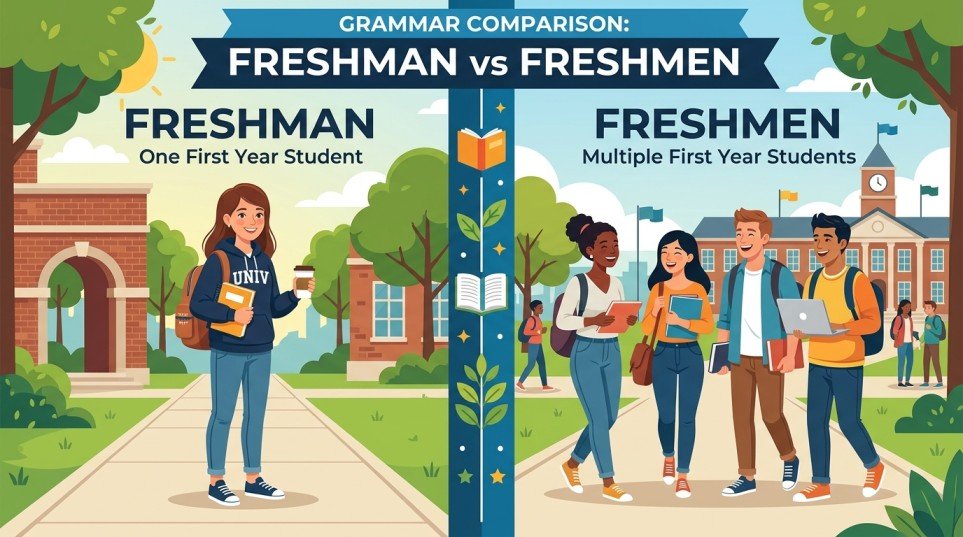
Quick Ans: The difference between freshmen or freshman is simple. Freshman is singular and refers to one first year student, while freshmen is plural and refers to two or more first year students. Using the correct form helps improve grammar, writing clarity, and communication.
Many students, writers, and English learners get confused about freshmen or freshman. The two words look almost identical. As a result, people often use them incorrectly in emails, essays, school reports, and everyday conversations.
The confusion usually comes from the small spelling change at the end of each word. One version ends with man, while the other ends with men. Although the difference appears minor, it changes the meaning completely.
For example, saying “The freshman attended orientation” refers to one student. On the other hand, saying “The freshmen attended orientation” refers to multiple students.
Understanding this distinction is important because grammar mistakes can affect academic writing and professional communication. Fortunately, the rule is straightforward once you learn it.
This guide explains everything about freshmen or freshman, including definitions, examples, common mistakes, grammar rules, real world usage, and practice exercises. By the end, you will know exactly when to use each word.
Quick Answer: Freshmen or Freshman
The easiest way to remember freshmen or freshman is to focus on the number of students being discussed.
| Word | Meaning | Number |
|---|---|---|
| Freshman | One first year student | Singular |
| Freshmen | Two or more first year students | Plural |
Examples:
- The freshman joined the debate club.
- The freshmen joined the debate club.
Therefore, use freshman for one person and freshmen for multiple people.
What Does Freshman Mean?
A freshman is a student in the first year of high school, college, or university.
Traditionally, the term has been used in educational settings throughout the United States. It identifies someone who has recently started a new academic program.
Examples of Freshman
Here are some examples using the singular form:
- The freshman arrived early for orientation.
- A freshman asked the professor a question.
- The freshman joined several student organizations.
- Every freshman received a campus guide.
In each sentence, only one student is being discussed.
Common Educational Usage
Schools frequently use the word freshman in:
- Course catalogs
- Student handbooks
- Orientation programs
- Academic advising materials
Because it refers to one student, singular verbs and pronouns often accompany it.
What Does Freshmen Mean?
Freshmen is the plural form of freshman. The word refers to multiple first year students.
Whenever you discuss two or more students in their first year, freshmen is the correct choice.
Examples of Freshmen
Consider the following examples:
- The freshmen attended orientation together.
- Several freshmen joined the soccer team.
- Freshmen often explore different clubs during their first semester.
- The freshmen gathered in the auditorium.
Each sentence refers to more than one student.
Why the Spelling Changes
English contains several nouns that change internally when moving from singular to plural.
Examples include:
| Singular | Plural |
|---|---|
| Man | Men |
| Woman | Women |
| Freshman | Freshmen |
Therefore, the spelling pattern follows a familiar English grammar rule.
Key Differences Between Freshmen or Freshman
Number of People
The primary difference involves quantity.
Freshman refers to one student.
Freshmen refers to multiple students.
Sentence Structure
Singular nouns usually take singular verbs.
Examples:
- The freshman is studying.
- A freshman was selected.
Plural nouns generally take plural verbs.
Examples:
- The freshmen are studying.
- Several freshmen were selected.
Pronoun Agreement
Correct pronouns help maintain grammatical accuracy.
Examples:
- The freshman forgot his or her schedule.
- The freshmen forgot their schedules.
Because the noun changes, the pronoun changes as well.
Advantages and Disadvantages of Using Each Term Correctly
Advantages of Correct Usage
Using the correct word provides several benefits:
- Improves grammar accuracy
- Enhances professional writing
- Creates clear communication
- Prevents confusion
- Strengthens academic work
Disadvantages of Incorrect Usage
Misusing freshmen or freshman can create problems such as:
- Grammar errors
- Reduced credibility
- Reader confusion
- Lower academic quality
- Professional mistakes
Therefore, learning the distinction is worthwhile.
Grammar Rules for Freshmen or Freshman
Rule One: One Student Equals Freshman
Whenever one first year student is mentioned, use freshman.
Examples:
- One freshman won the scholarship.
- The freshman completed the assignment.
Rule Two: Multiple Students Equal Freshmen
Whenever multiple students are involved, use freshmen.
Examples:
- The freshmen attended orientation.
- Several freshmen volunteered.
Rule Three: Match the Verb
Verb agreement must match the noun.
Correct:
- The freshman is excited.
- The freshmen are excited.
Incorrect:
- The freshman are excited.
- The freshmen is excited.
Real World Examples
College Orientation
A university may announce:
“The freshman orientation begins at 9:00 AM.”
This statement refers to one student if used literally.
However, schools usually say:
“The freshmen orientation begins at 9:00 AM.”
Even better, many institutions use:
“First year student orientation begins at 9:00 AM.”
Classroom Setting
A teacher might say:
- The freshman submitted the assignment.
- Three freshmen submitted the assignment.
The difference depends entirely on the number of students.
Sports Teams
Sports programs often separate athletes by year.
Examples include:
- The freshman earned a starting position.
- Several freshmen made the roster.
These examples demonstrate everyday usage.
Regional and Global Usage
United States
The terms freshman and freshmen remain common in American schools, colleges, and universities.
Canada
Many Canadian institutions also use the terms, although alternatives are becoming more popular.
United Kingdom
British schools typically use different terminology. Instead of freshman, students are often referred to by year or academic level.
Modern Educational Trends
Many institutions now prefer gender neutral alternatives such as:
- First year student
- First year students
- New student
- New students
Even so, freshman and freshmen remain widely understood.
Related Concepts and Comparisons
Freshman vs Sophomore
A freshman is a first year student.
A sophomore is a second year student.
Freshman vs Junior
A junior is generally a third year student.
Freshman vs Senior
A senior is typically in the final year of study.
Academic Year Comparison
| Academic Level | Typical Year |
|---|---|
| Freshman | First Year |
| Sophomore | Second Year |
| Junior | Third Year |
| Senior | Fourth Year |
Understanding these terms helps students navigate educational systems more effectively.
Common Mistakes About Freshmen or Freshman
Using Freshmen for One Student
Incorrect:
- The freshmen won the scholarship.
Correct:
- The freshman won the scholarship.
Only one student is involved.
Using Freshman for Multiple Students
Incorrect:
- The freshman attended orientation.
Correct:
- The freshmen attended orientation.
The sentence refers to several students.
Ignoring Verb Agreement
Incorrect:
- The freshman are ready.
Correct:
- The freshman is ready.
Likewise:
Incorrect:
- The freshmen is ready.
Correct:
- The freshmen are ready.
Forgetting Context
Always determine how many students the sentence discusses before choosing the word.
This simple habit prevents most errors.
Beginner to Advanced Usage Tips
Beginner Level
Ask yourself one question:
“Am I talking about one student or several students?”
The answer usually reveals the correct word.
Intermediate Level
Pay attention to nearby verbs and pronouns.
These clues often indicate whether the noun should be singular or plural.
Advanced Level
Consider audience and style guidelines.
Some institutions prefer gender neutral language. In those cases, first year student may be the preferred choice.
Step By Step Usage Scenario
Imagine you are writing a school newsletter.
If one student won an award:
- Identify the number of students.
- Confirm there is only one.
- Use freshman.
- Check verb agreement.
Example:
“The freshman received a leadership award.”
If multiple students won awards:
- Count the students.
- Confirm there is more than one.
- Use freshmen.
- Match the verb correctly.
Example:
“The freshmen received leadership awards.”
Following these steps reduces grammar mistakes.
Exercises With Answers
Exercise 1
Choose the correct word:
The ______ attended orientation.
Answer: Freshmen.
Exercise 2
Choose the correct word:
A ______ joined the science club.
Answer: Freshman.
Exercise 3
Which sentence is correct?
A. The freshmen is excited.
B. The freshman is excited.
Answer: B.
Exercise 4
Which sentence is correct?
A. The freshmen are studying.
B. The freshman are studying.
Answer: A.
Exercise 5
True or False: Freshman is the plural form.
Answer: False.
When Should You Use Freshmen or Freshman?
Use freshman when:
- Referring to one student
- Writing about a single individual
- Using singular verbs
Use freshmen when:
- Referring to multiple students
- Discussing a group
- Using plural verbs
The decision depends entirely on the number of people being discussed.
FAQs About Freshmen or Freshman
What is the difference between freshmen or freshman?
Freshman is singular and refers to one first year student. Freshmen is plural and refers to multiple first year students.
Is freshman singular or plural?
Freshman is singular and describes one student.
Is freshmen singular or plural?
Freshmen is plural and refers to two or more students.
Can I say freshmen student?
No. Freshmen is already plural. Use freshman student for one person or freshmen for a group.
Which is correct: freshman are or freshman is?
Freshman is should be used because freshman is singular.
Which is correct: freshmen is or freshmen are?
Freshmen are is correct because freshmen is plural.
Do colleges still use freshman and freshmen?
Many colleges still use these terms, although some institutions prefer first year student and first year students.
Is freshman considered gender neutral?
Some people consider it gender specific because it contains the word man. Consequently, many schools use first year student instead.
What is another word for freshman?
Common alternatives include first year student, new student, and incoming student.
How can I remember freshmen or freshman easily?
Think of man and men. Freshman follows the same singular pattern as man, while freshmen follows the same plural pattern as men.
Conclusion
Understanding freshmen or freshman is easier than many people think. The rule depends entirely on whether you are discussing one student or multiple students.
Freshman is singular and refers to one first year student. Freshmen is plural and refers to a group of first year students. Although the spelling difference is small, choosing the correct form improves grammar, writing quality, and communication.
Students, teachers, professionals, and writers benefit from using these words correctly. In addition, proper usage helps avoid confusion in academic papers, emails, reports, and presentations.
When uncertain, simply count the number of students being discussed. If there is one student, use freshman. If there are two or more, use freshmen.
By applying this simple rule consistently, you can confidently use freshmen or freshman in any situation.
Discover More:-
- Who’s or Whose: Difference, Examples, Grammar Rules, and Easy Guide
- Complement or Compliment: Difference, Meaning, Examples, and Usage Guide

Jennifer Collins is a professional grammar expert and language educator at gramtivo.com, specializing in English grammar, writing skills, and language improvement. She holds a Master’s degree in English Language and Literature from a recognized university in the United States. With years of teaching and content development experience, she is dedicated to helping learners improve their communication skills with clear and practical guidance.