
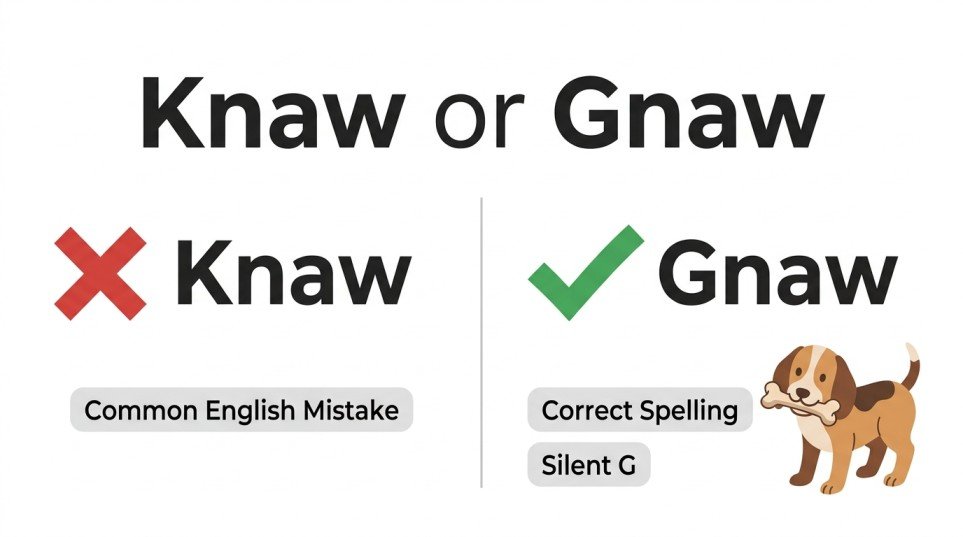
Quick Ans: The correct word is gnaw, not knaw. “Gnaw” means to bite, chew, or wear away gradually, while “knaw” is a common spelling mistake. People often confuse the two because the “g” in gnaw is silent.
Many English learners search for knaw or gnaw because the two words sound almost identical. In spoken English, the first letter in “gnaw” is silent. As a result, many people incorrectly spell the word as “knaw.”
This confusion is very common.
English contains many silent letters. Words like “knife,” “gnome,” and “gnaw” often create spelling problems for beginners and even advanced learners. Since pronunciation does not always match spelling, mistakes happen easily.
Understanding the difference between knaw or gnaw helps improve writing accuracy. It also prevents grammar and spelling errors in emails, essays, school assignments, and professional communication.
In this guide, you will learn the correct meaning of “gnaw,” why people misspell it as “knaw,” common examples, grammar tips, pronunciation help, and practical exercises. By the end, you will know exactly when and how to use the correct spelling.
Quick Answer: Knaw or Gnaw
Here is the simple answer:
| Word | Correct or Incorrect | Meaning |
|---|---|---|
| Knaw | Incorrect spelling | No official meaning |
| Gnaw | Correct spelling | To bite, chew, or wear away |
Therefore, gnaw is always the correct word in standard English.
What Does Gnaw Mean?
The word gnaw is a verb. It usually means to bite or chew something repeatedly.
Animals often gnaw on objects using their teeth. However, the word can also describe emotional feelings that slowly trouble someone.
Simple Definitions of Gnaw
Gnaw can mean:
- To chew repeatedly
- To bite persistently
- To wear away slowly
- To trouble mentally or emotionally
Examples of Gnaw in Sentences
Here are some common examples:
- The dog continued to gnaw on the bone.
- Rats can gnaw through wood and plastic.
- Hunger began to gnaw at him during the long trip.
- Guilt gnawed at her for many years.
These examples show both physical and emotional uses of the word.
Why Do People Write “Knaw” Instead of “Gnaw”?
The confusion between knaw or gnaw mainly happens because of pronunciation.
In the word “gnaw,” the letter “g” is silent. Therefore, the word sounds like “naw.”
Many people assume the spelling should start with “kn” because other English words use that sound pattern, such as:
- Know
- Knee
- Knife
As a result, learners incorrectly write “knaw.”
However, “knaw” does not exist as a standard English word.
Pronunciation of Gnaw
The pronunciation of “gnaw” is simple once you understand the silent letter.
Correct Pronunciation
“Gnaw” sounds like:
/nɔː/
It rhymes with:
- Saw
- Jaw
- Law
The “g” remains silent.
Pronunciation Tip
A helpful trick is to ignore the first letter completely. Start directly with the “n” sound when speaking.
Origin of the Word Gnaw
The word “gnaw” has a long history in the English language.
It comes from old Germanic roots connected to biting and chewing. Over time, the spelling remained similar even though pronunciation changed.
English keeps many silent letters because of historical spelling traditions. Therefore, words sometimes look different from how they sound.
Examples include:
- Gnat
- Gnome
- Knife
- Write
“Gnaw” follows this same pattern.
Common Uses of Gnaw
Physical Chewing
The most common meaning involves biting or chewing repeatedly.
Examples:
- A puppy may gnaw on furniture.
- Beavers gnaw through tree trunks.
- Rabbits gnaw on vegetables.
Emotional or Mental Pressure
The word can also describe feelings that slowly bother someone.
Examples:
- Fear gnawed at him all night.
- Doubt continued to gnaw at her confidence.
- Anxiety gnawed at the student’s mind before the exam.
This figurative meaning appears often in books and formal writing.
Key Differences Between Knaw or Gnaw
Spelling
The largest difference is spelling accuracy.
- “Gnaw” is correct.
- “Knaw” is incorrect.
Dictionary Recognition
“Gnaw” appears in English dictionaries. Meanwhile, “knaw” does not exist as a standard word.
Usage in Writing
Professional writing always uses “gnaw.” Using “knaw” may create spelling errors in academic or business communication.
Advantages of Learning the Correct Spelling
Better Writing Accuracy
Correct spelling improves communication quality.
Stronger Professional Image
Proper grammar and spelling help create a more professional impression.
Improved English Skills
Learning tricky words like “gnaw” strengthens vocabulary and spelling ability.
Fewer Grammar Mistakes
Understanding silent letters reduces future spelling confusion.
Real World Examples
School Assignments
A student writing “The dog knawed the bone” may lose marks because “knawed” is incorrect.
Workplace Emails
Professional writing requires correct spelling. Therefore, using “gnaw” helps maintain credibility.
Creative Writing
Authors often use “gnaw” in emotional descriptions.
Example:
- Regret gnawed at him after the argument.
This creates vivid imagery for readers.
Regional and Global Usage
American English
American English uses “gnaw” exactly the same way as British English.
British English
British English also uses the spelling “gnaw.”
Global English Learning
English learners worldwide commonly confuse knaw or gnaw because silent letters create pronunciation challenges.
Therefore, this spelling mistake appears frequently in schools and online writing.
Related Concepts and Comparisons
Gnaw vs Chew
Both involve biting, but “gnaw” usually suggests repeated or persistent chewing.
Example:
- The dog chewed the toy.
- The dog gnawed on the toy for hours.
Gnaw vs Bite
“Bite” describes a single action. “Gnaw” describes repeated chewing.
Silent Letter Words
The confusion between knaw or gnaw relates to other silent letter words such as:
| Word | Silent Letter |
|---|---|
| Knife | K |
| Gnome | G |
| Wrist | W |
| Write | W |
Learning these patterns improves English spelling skills.
Common Mistakes About Knaw or Gnaw
Writing “Knaw”
This is the most common error. The correct spelling is always “gnaw.”
Pronouncing the G
The “g” in gnaw remains silent.
Using Gnaw Incorrectly
Some learners use “gnaw” when they simply mean “eat.” However, gnaw specifically suggests repeated chewing or gradual emotional pressure.
Forgetting Figurative Meaning
“Gnaw” can describe emotions, not just physical chewing.
Beginner to Advanced Grammar Tips
Beginner Level
Remember this simple rule:
- Gnaw = correct
- Knaw = incorrect
Intermediate Level
Practice using “gnaw” in both physical and emotional contexts.
Advanced Level
Study figurative language in novels and essays where “gnaw” creates emotional imagery.
This improves writing style and vocabulary depth.
Step By Step Memory Trick
Use this simple memory method:
- Think of the word “gnome.”
- Notice the silent “g.”
- Remember that “gnaw” also starts with silent “g.”
- Avoid adding “k.”
This technique helps many learners remember the correct spelling.
Exercises With Answers
Exercise 1
Which spelling is correct: knaw or gnaw?
Answer: Gnaw.
Exercise 2
Which sentence is correct?
A. The dog knawed the bone.
B. The dog gnawed the bone.
Answer: B.
Exercise 3
True or False: The “g” in gnaw is pronounced.
Answer: False.
Exercise 4
Which word means to chew repeatedly?
Answer: Gnaw.
Exercise 5
Can “gnaw” describe emotions?
Answer: Yes.
When Should You Use Gnaw?
Use “gnaw” when describing:
- Repeated chewing
- Persistent biting
- Emotional worry or stress
- Gradual wearing away
Avoid using “knaw” because it is not a correct English word.
FAQs About Knaw or Gnaw
Is knaw or gnaw correct?
“Gnaw” is correct. “Knaw” is a spelling mistake.
Why do people spell gnaw as knaw?
People confuse the spelling because the “g” in gnaw is silent.
What does gnaw mean?
Gnaw means to chew, bite repeatedly, or emotionally trouble someone.
Is knaw a real English word?
No. Standard English dictionaries do not recognize “knaw.”
How do you pronounce gnaw?
“Gnaw” is pronounced like “naw.”
Can gnaw describe emotions?
Yes. For example, guilt or fear can gnaw at someone emotionally.
What is the past tense of gnaw?
The past tense is “gnawed.”
Do Americans and British people both use gnaw?
Yes. Both American and British English use the same spelling.
Why does gnaw have a silent g?
The silent letter comes from historical English spelling patterns.
What are words similar to gnaw?
Words like chew, nibble, bite, and chomp have related meanings.
Conclusion
Understanding knaw or gnaw is important for accurate English spelling. Although both words sound similar, only “gnaw” is correct. The confusion happens because the “g” remains silent in pronunciation.
The word “gnaw” usually means to chew repeatedly or to slowly trouble someone emotionally. It appears in everyday speech, literature, academic writing, and professional communication.
Learning silent letter patterns can improve spelling confidence. Words like “gnome,” “knife,” and “gnaw” follow similar pronunciation rules.
Whenever you feel unsure, remember this simple fact: “knaw” is incorrect, while “gnaw” is the proper English spelling.
With practice, using the correct word becomes much easier. Strong spelling habits also improve writing quality and communication skills over time.
Discover More:-
- Right or Racist: Understanding the Difference Between Opinion and Racism
- Malignant or Benign: Key Differences, Symptoms, and Diagnosis Guide

Jennifer Collins is a professional grammar expert and language educator at gramtivo.com, specializing in English grammar, writing skills, and language improvement. She holds a Master’s degree in English Language and Literature from a recognized university in the United States. With years of teaching and content development experience, she is dedicated to helping learners improve their communication skills with clear and practical guidance.