
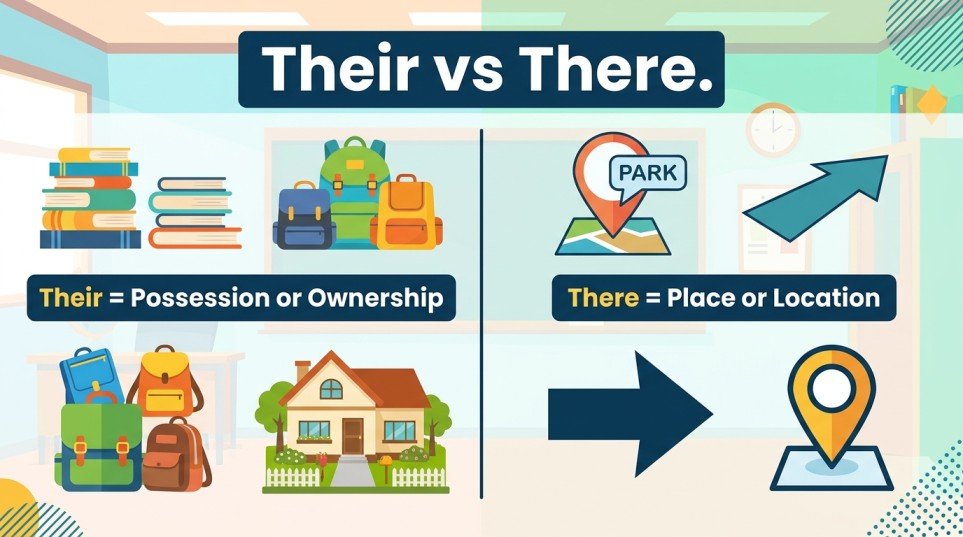
Quick Ans: The difference between their or there is simple but important. Their shows ownership or possession, while there refers to a place, location, or existence. Although the words sound alike, they have completely different meanings and grammatical uses.
Many English learners struggle with their or there because the two words sound exactly the same. These words are known as homophones, which means they share the same pronunciation but have different meanings and spellings.
As a result, people often use the wrong word when writing emails, essays, social media posts, or professional documents. Even native English speakers make this mistake from time to time.
Understanding the difference matters because incorrect word usage can confuse readers and make writing appear less professional. Fortunately, the distinction is easy to learn once you understand the purpose of each word.
One word shows ownership. The other points to a place or introduces a sentence. Because their functions are completely different, choosing the correct spelling becomes much easier when you know what role the word plays.
This guide explains their or there in simple language. You will learn definitions, examples, common mistakes, grammar rules, exercises, and practical tips that help you use both words correctly every time.
Quick Answer: Their or There
The easiest way to understand their or there is to remember their core meanings.
| Word | Meaning | Example |
|---|---|---|
| Their | Shows ownership | Their car is parked outside. |
| There | Refers to a place or existence | The keys are over there. |
In short:
- Their = belongs to someone.
- There = a place or location.
What Does Their Mean?
Their is a possessive determiner. It shows that something belongs to a group of people or to one person whose gender is unknown or unspecified.
Examples of Their
- Their house is beautiful.
- Their dog loves playing outside.
- Students should bring their notebooks.
- The team celebrated their victory.
In each sentence, their shows ownership.
How Their Works
Think of their as a word that answers the question:
“Whose?”
Examples:
- Whose backpack is this? → Their backpack.
- Whose project won? → Their project.
Whenever you talk about ownership, their is often the correct choice.
What Does There Mean?
There usually refers to a place, location, or position. However, it can also introduce a sentence to show that something exists.
Examples of There as a Location
- Put the box over there.
- We went there yesterday.
- The restaurant is right there.
In these examples, there points to a place.
Examples of There Showing Existence
- There is a problem.
- There are many books on the shelf.
- There was a storm last night.
Here, there introduces the existence of something.
How There Works
You can often think of there as answering the question:
“Where?”
Examples:
- Where is the car? → It is over there.
- Where should I sit? → Sit there.
Because it relates to location, there helps readers understand where something is.
Key Differences Between Their or There
Meaning
The most important difference involves meaning.
- Their shows ownership.
- There shows location or existence.
Grammar Function
Their functions as a possessive determiner.
There functions as an adverb, pronoun, adjective, noun, or introductory word depending on the sentence.
Usage
Use their when discussing something that belongs to someone.
Use there when discussing a place or indicating that something exists.
Example Comparison
| Correct Usage | Explanation |
|---|---|
| Their house is large. | House belongs to them. |
| The house is over there. | Refers to location. |
| Their teacher is kind. | Teacher belongs to their class. |
| There are many students. | Shows existence. |
Understanding these differences helps eliminate confusion between their or there.
Advantages and Disadvantages of Learning the Difference
Advantages
Knowing the correct usage offers several benefits:
- Improves grammar accuracy
- Makes writing more professional
- Prevents reader confusion
- Strengthens communication skills
- Improves academic performance
Disadvantages of Misusing Them
Using the wrong word can cause problems such as:
- Grammar mistakes
- Lower writing quality
- Professional embarrassment
- Confusing messages
Therefore, mastering their or there is valuable for anyone who writes in English.
Real World Examples
In Business Emails
Correct:
- Their report was submitted yesterday.
Incorrect:
- There report was submitted yesterday.
The incorrect version contains a grammar error because ownership is involved.
In Text Messages
Correct:
- Meet me over there.
Incorrect:
- Meet me over their.
The second sentence incorrectly uses the possessive form.
In Academic Writing
Correct grammar improves credibility. Consequently, understanding their or there becomes important for essays, reports, and research papers.
Regional and Global Usage
American English
American English follows the same rules for their and there.
British English
British English also uses these words in exactly the same way.
International English
English learners around the world encounter confusion with these homophones. However, the grammatical rules remain consistent regardless of country.
Because the rules are universal, learning them once helps in every English-speaking environment.
Related Concepts and Comparisons
Their vs There vs They’re
Many people confuse all three words.
| Word | Meaning | Example |
|---|---|---|
| Their | Possession | Their car is new. |
| There | Location or existence | The car is over there. |
| They’re | Contraction of “they are” | They’re driving home. |
Example Sentence Set
- Their dog is friendly.
- The dog is over there.
- They’re walking the dog.
Although the words sound alike, each serves a completely different purpose.
Common Mistakes About Their or There
Using There for Ownership
Incorrect:
- There house is beautiful.
Correct:
- Their house is beautiful.
Ownership requires their.
Using Their for Location
Incorrect:
- Put the chair over their.
Correct:
- Put the chair over there.
Location requires there.
Confusing All Three Homophones
Incorrect:
- Their going over there house.
Correct:
- They’re going over to their house.
Learning each meaning separately helps avoid this mistake.
Relying Only on Sound
Because both words sound identical, many writers choose the wrong spelling. Instead, focus on meaning rather than pronunciation.
Beginner to Advanced Learning Tips
Beginner Level
Ask yourself:
Does something belong to someone?
If yes, use their.
Intermediate Level
Ask another question:
Am I talking about a place?
If yes, use there.
Advanced Level
Practice identifying the grammatical function in complex sentences. This approach helps improve overall grammar accuracy.
Consistent reading and writing also reinforce correct usage over time.
Step By Step Usage Scenario
Imagine you are writing a sentence.
You want to say a backpack belongs to students.
Step 1: Identify ownership.
Step 2: Choose their.
Sentence:
- Their backpacks are on the floor.
Now imagine you want to describe location.
Step 1: Identify place.
Step 2: Choose there.
Sentence:
- The backpacks are over there.
Following these simple steps reduces mistakes.
Exercises With Answers
Exercise 1
Choose the correct word:
_____ car is parked outside.
Answer: Their
Exercise 2
Choose the correct word:
The restaurant is over _____.
Answer: There
Exercise 3
Choose the correct word:
_____ are many birds in the tree.
Answer: There
Exercise 4
Choose the correct word:
The students forgot _____ homework.
Answer: Their
Exercise 5
True or False:
“Their” refers to a location.
Answer: False
When Should You Use Their or There?
Use their when:
- Showing ownership
- Referring to possessions
- Talking about something belonging to people
Use there when:
- Referring to a place
- Pointing out a location
- Showing existence
Remembering these categories makes choosing the correct word much easier.
FAQs About Their or There
What is the difference between their or there?
Their shows ownership, while there refers to a place or indicates that something exists.
Is their used for possession?
Yes. Their is a possessive word that shows something belongs to someone.
Can there show location?
Yes. There commonly refers to a place or position.
Why do people confuse their or there?
The words are homophones, meaning they sound the same but have different meanings and spellings.
What does there mean in “There is a problem”?
In this sentence, there introduces the existence of something.
Can their refer to one person?
Yes. Modern English often uses their as a gender-neutral possessive pronoun.
How can I remember the difference between their or there?
Think of ownership for their and location for there.
Is there a grammar rule for choosing between them?
Yes. Use their for possession and there for place or existence.
Are their and there interchangeable?
No. They have different meanings and cannot replace each other.
What is the most common mistake with their or there?
The most common mistake is using there when ownership is intended.
Conclusion
Understanding their or there is essential for clear and professional writing. Although the words sound identical, they serve completely different purposes.
Their shows ownership and answers the question “whose?” For example, “their books” means the books belong to them. There refers to a location or introduces the existence of something. For instance, “over there” points to a place, while “there is” introduces a fact or condition.
Many grammar mistakes happen because writers rely on pronunciation rather than meaning. Fortunately, the solution is simple. Focus on the role the word plays in the sentence before choosing a spelling.
Regular practice, reading, and writing can help reinforce correct usage. Over time, distinguishing between their or there becomes automatic.
Whenever you are unsure, ask yourself one question: Am I talking about ownership or location? The answer will usually reveal the correct word immediately.
Discover More:-
- Who’s or Whose: Difference, Examples, Grammar Rules, and Easy Guide
- Complement or Compliment: Difference, Meaning, Examples, and Usage Guide

Lisa Thompson is a USA-based content writer and language specialist focused on grammar, writing improvement and digital publishing.
She holds a degree in English Language and Communication and has professional experience in educational and web content creation.
As the author of Gramtivo.Com, she aims to help readers improve their writing skills through clear and practical guidance.