
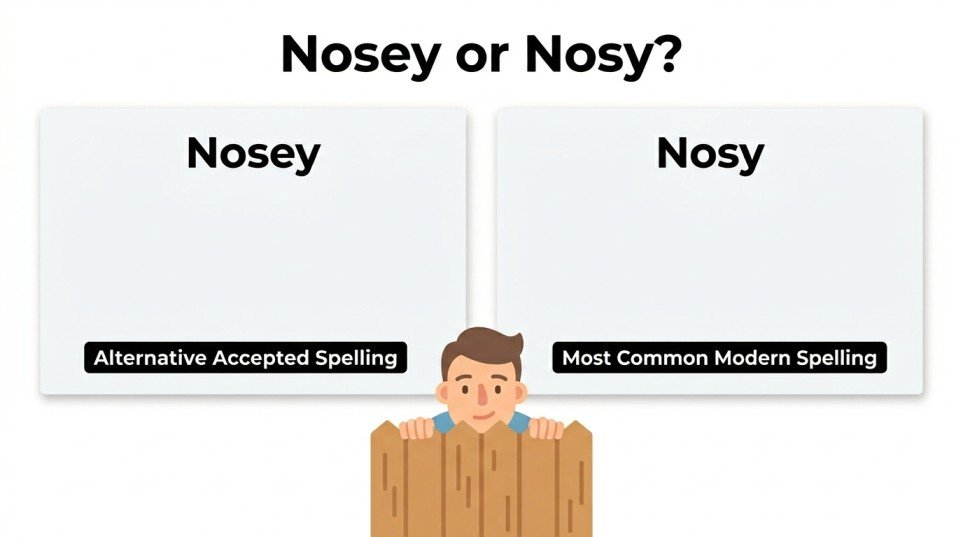
Quick Ans: The words nosey or nosy have the same meaning and are both accepted spellings in English. However, nosy is the more common and preferred spelling in modern American and British English. Both words describe a person who is overly curious about other people’s private affairs.
Many writers and English learners wonder whether they should use nosey or nosy. The two words sound exactly the same. They carry the same meaning. Yet different dictionaries and style guides sometimes show different spellings.
This creates confusion.
You may see nosy neighbor in one article and nosey neighbor in another. As a result, people often ask which version is correct. Some assume one spelling is wrong. Others believe the words have different meanings.
In reality, both spellings are accepted. However, one version is used far more often in modern writing. Understanding the difference can help you write more confidently and avoid inconsistency.
Whether you are writing an email, a blog post, a school assignment, or professional content, knowing when to use nosey or nosy improves clarity and credibility.
This guide explains the meaning, spelling differences, usage examples, advantages and disadvantages of each form, common mistakes, and practical exercises. By the end, you will know exactly which spelling fits your writing situation.
Quick Answer: Nosey or Nosy
If you want the short answer, use nosy.
Both spellings are correct, but nosy is the standard spelling in most modern publications.
| Feature | Nosy | Nosey |
|---|---|---|
| Meaning | Overly curious | Overly curious |
| Accepted Spelling | Yes | Yes |
| More Common Today | Yes | No |
| Preferred by Most Style Guides | Yes | Less Often |
| Common in Modern Writing | Very common | Less common |
Therefore, when choosing between nosey or nosy, most writers should use nosy.
What Does Nosy Mean?
The word nosy describes someone who takes too much interest in other people’s business.
A nosy person often asks personal questions. They may try to learn information that does not concern them.
For example:
- My nosy neighbor always asks who visits my house.
- The reporter seemed nosy during the interview.
- Children can become nosy when they hear adults talking.
In each example, the person shows excessive curiosity.
Origin of the Word
The word comes from the noun nose.
Historically, people associated a person’s nose with poking into places where it did not belong. Over time, this idea evolved into the adjective nosy.
As language developed, alternative spellings appeared. Consequently, both nosey and nosy became accepted forms.
What Does Nosey Mean?
The word nosey has the same meaning as nosy.
There is no difference in definition. A nosey person is simply someone who interferes in or investigates matters that are private.
Examples include:
- She is too nosey about her coworkers’ lives.
- The nosey customer wanted to know everyone’s salary.
- Their nosey questions made people uncomfortable.
Although the meaning is identical, nosey appears less frequently in modern publications.
Key Differences Between Nosey or Nosy
Meaning
There is no difference in meaning between nosey or nosy.
Both words describe someone who is excessively curious.
Popularity
The major difference involves usage frequency.
Today, nosy appears much more often in books, newspapers, websites, and professional writing.
Style Preference
Many editors prefer nosy because it is considered the standard modern spelling.
Meanwhile, nosey remains acceptable but less common.
Reader Expectations
Most readers expect to see nosy. Therefore, using it may make your writing appear more natural.
Why Is Nosy More Common?
Language changes over time.
Shorter spellings often become more popular because they are easier to write and recognize. As a result, nosy gradually became the preferred form.
Several factors contributed to this trend:
- Simpler appearance
- Wider dictionary support
- Frequent use in publications
- Consistency across style guides
Consequently, modern writers usually choose nosy.
Nosey or Nosy in American English
In American English, nosy is the dominant spelling.
You will commonly see:
- Nosy neighbor
- Nosy questions
- Nosy coworker
- Nosy relative
Although nosey is still accepted, it appears less often in newspapers, magazines, and professional documents.
Therefore, American writers generally prefer nosy.
Nosey or Nosy in British English
British English also favors nosy.
Many British dictionaries list nosey as an alternative spelling. Nevertheless, nosy remains more common in everyday writing.
Because of this preference, both American and British writers typically choose the shorter form.
Advantages and Disadvantages
Advantages of Using Nosy
- More common spelling
- Preferred by many editors
- Recognized immediately by readers
- Suitable for professional writing
Disadvantages of Using Nosy
- Some readers may be more familiar with nosey
- Older publications occasionally use alternative spellings
Advantages of Using Nosey
- Accepted spelling
- Historically established
- Sometimes preferred for stylistic reasons
Disadvantages of Using Nosey
- Less common today
- May appear outdated
- Some readers may assume it is a spelling mistake
For most situations, nosy remains the safer choice.
Real World Examples
In Everyday Conversation
A friend might say:
“Stop being so nosy and let them handle it.”
This usage sounds natural and common.
In Professional Writing
An article might state:
“Employees should avoid asking nosy questions about personal finances.”
Here, the standard spelling improves professionalism.
In Fiction Writing
Authors may choose either spelling.
For example:
“The nosey old woman watched everyone from her porch.”
Creative writing often allows more flexibility.
Regional and Global Usage
United States
American publications overwhelmingly prefer nosy.
United Kingdom
British writers also use nosy more frequently.
Other English Speaking Countries
Countries such as Canada, Australia, and New Zealand generally follow the same trend.
As a result, nosy has become the dominant international spelling.
Related Concepts and Comparisons
Nosy vs Curious
A curious person wants to learn.
A nosy person wants to know information that may not concern them.
Curiosity can be positive. Being nosy often has a negative meaning.
Nosy vs Inquisitive
Inquisitive usually carries a positive tone.
Nosy often suggests unwanted interference.
Nosy vs Intrusive
Intrusive describes behavior that invades privacy.
Nosy describes excessive curiosity.
Although the concepts overlap, they are not identical.
Common Mistakes About Nosey or Nosy
Thinking One Spelling Is Wrong
Many people believe only one spelling is correct.
In reality, both nosey and nosy are accepted.
Using Different Spellings in the Same Article
Consistency matters.
If you choose one spelling, use it throughout the entire document.
Assuming the Meanings Differ
The meanings are exactly the same.
Only the spelling changes.
Using Nosy in Positive Situations
Nosy usually carries a negative tone.
When describing healthy curiosity, words such as curious or inquisitive may work better.
Beginner to Advanced Writing Tips
Beginner Level
Use nosy whenever possible.
This choice works in most situations.
Intermediate Level
Maintain consistency throughout your writing.
Avoid switching between spellings.
Advanced Level
Consider audience expectations.
Professional publications generally favor nosy, while creative writing may allow either version.
Step By Step Usage Scenario
Imagine you are writing a blog post.
If you want the most common spelling:
- Choose nosy
- Use it consistently
- Proofread for uniformity
- Follow your style guide
If you intentionally prefer the alternative:
- Choose nosey
- Keep usage consistent
- Ensure readers understand the context
Either approach works, but nosy is usually preferred.
Exercises With Answers
Exercise 1
Which spelling is more common today?
Answer: Nosy.
Exercise 2
Do nosey and nosy have different meanings?
Answer: No.
Exercise 3
Which spelling do most style guides prefer?
Answer: Nosy.
Exercise 4
True or False: Nosey is always incorrect.
Answer: False.
Exercise 5
Which word describes excessive curiosity about other people’s business?
Answer: Both nosy and nosey.
When Should You Use Nosey or Nosy?
Use nosy when:
- Writing professionally
- Creating online content
- Following modern style guides
- Seeking the most common spelling
Use nosey when:
- Following a specific house style
- Quoting older texts
- Writing creatively and intentionally choosing the alternative spelling
In most situations, nosy is the recommended choice.
FAQs About Nosey or Nosy
Which is correct, nosey or nosy?
Both spellings are correct. However, nosy is more common in modern English.
Is nosey a real word?
Yes. Nosey is an accepted alternative spelling of nosy.
Why is nosy more popular than nosey?
Many writers and editors prefer the shorter spelling, which has become the standard form.
Do nosey and nosy mean the same thing?
Yes. Both words describe someone who is overly interested in other people’s affairs.
Which spelling should I use in professional writing?
Most professionals choose nosy because it is the preferred modern spelling.
Is nosey outdated?
Not entirely. However, it appears less frequently in current publications.
Do dictionaries accept both spellings?
Yes. Many dictionaries list both nosey and nosy as correct variants.
Is nosy always negative?
Usually yes. The term often suggests unwanted curiosity or interference.
Can I use nosey in creative writing?
Yes. Creative writing allows either spelling unless a style guide specifies otherwise.
What is the best choice between nosey or nosy?
For most situations, nosy is the safest and most widely accepted option.
Conclusion
The debate over nosey or nosy is simpler than many people think. Both spellings are correct. Both carry the same meaning. Each describes a person who takes too much interest in matters that are not their concern.
Despite this similarity, modern English strongly favors nosy. Newspapers, websites, books, and professional publications use it far more frequently. Consequently, most writers choose the shorter spelling for clarity and consistency.
That does not make nosey incorrect. The alternative form remains accepted and can still appear in creative writing or older texts. Nevertheless, readers are generally more familiar with nosy.
When deciding between nosey or nosy, consider your audience and writing purpose. For professional communication, academic work, and online content, nosy is usually the best choice. Maintaining consistency throughout your writing is equally important.
By understanding the history, usage, and modern preference for these spellings, you can write with greater confidence and accuracy.
Discover More:-
- Who’s or Whose: Difference, Examples, Grammar Rules, and Easy Guide
- Complement or Compliment: Difference, Meaning, Examples, and Usage Guide

Robert Mitchell is a U.S.-based writer at Gramtivo.Com who focuses on grammar, writing improvement, and language-related content. He holds a degree in English and Linguistics from a U.S. university. His work aims to help readers enhance their writing skills with clear and practical guidance.