
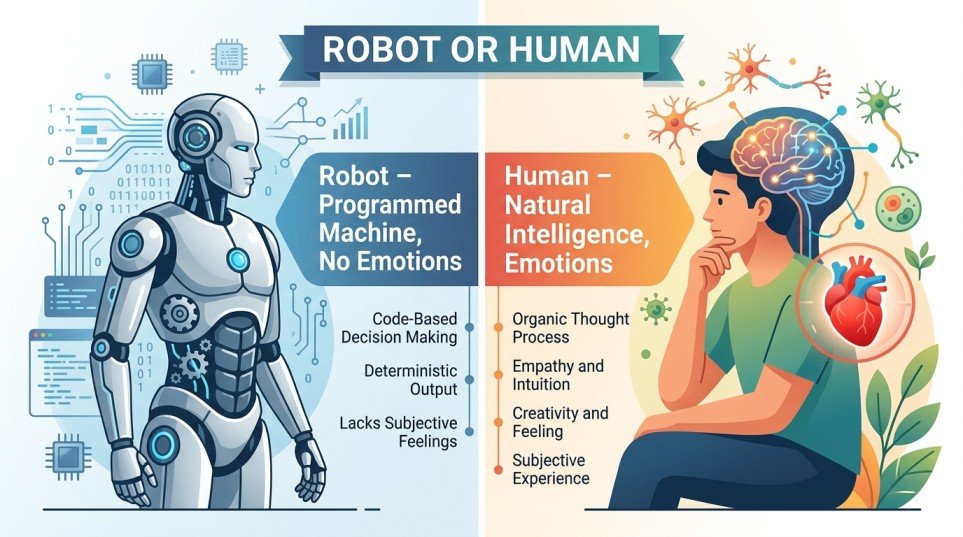
Quick Ans: The key difference between robot or human lies in intelligence and origin. A robot is a machine designed to perform tasks through programming and automation, while a human is a living being with emotions, consciousness, and natural intelligence. Although both can complete tasks, their abilities and thinking processes are fundamentally different.
Many people wonder about robot or human when thinking about technology and daily life. Robots are becoming more common. Humans have always been at the center of decision making. Because of this, comparisons between the two continue to grow.
A robot follows instructions. A human thinks, feels, and adapts. That simple contrast creates many questions. For example, can robots replace humans? Are robots smarter? Which is better for certain tasks?
Confusion often arises because modern machines can perform complex actions. At the same time, humans can learn and improve without strict programming. As technology advances, the line between human and machine seems less clear.
Understanding robot or human helps in education, careers, and everyday decisions. It also helps people understand the limits and strengths of technology.
This guide explains everything in simple terms. You will learn definitions, advantages, disadvantages, real world examples, common mistakes, and practical exercises.
Quick Answer: Robot or Human
To understand robot or human, focus on intelligence and function.
| Feature | Robot | Human |
|---|---|---|
| Nature | Machine | Living being |
| Thinking | Programmed logic | Natural intelligence |
| Emotions | None | Present |
| Learning | Data based | Experience based |
| Flexibility | Limited | Highly adaptable |
In simple terms, a robot follows code, while a human uses thinking and emotions.
What Is a Robot?
A robot is a machine designed to perform tasks automatically. Engineers build robots using hardware and software. These machines can complete repetitive or complex tasks with high accuracy.
Robots appear in many industries:
- Manufacturing
- Healthcare
- Space exploration
- Customer service
- Logistics
Typical Robot Features
Most robots share these characteristics:
- Programmed instructions
- Sensors to detect surroundings
- Mechanical parts for movement
- Ability to repeat tasks consistently
Because robots rely on programming, they perform tasks exactly as instructed.
Common Robot Uses
Robots serve many purposes. For example:
- Assembling products in factories
- Performing surgeries with precision
- Delivering packages
- Exploring dangerous environments
As a result, robots improve efficiency and reduce human effort.
How Robots Work
Robots operate through a combination of systems.
- Input through sensors
- Processing via software
- Action using mechanical parts
- Feedback for adjustments
Each step follows programmed logic, ensuring consistent performance.
What Is a Human?
A human is a living being with natural intelligence, emotions, and consciousness. Humans can think, learn, and adapt without strict programming.
Humans exist in all areas of life:
- Work environments
- Education systems
- Creative industries
- Social interactions
Typical Human Features
Humans have several unique traits:
- Emotional awareness
- Critical thinking
- Creativity
- Ability to learn from experience
These qualities allow humans to handle complex and unpredictable situations.
Common Human Roles
Humans perform tasks that require judgment and emotion. For instance:
- Teaching and mentoring
- Creating art and music
- Making decisions
- Building relationships
Therefore, humans bring flexibility and creativity to many fields.
How Humans Learn
Human learning follows a natural process:
- Observation
- Experience
- Practice
- Adaptation
Unlike robots, humans improve through understanding and reflection.
Key Differences Between Robot or Human
Intelligence
Robots rely on programmed logic. Humans use natural intelligence and reasoning.
Emotions
Robots do not feel emotions. Humans experience a wide range of emotions.
Flexibility
Robots perform specific tasks well. Humans adapt to new situations easily.
Creativity
Robots follow patterns. Humans create new ideas and solutions.
Decision Making
Robots make decisions based on data. Humans consider emotions, ethics, and experience.
Advantages and Disadvantages
Robot Advantages
Robots offer several benefits:
- High accuracy
- No fatigue
- Fast performance
- Ability to work in dangerous environments
Robot Disadvantages
However, robots also have limits:
- Lack of creativity
- No emotional understanding
- Dependence on programming
- Limited adaptability
Human Advantages
Humans bring unique strengths:
- Creativity and innovation
- Emotional intelligence
- Flexible thinking
- Ability to solve complex problems
Human Disadvantages
Some challenges also exist:
- Fatigue and errors
- Slower repetitive work
- Emotional bias
- Physical limitations
Therefore, the robot or human comparison shows that both have strengths and weaknesses.
Real World Examples
In Factories
Robots handle repetitive tasks like assembly. Humans supervise and manage operations.
In Healthcare
Robots assist in surgeries with precision. Doctors make decisions and interact with patients.
In Daily Life
Smart assistants perform automated tasks. Humans use them to simplify routines.
These examples show how robots and humans often work together.
Regional and Global Usage
Developed Countries
Advanced economies use robots in industries like manufacturing and logistics.
Developing Countries
Human labor remains more common due to cost and accessibility.
Global Trends
Automation is increasing worldwide. However, humans still play essential roles in many sectors.
The balance between robot or human continues to evolve globally.
Related Concepts and Comparisons
Robot vs Artificial Intelligence
Artificial intelligence refers to software that enables machines to learn and make decisions. Robots are physical machines that may use artificial intelligence.
Human vs Machine Learning
Humans learn through experience. Machine learning uses data to improve performance.
Robot or Human vs Automation
Automation includes systems that reduce human effort. Robots are one form of automation.
Understanding these concepts helps clarify the broader discussion.
Common Mistakes About Robot or Human
Assuming Robots Think Like Humans
Robots follow programmed logic. They do not think independently.
Believing Robots Have Emotions
Robots can simulate emotions. However, they do not truly feel anything.
Ignoring Human Strengths
Some people assume machines are always better. In reality, humans excel in creativity and judgment.
Overestimating Automation
Automation improves efficiency. Still, human oversight remains necessary.
Avoiding these mistakes leads to better understanding.
Beginner to Advanced Insights
Beginner Level
Understand basic differences between machines and humans.
Intermediate Level
Learn how robots and humans work together in industries.
Advanced Level
Explore artificial intelligence, ethics, and future technology trends.
As knowledge grows, the comparison becomes more meaningful.
Step By Step Scenario
Imagine a task like customer service.
If handled by a robot:
- Receive input
- Process data
- Provide standard response
- Repeat for each query
If handled by a human:
- Listen to the problem
- Understand emotions
- Provide personalized solution
- Adapt response if needed
Both approaches work differently but can complement each other.
Exercises With Answers
Exercise 1
Which one uses programmed instructions in the robot or human comparison?
Answer: Robot.
Exercise 2
Which one has emotions?
Answer: Human.
Exercise 3
Which one is better at repetitive tasks?
Answer: Robot.
Exercise 4
Which one shows creativity?
Answer: Human.
Exercise 5
True or False: Robots can feel emotions.
Answer: False.
When Should You Choose Robot or Human?
Choose a robot if you:
- Need repetitive tasks done quickly
- Require high precision
- Want to reduce physical labor
Choose a human if you:
- Need creativity and decision making
- Require emotional understanding
- Face complex or unpredictable situations
The best approach often combines both.
FAQs About Robot or Human
What is the main difference between robot or human?
A robot is a programmed machine, while a human is a living being with natural intelligence and emotions.
Can robots replace humans completely?
No. Robots can assist with tasks, but humans are still needed for creativity and decision making.
Are robots smarter than humans?
Robots can process data faster, but humans have broader intelligence and adaptability.
Do robots have emotions?
No. Robots can simulate emotions, but they do not feel them.
Which is better for jobs, robot or human?
It depends on the task. Robots handle repetitive work, while humans manage complex roles.
Can robots learn like humans?
Robots learn through data and programming, not through experience like humans.
Why are robots important?
They improve efficiency, safety, and productivity in many industries.
Do humans control robots?
Yes. Humans design, program, and supervise robots.
Will robots take over all jobs?
No. Many jobs require human skills that robots cannot replace.
Can robots be creative?
Robots can generate outputs based on data, but true creativity comes from humans.
Conclusion
The comparison of robot or human highlights two very different forms of intelligence. Robots are machines designed for efficiency, accuracy, and repetitive tasks. Humans are living beings capable of creativity, emotion, and complex thinking.
Although robots can perform tasks faster and with fewer errors, they lack the ability to understand emotions or adapt like humans. On the other hand, humans may not match machine precision, but they bring innovation and flexibility.
Choosing between robot or human depends on the situation. Tasks that require speed and consistency suit robots. Tasks that involve judgment, empathy, and creativity suit humans.
In most cases, the best solution combines both. Robots handle repetitive work, while humans focus on decision making and innovation.
Understanding this balance helps individuals and organizations make smarter choices in a rapidly changing world.
Discover More:-
- Anual or Annual: Correct Spelling, Meaning, and Usage Guide
- Coaches or Coach’s: Difference, Rules, and Easy Grammar Guide

Jennifer Collins is a professional grammar expert and language educator at gramtivo.com, specializing in English grammar, writing skills, and language improvement. She holds a Master’s degree in English Language and Literature from a recognized university in the United States. With years of teaching and content development experience, she is dedicated to helping learners improve their communication skills with clear and practical guidance.


Pingback: Hemsworth or Pratt: Comparing Acting Style, Movies, and Hollywood Success
Pingback: Nikon or Canon: Differences, Camera Comparison, and Buying Guide
Pingback: Paros or Naxos: Which Greek Island Is Better for Your Vacation?