Quick Ans: The difference between who’s or whose is simple but important. Who’s is a contraction of “who is” or “who has,” while whose shows possession or ownership. Although the words sound the same, they serve completely different grammatical purposes.
Many English learners and native speakers struggle with who’s or whose. The two words sound identical when spoken. However, their meanings are very different.
This confusion often appears in emails, essays, social media posts, and professional writing. A small mistake can change the meaning of a sentence and make writing look less polished.
For example, someone might write, “Whose coming to the meeting?” when they actually mean “Who’s coming to the meeting?” Even though the pronunciation is the same, the grammar is incorrect.
Fortunately, learning the difference is easier than many people think. Once you understand the role of contractions and possessive words, choosing the correct form becomes much simpler.
In this complete guide, you will learn everything about who’s or whose, including definitions, examples, advantages of correct usage, common mistakes, exercises, and practical writing tips. By the end, you will know exactly when to use each word.
Quick Answer: Who’s or Whose
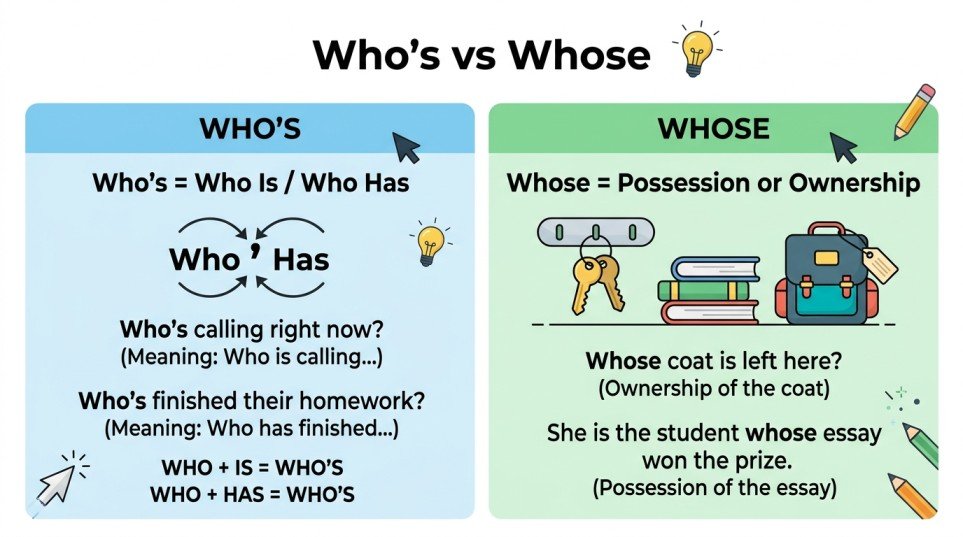
The easiest way to understand who’s or whose is to remember this rule:
- Who’s = Who is or Who has
- Whose = Possession or ownership
Quick Comparison Table
| Word | Meaning | Example |
|---|---|---|
| Who’s | Who is / Who has | Who’s ready for lunch? |
| Whose | Belonging to whom | Whose book is this? |
A simple test can help. Replace who’s with who is. If the sentence still makes sense, who’s is correct.
What Is Who’s?
Who’s is a contraction.
A contraction combines two words into one shorter form. In this case, who’s can mean:
- Who is
- Who has
Examples of Who’s Meaning “Who Is”
- Who’s at the door?
- Who’s responsible for this project?
- Who’s ready to begin?
Each sentence can be expanded:
- Who is at the door?
- Who is responsible for this project?
- Who is ready to begin?
Because the meaning stays the same, who’s is correct.
Examples of Who’s Meaning “Who Has”
Sometimes who’s means “who has.”
Examples include:
- Who’s finished the assignment?
- Who’s already eaten?
- Who’s completed the report?
Expanded versions:
- Who has finished the assignment?
- Who has already eaten?
- Who has completed the report?
Therefore, who’s always functions as a contraction.
What Is Whose?
Whose is a possessive word.
It shows ownership, connection, or relationship.
Examples of Whose
- Whose jacket is on the chair?
- Whose car is parked outside?
- Whose idea was selected?
In these examples, the speaker is asking about ownership.
Possession Without Ownership
Sometimes whose refers to relationships rather than physical ownership.
Examples:
- Whose turn is it?
- Whose responsibility is this?
- Whose team won the game?
The word still indicates a connection between a person and something else.
Key Differences Between Who’s or Whose
Meaning
The biggest difference between who’s or whose is meaning.
- Who’s means “who is” or “who has.”
- Whose indicates possession.
Grammar Function
Who’s functions as a contraction.
Whose functions as a possessive determiner or pronoun.
Sentence Role
Who’s typically introduces information about a person.
Whose asks about ownership or association.
Examples Side by Side
| Correct Usage | Explanation |
|---|---|
| Who’s calling? | Means “Who is calling?” |
| Whose phone is ringing? | Asks about ownership |
| Who’s coming to dinner? | Means “Who is coming?” |
| Whose invitation is this? | Refers to possession |
Understanding these differences makes choosing between who’s or whose much easier.
Why Correct Usage Matters
Using the right word improves clarity.
Professional writing requires accurate grammar. Employers, teachers, and clients often notice mistakes involving who’s or whose.
Correct usage can help with:
- Academic writing
- Business communication
- Job applications
- Professional emails
- Social media content
In addition, proper grammar improves credibility.
Readers tend to trust writing that follows standard language rules.
Advantages and Disadvantages of Each Form
Advantages of Using Who’s Correctly
- Creates grammatically correct sentences
- Improves readability
- Makes contractions clear
- Helps writing sound natural
Problems When Who’s Is Used Incorrectly
- Creates confusion
- Changes sentence meaning
- Makes writing appear careless
Advantages of Using Whose Correctly
- Clearly shows ownership
- Improves sentence accuracy
- Strengthens professional writing
Problems When Whose Is Used Incorrectly
- Ownership becomes unclear
- Readers may misunderstand the message
- Grammar errors reduce credibility
Therefore, mastering who’s or whose is valuable for every writer.
Real World Examples
In Email Writing
Incorrect:
- Whose attending the meeting tomorrow?
Correct:
- Who’s attending the meeting tomorrow?
The corrected sentence means “Who is attending the meeting tomorrow?”
In Classroom Writing
Incorrect:
- Who’s backpack is this?
Correct:
- Whose backpack is this?
The question asks about ownership, so whose is required.
In Social Media Posts
Incorrect:
- Whose excited for the concert?
Correct:
- Who’s excited for the concert?
Again, the sentence means “Who is excited.”
These examples demonstrate why understanding who’s or whose matters in everyday communication.
Regional and Global Usage
American English
American English follows the standard distinction:
- Who’s = who is / who has
- Whose = possession
British English
British English uses the same grammatical rules.
International English Learning
English learners worldwide commonly confuse these words because they sound identical.
However, grammar rules remain consistent across English-speaking countries.
As a result, the distinction between who’s or whose is universal.
Related Concepts and Comparisons
Its vs It’s
This pair follows a similar pattern.
| Word | Meaning |
|---|---|
| It’s | It is / It has |
| Its | Possession |
Your vs You’re
Another common comparison involves:
| Word | Meaning |
|---|---|
| You’re | You are |
| Your | Possession |
Their, There, and They’re
Many writers confuse these words because they sound alike.
Learning who’s or whose often helps people understand other homophone pairs.
Common Mistakes About Who’s or Whose
Using Who’s for Ownership
Incorrect:
- Who’s laptop is this?
Correct:
- Whose laptop is this?
Ownership requires whose.
Using Whose Instead of Who Is
Incorrect:
- Whose coming to dinner?
Correct:
- Who’s coming to dinner?
The sentence means “Who is coming.”
Ignoring the Expansion Test
Many mistakes happen because writers forget to expand contractions.
Try replacing who’s with who is.
If the sentence works, use who’s.
If it does not, use whose when ownership is involved.
Relying Only on Sound
The words sound exactly the same.
Pronunciation cannot help determine which word is correct.
Grammar must guide the choice.
Beginner to Advanced Writing Tips
Beginner Level
Remember one simple rule:
- Who’s = who is
- Whose = ownership
Intermediate Level
Practice expanding contractions whenever you are unsure.
This method catches most mistakes immediately.
Advanced Level
Proofread carefully during editing.
Many experienced writers accidentally type the wrong form because both words sound identical.
Regular proofreading reduces these errors.
Step By Step Decision Process
Imagine you are writing a sentence and must choose between who’s or whose.
Step 1
Ask yourself whether the sentence means “who is” or “who has.”
If yes, choose who’s.
Step 2
If the sentence asks about ownership, choose whose.
Step 3
Expand the contraction.
For example:
- Who’s running the event?
Expansion:
- Who is running the event?
The sentence still works, so who’s is correct.
Step 4
Check for possession.
Example:
- Whose notebook is this?
The sentence asks about ownership, so whose is correct.
Exercises With Answers
Exercise 1
Choose the correct word:
___ coming to the party tonight?
Answer: Who’s
Exercise 2
Choose the correct word:
___ keys are on the table?
Answer: Whose
Exercise 3
Choose the correct word:
___ already completed the project?
Answer: Who’s
Exercise 4
Choose the correct word:
___ bicycle is parked outside?
Answer: Whose
Exercise 5
True or False:
Who’s can mean “who is.”
Answer: True
When Should You Use Who’s or Whose?
Use who’s when:
- You mean “who is”
- You mean “who has”
- A contraction is appropriate
Use whose when:
- Asking about ownership
- Referring to possession
- Showing a relationship between a person and something
Following this guideline eliminates most grammar mistakes.
FAQs About Who’s or Whose
What is the main difference between who’s or whose?
Who’s means “who is” or “who has,” while whose shows ownership or possession.
Is who’s a contraction?
Yes. Who’s is a contraction of “who is” or “who has.”
Does whose show possession?
Yes. Whose is used to indicate ownership or association.
How can I remember who’s or whose?
Replace who’s with “who is.” If the sentence still makes sense, use who’s. Otherwise, use whose for possession.
Is “Who’s book is this?” correct?
No. The correct sentence is “Whose book is this?” because the sentence asks about ownership.
Can who’s mean who has?
Yes. For example, “Who’s finished the assignment?” means “Who has finished the assignment?”
Why do people confuse who’s or whose?
The words sound exactly alike, making them easy to mix up in writing.
Do British and American English use different rules?
No. Both varieties follow the same grammatical distinction.
Is whose always about ownership?
Generally, yes. It indicates possession, connection, or association.
What is the easiest test for who’s or whose?
Expand who’s to “who is.” If the sentence works, use who’s. If ownership is involved, use whose.
Conclusion
Understanding who’s or whose is essential for clear and professional writing. Although the two words sound identical, their functions are completely different.
Who’s is a contraction that means “who is” or “who has.” Whenever a sentence can be expanded using those phrases, who’s is the correct choice.
Whose, on the other hand, indicates possession or ownership. It is used when asking who something belongs to or when describing a connection between a person and an object, idea, responsibility, or relationship.
Many writing mistakes occur because people rely on pronunciation rather than grammar. Fortunately, one simple rule solves most problems. If you can replace the word with “who is,” choose who’s. If the sentence refers to ownership, choose whose.
By practicing regularly and proofreading carefully, you can confidently use who’s or whose in emails, essays, business communication, and everyday writing.
Discover More:-
- Start or Sit: Complete Fantasy Football Decision Making Guide
- Forty or Fourty: Which Spelling Is Correct and Why?

Lisa Thompson is a USA-based content writer and language specialist focused on grammar, writing improvement and digital publishing.
She holds a degree in English Language and Communication and has professional experience in educational and web content creation.
As the author of Gramtivo.Com, she aims to help readers improve their writing skills through clear and practical guidance.