Quick Ans: The phrase naughty or nice is commonly used to describe whether someone has behaved badly or well, especially during the holiday season. Traditionally linked to Santa Claus, the expression helps teach behavior, responsibility, and rewards, but it is also used in everyday conversations, marketing, entertainment, and popular culture.
The phrase naughty or nice is one of the most recognized expressions in the English language. Most people first hear it as children when they learn about Santa Claus and the famous list that tracks good and bad behavior.
Although the phrase is strongly connected to Christmas traditions, its meaning goes far beyond the holiday season. People use it in schools, families, workplaces, advertising campaigns, movies, and everyday conversations.
The confusion often comes from how the phrase is interpreted. Some people view it literally as a way to judge behavior. Others see it as a playful expression used for fun. In many cases, it serves as a simple way to compare positive actions with negative ones.
Understanding naughty or nice helps people use the phrase correctly in different situations. It also reveals how language, culture, and traditions influence everyday communication.
This guide explores the meaning, history, advantages, disadvantages, real world examples, common mistakes, related concepts, and practical exercises. By the end, you will have a complete understanding of the phrase and its modern usage.
Quick Answer: Naughty or Nice
The phrase naughty or nice refers to a comparison between bad behavior and good behavior.
| Term | Meaning |
|---|---|
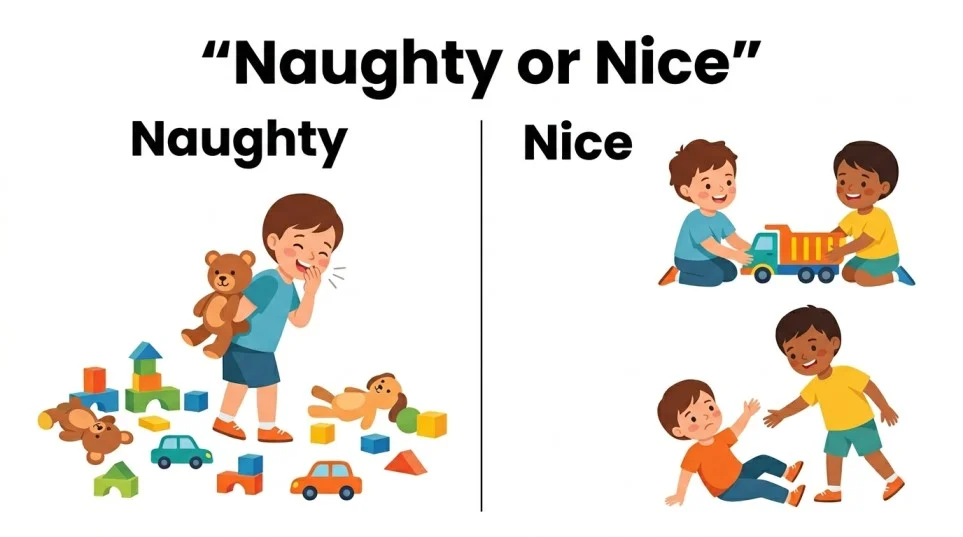
| Naughty | Behaving badly, breaking rules, causing trouble |
| Nice | Behaving well, showing kindness, following rules |
In simple terms, naughty represents undesirable behavior, while nice represents positive behavior.
What Does Naughty Mean?
The word naughty describes behavior that is disobedient, troublesome, or inappropriate. It is often used when talking about children, but adults can also be described as naughty in certain situations.
Common Meanings of Naughty
Depending on context, naughty may mean:
- Breaking rules
- Misbehaving
- Ignoring instructions
- Playing pranks
- Acting mischievously
In some situations, the word is used humorously rather than seriously.
Examples of Naughty Behavior
Examples include:
- Refusing to follow classroom rules
- Playing a prank on a friend
- Ignoring household responsibilities
- Interrupting others repeatedly
The severity of naughty behavior can vary. Sometimes it refers to minor mischief rather than serious wrongdoing.
What Does Nice Mean?
The word nice refers to behavior that is kind, respectful, and considerate. People often associate niceness with positive actions and good manners.
Common Meanings of Nice
A nice person may:
- Help others
- Show respect
- Follow rules
- Share with others
- Demonstrate kindness
Because of these qualities, nice behavior is usually encouraged and rewarded.
Examples of Nice Behavior
Examples include:
- Helping a classmate
- Holding a door open
- Sharing toys or supplies
- Speaking politely
- Showing gratitude
These actions contribute to positive relationships and social harmony.
The History of Naughty or Nice
The phrase naughty or nice became widely popular through Christmas traditions involving Santa Claus.
According to popular folklore, Santa keeps a list of children and determines who has been naughty and who has been nice throughout the year.
The tradition gained popularity through:
- Christmas songs
- Holiday stories
- Children’s books
- Television specials
- Advertising campaigns
Over time, the phrase expanded beyond Christmas and became part of everyday language.
Today, people use it in both serious and playful ways.
Key Differences Between Naughty and Nice
Behavior
Naughty behavior often involves rule breaking or mischief. Nice behavior focuses on cooperation and kindness.
Consequences
Negative actions may lead to punishment or correction. Positive actions often result in praise or rewards.
Social Impact
Naughty actions can create problems for others. Nice actions usually improve relationships.
Intent
Sometimes naughty behavior is intentional. Nice behavior generally involves positive intentions toward others.
Advantages and Disadvantages of the Naughty or Nice Concept
Advantages
The concept offers several benefits:
- Encourages good behavior
- Helps children understand consequences
- Promotes responsibility
- Reinforces positive values
- Creates clear expectations
Because of these benefits, parents and teachers often use the concept when discussing behavior.
Disadvantages
However, there are some limitations:
- Behavior is not always black and white
- People can be both naughty and nice at different times
- Labels may oversimplify situations
- Judgments can sometimes be unfair
Therefore, many experts encourage focusing on actions rather than permanent labels.
Real World Examples
In Families
Parents may use the phrase when discussing behavior before holidays. Children often hear reminders about being nice and respectful.
In Schools
Teachers sometimes use similar ideas to encourage cooperation and positive classroom behavior.
In Marketing
Many businesses run naughty or nice promotions during the holiday season. Customers may be invited to choose gifts, discounts, or themed products.
In Entertainment
Movies, books, and television programs frequently use the phrase for humor and storytelling.
These examples show how the expression appears in everyday life.
Regional and Global Usage
North America
The phrase is especially popular in the United States and Canada because of Christmas traditions.
Europe
Many European countries use similar concepts connected to holiday folklore and seasonal celebrations.
Global Popularity
Through movies, music, and advertising, the phrase has become recognizable around the world.
As a result, naughty or nice is now part of international popular culture.
Related Concepts and Comparisons
Naughty vs Bad
Naughty usually suggests minor misbehavior. Bad often implies more serious wrongdoing.
Nice vs Kind
Kindness is a specific action. Nice is a broader description of positive behavior.
Naughty or Nice vs Good or Bad
Both comparisons evaluate behavior. However, naughty or nice often carries a lighter and more playful tone.
Mischievous vs Naughty
A mischievous person enjoys harmless fun. Naughty behavior may involve rule breaking or disobedience.
Comparison Table: Naughty vs Nice
| Feature | Naughty | Nice |
|---|---|---|
| Follows Rules | Usually No | Usually Yes |
| Helps Others | Rarely | Often |
| Causes Problems | Sometimes | Rarely |
| Receives Praise | Less Often | More Often |
| Associated With | Mischief | Kindness |
This comparison helps clarify the differences between the two terms.
Common Mistakes About Naughty or Nice
Treating People as Only One or the Other
Most people display both positive and negative behaviors at different times. Human behavior is more complex than simple labels.
Assuming Naughty Means Evil
The word usually refers to minor misbehavior rather than serious wrongdoing.
Ignoring Context
The same action may be considered naughty in one situation and acceptable in another.
Overusing Labels
Focusing too much on labels can discourage personal growth. Discussing specific actions often works better.
Avoiding these mistakes leads to a more balanced understanding of behavior.
Beginner to Advanced Understanding
Beginner Level
At a basic level, naughty means behaving badly and nice means behaving well.
Intermediate Level
At this stage, people understand that behavior depends on circumstances and intentions.
Advanced Level
A deeper understanding recognizes that individuals can show both positive and negative behaviors throughout life.
This perspective encourages fairness and empathy.
Step By Step Scenario
Imagine a student during a school week.
On Monday, the student helps a classmate with homework. That action is considered nice.
On Wednesday, the same student interrupts the teacher repeatedly. That behavior may be considered naughty.
On Friday, the student volunteers for a school project. Once again, the action is nice.
This example shows that behavior changes depending on actions and choices.
Exercises With Answers
Exercise 1
Which term describes kind and respectful behavior?
Answer: Nice.
Exercise 2
Which term is commonly associated with mischief?
Answer: Naughty.
Exercise 3
True or False: A person can only be naughty or nice, never both.
Answer: False.
Exercise 4
Which word is often linked to helping others?
Answer: Nice.
Exercise 5
What holiday tradition popularized the phrase naughty or nice?
Answer: The Santa Claus Christmas tradition.
When Should You Use Naughty or Nice?
Use the phrase when:
- Discussing behavior
- Talking about Christmas traditions
- Writing holiday content
- Creating playful comparisons
- Describing actions in stories
The expression works best when the tone is lighthearted and easy to understand.
FAQs About Naughty or Nice
What does naughty or nice mean?
The phrase compares bad behavior with good behavior. Naughty refers to misbehavior, while nice refers to positive actions.
Where did the phrase naughty or nice come from?
It became popular through Santa Claus stories and Christmas traditions.
Is naughty always a serious term?
No. In many situations, naughty simply describes harmless mischief.
Can adults be described as naughty or nice?
Yes. The phrase can be used for people of any age, often in a playful way.
What is the opposite of naughty?
The opposite of naughty is nice.
Why is naughty or nice associated with Christmas?
According to holiday folklore, Santa keeps a list of who has been naughty and who has been nice.
Does naughty mean bad?
Not necessarily. Naughty usually refers to minor rule breaking or mischievous behavior.
Can someone be both naughty and nice?
Yes. Most people display both types of behavior at different times.
Is naughty or nice used outside of Christmas?
Yes. The phrase appears in everyday conversations, advertising, books, and entertainment.
Why is the phrase still popular today?
Its simple message, cultural significance, and playful nature make it easy to understand and remember.
Conclusion
The phrase naughty or nice remains one of the most familiar expressions in modern culture. While it began as part of Christmas traditions involving Santa Claus, its meaning now extends far beyond the holiday season.
At its core, the phrase compares negative behavior with positive behavior. Naughty actions often involve mischief or rule breaking. Nice actions typically reflect kindness, cooperation, and respect.
Although the concept appears simple, human behavior is much more complex. Most people demonstrate both naughty and nice qualities depending on circumstances and choices. For that reason, focusing on specific actions rather than permanent labels often provides a more balanced perspective.
Whether used in family discussions, classroom settings, holiday marketing, or everyday conversations, the phrase continues to play an important role in communication. Understanding naughty or nice helps people use the expression correctly and appreciate its cultural significance.
Discover More:-
- Stretcher vs Gurney: Key Differences, Uses, and Medical Comparison Guide
- Balcony vs Patio: Differences, Uses, and Outdoor Space Guide

Robert Mitchell is a U.S.-based writer at Gramtivo.Com who focuses on grammar, writing improvement, and language-related content. He holds a degree in English and Linguistics from a U.S. university. His work aims to help readers enhance their writing skills with clear and practical guidance.