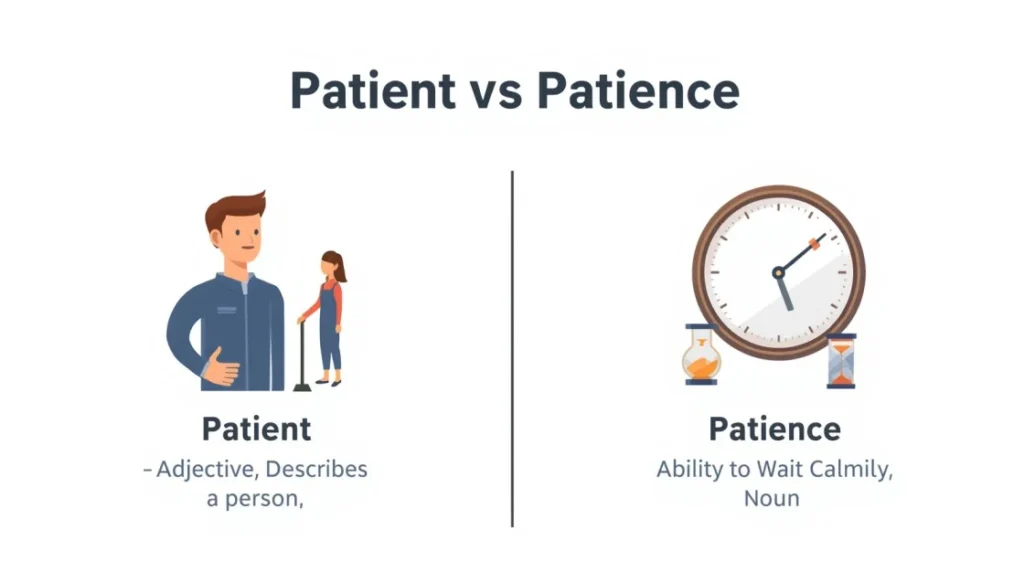
Quick Ans: The difference between patient or patience is simple but important. Patient is usually an adjective that describes someone who can wait calmly, while patience is a noun that refers to the ability to stay calm while waiting or dealing with difficulties. Although the words are closely related, they serve different roles in English grammar.
Many English learners struggle with patient or patience because the words look and sound similar. In fact, they come from the same root word and are often used in similar situations. As a result, people frequently mix them up in writing and conversation.
The confusion becomes even greater because both words relate to waiting, tolerance, and self control. However, one word describes a person or behavior, while the other names a quality or characteristic.
For example, someone might write, “Thank you for your patient,” when the correct word should be “patience.” Likewise, another person may say, “You need more patience,” when they actually mean “You need to be more patient.”
Understanding the difference between patient or patience improves grammar, writing, speaking, and professional communication. Whether you are a student, job seeker, business professional, or English learner, knowing when to use each word helps you communicate more clearly.
This complete guide explains definitions, examples, grammar rules, common mistakes, exercises, and practical usage scenarios so you can confidently choose the correct word every time.
Quick Answer: Patient or Patience
The easiest way to understand patient or patience is to look at their grammatical roles.
| Word | Part of Speech | Meaning |
|---|---|---|
| Patient | Adjective | Able to wait calmly |
| Patience | Noun | The ability to wait calmly |
Simple Examples
- She is patient with children.
- He showed great patience during the delay.
In short:
- Use patient to describe a person or behavior.
- Use patience to name the quality of calm waiting.
What Does Patient Mean?
The word patient is most commonly used as an adjective. It describes someone who remains calm and does not become easily annoyed while waiting or dealing with problems.
Definition of Patient
A patient person:
- Waits without complaining
- Remains calm under pressure
- Handles delays well
- Shows understanding toward others
Examples of Patient in Sentences
- The teacher was patient with struggling students.
- My father is patient when teaching me new skills.
- She remained patient during the long meeting.
- You need to be patient while learning a new language.
In each example, patient describes a person or behavior.
Patient as a Noun
The word patient can also be a noun in medical settings.
For example:
- The doctor examined the patient.
- Several patients waited in the clinic.
However, when discussing patient or patience, most grammar questions focus on the adjective form.
What Does Patience Mean?
The word patience is a noun. It refers to the ability or quality of remaining calm while waiting, facing difficulties, or dealing with frustration.
Definition of Patience
Patience is:
- Self control
- Calm endurance
- Tolerance during delays
- Ability to avoid frustration
Examples of Patience in Sentences
- Thank you for your patience.
- Learning a new skill requires patience.
- Her patience impressed everyone.
- Parents often need a lot of patience.
Unlike patient, the word patience names a quality rather than describing a person.
Key Differences Between Patient or Patience
Part of Speech
The biggest difference between patient or patience involves grammar.
- Patient = adjective
- Patience = noun
Function in a Sentence
Patient describes someone.
Example:
- He is patient.
Patience names a quality.
Example:
- He has patience.
Sentence Structure
Notice how the sentence changes:
| Correct Usage | Explanation |
|---|---|
| She is patient. | Describes the person |
| She has patience. | Names the quality |
Although both sentences communicate a similar idea, the grammar is different.
Memory Trick
A simple trick can help:
- Patient describes a person.
- Patience describes a characteristic.
If you can replace the word with “calm,” use patient. If you mean “ability to stay calm,” use patience.
Advantages and Disadvantages of Using Each Correctly
Benefits of Using Patient Correctly
- Improves grammar accuracy
- Makes writing clearer
- Enhances professional communication
- Demonstrates language proficiency
Benefits of Using Patience Correctly
- Creates natural sounding sentences
- Avoids confusion
- Strengthens academic writing
- Improves speaking confidence
Problems Caused by Incorrect Usage
Using the wrong word can:
- Confuse readers
- Create grammatical errors
- Reduce credibility
- Make communication less professional
Therefore, understanding patient or patience is important for both casual and formal communication.
Real World Examples
Workplace Communication
Manager:
“Please be patient while we review your application.”
This sentence describes the applicant’s behavior.
Another example:
“Thank you for your patience during the hiring process.”
In this case, patience refers to the applicant’s ability to wait calmly.
School Environment
Teacher:
“Be patient with yourself while learning.”
Student:
“Learning mathematics requires patience.”
Both sentences are correct because each word serves a different grammatical purpose.
Customer Service
Many businesses write:
“Thank you for your patience.”
This phrase is correct because the company is thanking customers for their ability to wait.
Regional and Global Usage
American English
American English commonly uses both words in everyday communication.
Examples include:
- Be patient.
- Thank you for your patience.
British English
British English follows the same grammar rules.
Consequently, there is no major difference between American and British usage for patient or patience.
International English Learning
English learners worldwide often confuse these terms because many languages use similar forms for adjectives and nouns.
For that reason, practicing sentence structure becomes especially important.
Related Concepts and Comparisons
Patient vs Patients
Many learners confuse these words.
| Word | Meaning |
|---|---|
| Patient | Calm and understanding |
| Patients | People receiving medical treatment |
Examples:
- Be patient during the process.
- The hospital treated many patients.
Patience vs Tolerance
Patience involves calm waiting. Tolerance involves accepting differences or difficulties.
Examples:
- Patience helps during delays.
- Tolerance helps when dealing with opinions you dislike.
Patient vs Calm
A calm person feels relaxed. A patient person remains calm while waiting or facing challenges.
Therefore, patience includes calmness but focuses on endurance.
Common Mistakes About Patient or Patience
Using Patience Instead of Patient
Incorrect:
- She is patience.
Correct:
- She is patient.
The adjective is needed because it describes a person.
Using Patient Instead of Patience
Incorrect:
- Thank you for your patient.
Correct:
- Thank you for your patience.
A noun is needed because the sentence refers to a quality.
Forgetting Sentence Structure
Incorrect:
- He has patient.
Correct:
- He has patience.
The verb “has” should be followed by the noun.
Confusing Medical and Grammar Meanings
Remember that patient can refer to a person receiving medical care. However, grammar discussions about patient or patience usually involve the adjective form.
Beginner to Advanced Usage Tips
Beginner Level
Learn the basic rule:
- Patient = adjective
- Patience = noun
Intermediate Level
Practice identifying parts of speech in sentences.
Examples:
- She is patient.
- She has patience.
Advanced Level
Use both words naturally in professional communication.
Example:
“The manager remained patient, and her patience helped the team stay focused.”
This sentence demonstrates correct use of both forms.
Step By Step Grammar Scenario
Imagine a customer waiting for technical support.
If you describe the customer:
- The customer is patient.
If you describe the quality:
- The customer has patience.
Now consider a teacher helping students.
Describing the teacher:
- The teacher is patient.
Describing the teacher’s quality:
- The teacher shows patience.
These examples clearly illustrate the difference between patient or patience.
Exercises With Answers
Exercise 1
Choose the correct word:
She was very ______ during the long delay.
Answer: Patient
Exercise 2
Choose the correct word:
Learning a new language requires ______.
Answer: Patience
Exercise 3
Choose the correct word:
Thank you for your ______.
Answer: Patience
Exercise 4
Choose the correct word:
You should be more ______ with beginners.
Answer: Patient
Exercise 5
True or False:
Patience is an adjective.
Answer: False
When Should You Use Patient or Patience?
Use patient when:
- Describing a person
- Describing behavior
- Talking about calm actions
- Using linking verbs such as “is” or “seems”
Use patience when:
- Naming a quality
- Referring to self control
- Following words like “have” or “show”
- Thanking someone for waiting
Following these guidelines helps eliminate confusion.
FAQs About Patient or Patience
What is the difference between patient or patience?
Patient is an adjective describing someone who waits calmly, while patience is a noun referring to the ability to wait calmly.
Is it “be patience” or “be patient”?
The correct phrase is “be patient” because patient functions as an adjective.
Do you say thank you for your patient or patience?
The correct phrase is “thank you for your patience.”
Can patient be a noun?
Yes. In healthcare, a patient is a person receiving medical treatment.
Why do people confuse patient or patience?
The words look and sound similar and come from the same root word.
Which is correct: she has patient or she has patience?
The correct sentence is “she has patience.”
Which is correct: he is patience or he is patient?
The correct sentence is “he is patient.”
What part of speech is patience?
Patience is a noun.
What part of speech is patient?
Patient is usually an adjective, although it can also be a noun in medical contexts.
How can I remember the difference between patient or patience?
Remember that patient describes a person, while patience names a quality.
Conclusion
Understanding patient or patience is essential for clear and accurate English communication. Although the two words are closely related, they serve different grammatical functions.
Patient is primarily an adjective used to describe someone who remains calm while waiting or dealing with challenges. Patience, on the other hand, is a noun that refers to the ability or quality of staying calm under those circumstances.
Many common mistakes occur because the words sound similar. Fortunately, remembering one simple rule can help: describe a person with patient and describe a quality with patience.
Practice using both words in everyday conversations, emails, academic writing, and professional communication. Over time, the distinction becomes natural.
Once you understand the difference between patient or patience, your grammar becomes stronger, your writing becomes clearer, and your communication becomes more professional.
Discover More:-
- Allergies or Cold: How to Tell the Difference and Choose the Right Treatment
- Flier or Flyer: Which Spelling Is Correct and When to Use Each

Lisa Thompson is a USA-based content writer and language specialist focused on grammar, writing improvement and digital publishing.
She holds a degree in English Language and Communication and has professional experience in educational and web content creation.
As the author of Gramtivo.Com, she aims to help readers improve their writing skills through clear and practical guidance.