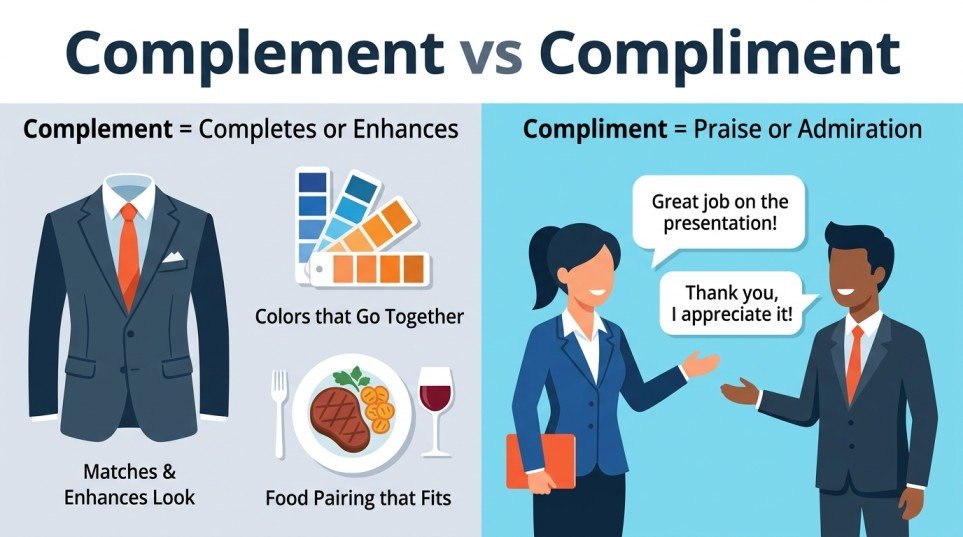
Quick Ans: The difference between complement or compliment comes down to meaning. Complement means something that completes, enhances, or goes well with something else, while compliment means praise, admiration, or a kind remark. Although the words sound alike, they are used in very different situations.
Many English learners struggle with complement or compliment because the words look and sound almost identical. In fact, they are among the most commonly confused words in English.
The challenge comes from their similar spelling and pronunciation. A single letter changes the meaning completely. As a result, people often use the wrong word in emails, essays, social media posts, and professional communication.
Imagine telling someone their presentation “complemented” them when you actually meant to praise them. Likewise, writing that a tie “complimented” a suit can create confusion. Even experienced writers occasionally make this mistake.
Fortunately, understanding the difference is easier than it seems. Once you learn the definitions, examples, and memory tricks, choosing the correct word becomes much simpler.
This guide explains complement or compliment in clear language. You will learn definitions, meanings, examples, common mistakes, usage tips, exercises, and frequently asked questions. By the end, you will know exactly when to use each word.
Quick Answer: Complement or Compliment
The easiest way to remember complement or compliment is to focus on their meanings.
| Word | Meaning | Example |
|---|---|---|
| Complement | Something that completes or improves another thing | The sauce complements the pasta. |
| Compliment | Praise or admiration | She gave me a compliment on my work. |
In simple terms:
- Complement = Complete
- Compliment = Praise
That one distinction solves most confusion.
What Does Complement Mean?
The word complement refers to something that completes, enhances, improves, or matches another thing.
When two things work well together, one complements the other.
Examples of Complement
Consider these examples:
- The red curtains complement the room’s design.
- Her skills complement the team’s strengths.
- Fresh herbs complement the flavor of the soup.
- The necklace complements her dress.
In each sentence, one thing improves or enhances another.
Complement as a Noun
As a noun, complement refers to something that completes a whole.
Examples include:
- The wine is a perfect complement to the meal.
- The new software is an excellent complement to existing tools.
Complement as a Verb
As a verb, complement means to improve or complete something.
Examples include:
- These colors complement each other.
- The two departments complement one another perfectly.
Because of its meaning, complement often appears in discussions about design, fashion, food, business, and teamwork.
What Does Compliment Mean?
The word compliment refers to praise, admiration, approval, or a positive remark.
People give compliments to show appreciation or kindness.
Examples of Compliment
Look at these examples:
- She gave me a compliment about my presentation.
- His teacher complimented him on his hard work.
- They complimented the chef on the meal.
- I received several compliments on my new jacket.
Each example involves praise rather than completion.
Compliment as a Noun
As a noun, compliment means a positive comment.
Examples include:
- Thank you for the compliment.
- Her compliment made my day better.
Compliment as a Verb
As a verb, compliment means to express praise.
Examples include:
- The manager complimented the employee.
- Guests complimented the host on the decorations.
Therefore, compliment is associated with admiration and positive feedback.
Key Differences Between Complement or Compliment
Meaning
The primary difference involves definition.
- Complement means to complete or enhance.
- Compliment means to praise or admire.
Usage
Complement is used when discussing things that work well together.
Compliment is used when discussing positive comments or praise.
Context
Complement commonly appears in:
- Design
- Fashion
- Food
- Business
- Relationships
Compliment frequently appears in:
- Conversations
- Performance reviews
- Social situations
- Customer feedback
Example Comparison
| Sentence | Correct Word |
|---|---|
| Your shoes _____ your outfit. | Complement |
| She gave me a _____ about my speech. | Compliment |
| The colors _____ each other. | Complement |
| He _____ me on my success. | Compliment |
Why Do People Confuse Complement and Compliment?
Several factors contribute to confusion.
Similar Pronunciation
Both words sound almost identical in everyday speech.
Similar Spelling
Only one letter differs between them.
- Complement
- Compliment
Because the spelling is so close, many writers type the wrong word accidentally.
Similar Origins
Both words come from related Latin roots, which contributes to their resemblance.
However, their modern meanings have developed differently.
Memory Tricks for Complement or Compliment
Memory tricks can make the distinction easier.
The E Rule
Think of the letter E in complement.
- Complement
- Complete
Since both words contain “E,” they are easy to connect mentally.
The I Rule
Think of the letter I in compliment.
- Compliment
- I like your work.
Since compliments involve praise directed at someone, the “I” can remind you of a personal remark.
Quick Formula
Remember this simple formula:
- Complement = Complete
- Compliment = Praise
Many learners find this trick helpful in everyday writing.
Real World Examples
Fashion Example
A stylist might say:
“The blue tie complements the gray suit.”
The tie improves the overall appearance.
Workplace Example
A manager might say:
“I want to compliment you on your excellent report.”
This statement offers praise.
Food Example
A chef may explain:
“The lemon complements the fish.”
Here, one flavor enhances another.
Customer Service Example
A customer could say:
“I want to compliment your staff for their professionalism.”
This sentence expresses appreciation.
These examples demonstrate how context determines whether complement or compliment is correct.
Regional and Global Usage
American English
American English uses both complement and compliment regularly.
Business writing often includes both words.
British English
British English follows the same rules.
The meanings remain identical.
Academic Writing
Academic papers frequently use complement when discussing systems, theories, and relationships.
Compliment appears less often in academic contexts because it focuses on praise.
Everyday Communication
In daily conversation, compliment is generally more common because people frequently praise others.
Meanwhile, complement appears often in discussions involving style, design, and functionality.
Related Concepts and Comparisons
Complement vs Supplement
A complement completes something.
A supplement adds something extra.
Example:
- A salad complements the meal.
- Vitamins supplement the diet.
Compliment vs Praise
These words are closely related.
A compliment is a specific form of praise.
Complement vs Enhance
Enhance and complement share similar meanings.
However, complement often suggests two things working together effectively.
Complement vs Compliment vs Supplement
| Word | Meaning |
|---|---|
| Complement | Completes or improves |
| Compliment | Praise or admiration |
| Supplement | Adds extra support |
Understanding these related terms helps clarify the complement or compliment distinction.
Common Mistakes About Complement or Compliment
Using Compliment for Matching Items
Incorrect:
- The curtains compliment the furniture.
Correct:
- The curtains complement the furniture.
The curtains improve the appearance rather than praise it.
Using Complement for Praise
Incorrect:
- She complemented me on my presentation.
Correct:
- She complimented me on my presentation.
The speaker is giving praise.
Forgetting Context
Many writers focus on spelling instead of meaning.
Always determine whether the sentence involves enhancement or praise.
Relying Only on Pronunciation
Because both words sound alike, pronunciation alone cannot identify the correct choice.
Context is the key factor.
Beginner to Advanced Usage Tips
Beginner Level
Ask yourself:
“Is someone giving praise?”
If yes, use compliment.
Intermediate Level
Look for relationships between objects.
If one thing improves another, use complement.
Advanced Level
Pay attention to professional and academic contexts.
Complement often appears in technical writing involving systems, products, and design concepts.
Careful proofreading can prevent mistakes in formal documents.
Step By Step Decision Process
Suppose you need to choose between complement or compliment.
Follow these steps:
- Read the sentence.
- Identify the intended meaning.
- Ask whether praise is involved.
- If praise exists, choose compliment.
- If enhancement or completion exists, choose complement.
Example:
“The artwork _____ the room.”
No praise is occurring.
Therefore, the correct answer is:
“The artwork complements the room.”
Exercises With Answers
Exercise 1
Choose the correct word:
“The scarf _____ the jacket.”
Answer: Complements.
Exercise 2
Choose the correct word:
“He gave me a nice _____.”
Answer: Compliment.
Exercise 3
Choose the correct word:
“The manager _____ the employee.”
Answer: Complimented.
Exercise 4
Choose the correct word:
“The furniture _____ the room design.”
Answer: Complements.
Exercise 5
True or False:
A compliment means something that completes another thing.
Answer: False.
When Should You Use Complement or Compliment?
Use complement when:
- Something improves another thing
- Two items work well together
- You describe matching colors, designs, or flavors
- You discuss completion or enhancement
Use compliment when:
- Giving praise
- Expressing admiration
- Offering positive feedback
- Recognizing someone’s achievement
Understanding the purpose of the sentence makes the choice much easier.
FAQs About Complement or Compliment
What is the difference between complement or compliment?
Complement means to complete or enhance something, while compliment means praise or admiration.
How can I remember complement or compliment?
Remember that complement relates to complete, and compliment relates to praise.
Is a compliment always praise?
Yes. A compliment is a positive remark or expression of admiration.
Can complement be used as a verb?
Yes. Complement can mean to improve, complete, or work well with something else.
Can compliment be used as a verb?
Yes. Compliment can mean to express praise toward someone.
Which word is used for matching colors?
Complement is correct because one color enhances another.
Which word is used for positive feedback?
Compliment is correct because positive feedback involves praise.
Why are complement and compliment confusing?
They look similar, sound alike, and differ by only one letter.
Is ‘Your shoes compliment your outfit’ correct?
No. The correct sentence is “Your shoes complement your outfit.”
How do professionals avoid complement or compliment mistakes?
They focus on meaning first and proofread carefully before publishing or sending documents.
Conclusion
Understanding complement or compliment is essential for clear and accurate communication. Although the two words look and sound similar, their meanings are completely different.
Complement refers to something that completes, improves, or enhances another thing. Compliment refers to praise, admiration, or positive feedback directed toward a person.
The easiest memory trick is simple. Complement relates to complete. Compliment relates to praise. Once you remember that distinction, choosing the correct word becomes much easier.
Whether you are writing emails, academic papers, business reports, or social media posts, using the correct term improves clarity and professionalism.
Whenever you encounter complement or compliment, focus on the context. If something enhances another thing, choose complement. If someone is receiving praise, choose compliment.
With practice, this common grammar confusion becomes easy to avoid.
Discover More:-
- Forty or Fourty: Which Spelling Is Correct and Why?
- Led or Lead: Difference, Meaning, Grammar Rules, and Examples

Robert Mitchell is a U.S.-based writer at Gramtivo.Com who focuses on grammar, writing improvement, and language-related content. He holds a degree in English and Linguistics from a U.S. university. His work aims to help readers enhance their writing skills with clear and practical guidance.