
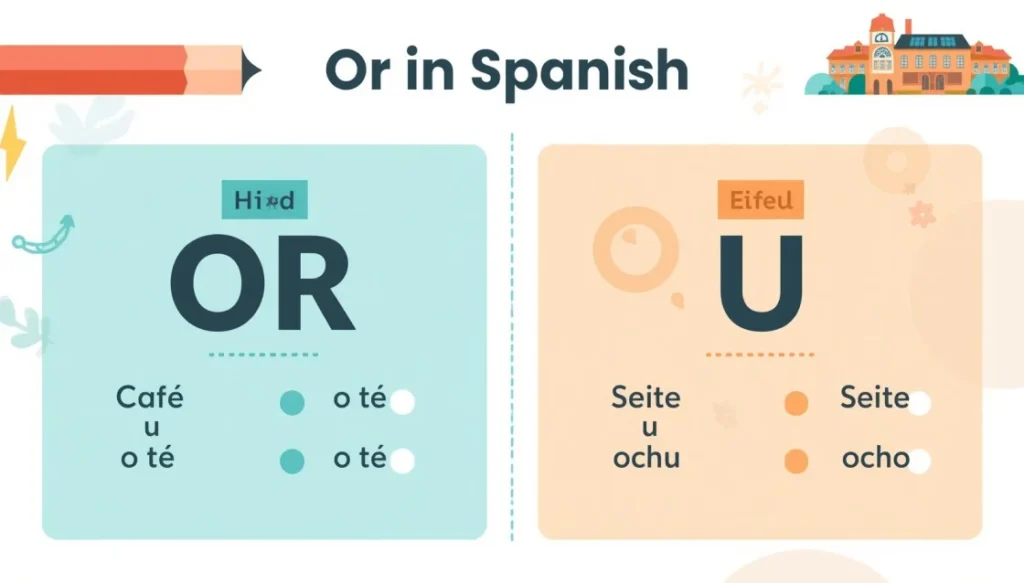
Quick Ans: The word “or” in Spanish is usually translated as “o.” However, when the following word begins with the sound “o” or “ho,” Spanish changes “o” to “u” to improve pronunciation. Learning this simple rule helps you speak and write Spanish more naturally.
Many Spanish learners quickly learn that “or” in Spanish means “o.” At first, the translation seems easy. After all, English speakers use “or” every day to present choices, alternatives, and possibilities.
Nevertheless, Spanish has a few special rules that make the topic more interesting than it appears.
For example, native speakers sometimes use “u” instead of “o.” This change surprises many beginners because they assume one word always has one translation. In reality, pronunciation and grammar influence which form should be used.
Understanding or in Spanish is important because the word appears in conversations, emails, school assignments, business communication, and travel situations. Whether you are ordering food, asking questions, making decisions, or comparing options, you will likely use this conjunction frequently.
This guide explains everything you need to know about or in Spanish, including pronunciation, grammar rules, examples, common mistakes, regional usage, exercises, and frequently asked questions. By the end, you will know exactly when to use o and when to use u.
Quick Answer: Or in Spanish
The standard translation of “or” in Spanish is:
| English | Spanish |
|---|---|
| Or | O |
Examples:
- Coffee or tea = Café o té
- Red or blue = Rojo o azul
- Today or tomorrow = Hoy o mañana
However, there is an important exception.
When the next word starts with the sound o or ho, Spanish uses u instead of o.
Examples:
- Seven or eight = Siete u ocho
- Men or women = Hombres u mujeres
Therefore, both o and u can mean “or” in Spanish.
What Does Or in Spanish Mean?
The Spanish conjunction o connects words, phrases, and ideas that offer alternatives.
In English, we often use “or” to present choices. Spanish follows the same basic concept.
Examples:
- Do you want water or juice?
- ¿Quieres agua o jugo?
- Should we leave today or tomorrow?
- ¿Debemos salir hoy o mañana?
- Is it black or white?
- ¿Es negro o blanco?
As a result, Spanish speakers use o whenever they want to express options.
Understanding the Spanish Conjunction O
A conjunction connects ideas together.
In Spanish grammar, o belongs to a category called coordinating conjunctions.
Its main purpose is to link alternatives.
Examples include:
- Dogs or cats
- Summer or winter
- Morning or evening
Spanish translations:
- Perros o gatos
- Verano o invierno
- Mañana o tarde
Because the word is short and simple, it appears constantly in everyday speech.
When O Changes to U
This is one of the most important grammar rules related to or in Spanish.
Spanish changes o to u before words that begin with the sound o or ho.
Why Does This Happen?
The change improves pronunciation.
Without the rule, two similar sounds would occur together and sound awkward.
Examples
| Incorrect | Correct |
|---|---|
| O ocho | U ocho |
| O hombres | U hombres |
| O hojas | U hojas |
| O hormigas | U hormigas |
Correct sentences:
- Siete u ocho personas.
- Hombres u mujeres pueden participar.
- Una u otra opción.
Consequently, native speakers naturally switch to u in these situations.
Pronunciation of Or in Spanish
Correct pronunciation helps learners sound more natural.
Pronouncing O
The letter o sounds similar to the English “o” in “go,” but shorter.
Example:
- O = oh
Pronouncing U
The letter u sounds like:
- oo
Example:
- U ocho = oo-oh-cho
Although the spelling changes, the meaning remains exactly the same.
Common Uses of Or in Spanish
Spanish speakers use o in many situations.
Making Choices
Examples:
- Pizza o pasta
- Té o café
- Playa o montaña
Asking Questions
Examples:
- ¿Quieres quedarte o salir?
- ¿Vienes hoy o mañana?
Giving Alternatives
Examples:
- Puedes llamar o enviar un correo.
- Podemos caminar o tomar un taxi.
Comparing Possibilities
Examples:
- Ganará Juan o Pedro.
- Será fácil o difícil.
Therefore, learning or in Spanish helps improve both speaking and writing skills.
Types of Choices Expressed With Or in Spanish
Different situations require different types of alternatives.
Exclusive Choice
Only one option is possible.
Example:
- ¿Es verdadero o falso?
Only one answer can be correct.
Inclusive Choice
More than one option may be possible.
Example:
- Puedes traer lápices o bolígrafos.
Both could be acceptable.
Conditional Choice
Sometimes alternatives depend on circumstances.
Example:
- Podemos viajar en tren o en avión.
The final decision depends on preference or budget.
Advantages and Disadvantages of Learning Direct Translations
Understanding direct translations offers many benefits.
Advantages
- Easy to remember
- Improves beginner confidence
- Helps build vocabulary
- Speeds up communication
Disadvantages
- Some grammar rules are overlooked
- Pronunciation exceptions may be missed
- Context can affect usage
Therefore, learners should understand both translation and grammar.
Real World Examples of Or in Spanish
At a Restaurant
English:
- Water or soda?
Spanish:
- ¿Agua o refresco?
During Travel
English:
- Train or bus?
Spanish:
- ¿Tren o autobús?
In School
English:
- History or science?
Spanish:
- ¿Historia o ciencia?
At Work
English:
- Email or phone call?
Spanish:
- ¿Correo electrónico o llamada telefónica?
Because these situations occur daily, mastering or in Spanish provides immediate practical value.
Regional and Global Usage
Spanish is spoken across many countries.
Spain
Speakers use o and u according to standard grammar rules.
Mexico
The same rule applies.
Argentina
Usage remains identical.
Colombia
Grammar follows the same pattern.
Other Spanish Speaking Countries
Whether you travel to Peru, Chile, Ecuador, or Costa Rica, the rule remains consistent.
As a result, the word or in Spanish works universally across the Spanish-speaking world.
Related Concepts and Comparisons
Understanding related conjunctions helps build stronger language skills.
And vs Or in Spanish
| English | Spanish |
|---|---|
| And | Y |
| Or | O |
Examples:
- Juan y María
- Juan o María
But vs Or in Spanish
| English | Spanish |
|---|---|
| But | Pero |
| Or | O |
Examples:
- Quiero ir, pero estoy ocupado.
- Quiero ir o quedarme.
Either Or in Spanish
English:
- Either coffee or tea.
Spanish:
- Café o té.
Sometimes Spanish does not require a direct translation of “either.”
Grammar Rules for Or in Spanish
Several important rules should be remembered.
Rule One
Use o in normal situations.
Example:
- Azul o verde.
Rule Two
Use u before words beginning with the sound o or ho.
Example:
- U ocho.
Rule Three
Do not confuse o with the number zero.
Context usually makes the meaning clear.
Rule Four
Maintain consistency in formal writing.
Proper conjunction usage improves readability.
Common Mistakes About Or in Spanish
Forgetting the U Rule
Incorrect:
- Siete o ocho
Correct:
- Siete u ocho
Using Y Instead of O
Incorrect:
- Café y té
Correct:
- Café o té
The first means both. The second means one choice.
Translating Word for Word
English patterns do not always match Spanish patterns perfectly.
Therefore, learners should focus on context.
Ignoring Pronunciation
Many students learn spelling but neglect speaking practice.
Listening to native speakers helps reinforce correct usage.
Beginner to Advanced Learning Tips
Beginner Level
Memorize:
- Or = o
Practice simple choices daily.
Intermediate Level
Learn the u rule.
Create example sentences using both forms.
Advanced Level
Study conjunction usage in literature, news articles, and professional writing.
Pay attention to how native speakers present alternatives.
Consequently, your Spanish will become more natural and accurate.
Step By Step Learning Scenario
Imagine you are learning Spanish from scratch.
Step One
Learn the word:
- Or = o
Step Two
Practice basic phrases:
- Tea or coffee
- Today or tomorrow
Step Three
Learn the pronunciation rule.
Examples:
- Siete u ocho
- Hombres u mujeres
Step Four
Use the conjunction in conversation.
Step Five
Read authentic Spanish content to see real examples.
Following this process builds confidence steadily.
Exercises With Answers
Exercise 1
Translate:
Coffee or tea
Answer:
Café o té
Exercise 2
Translate:
Seven or eight
Answer:
Siete u ocho
Exercise 3
Which word normally means “or” in Spanish?
Answer:
O
Exercise 4
Which form comes before “hombres”?
Answer:
U
Exercise 5
Translate:
Today or tomorrow
Answer:
Hoy o mañana
Exercise 6
Translate:
Men or women
Answer:
Hombres u mujeres
Exercise 7
True or False:
Spanish always uses “o.”
Answer:
False.
Exercise 8
Complete the sentence:
Siete ___ ocho.
Answer:
U
Practical Conversation Examples
Shopping
- ¿Rojo o azul?
- Red or blue?
Travel
- ¿Avión o tren?
- Plane or train?
Education
- ¿Matemáticas o historia?
- Math or history?
Entertainment
- ¿Película o serie?
- Movie or series?
Food
- ¿Hamburguesa o pizza?
- Burger or pizza?
These examples demonstrate how frequently the conjunction appears in daily life.
Why Or in Spanish Is Important
Some vocabulary words appear occasionally.
The conjunction o appears constantly.
Without it, expressing alternatives becomes difficult.
Moreover, conversations often involve choices.
Students choose courses.
Travelers choose transportation.
Families choose meals.
Businesses choose strategies.
Because alternatives exist everywhere, the word remains essential for communication.
FAQs About Or in Spanish
What is or in Spanish?
The most common translation of “or” in Spanish is o.
Why does o sometimes change to u?
Spanish changes o to u before words beginning with the sound o or ho.
Is u a different word from o?
No. Both mean “or” in Spanish. The change exists for pronunciation purposes.
How do you say coffee or tea in Spanish?
You say café o té.
How do you say seven or eight in Spanish?
The correct form is siete u ocho.
Do all Spanish speaking countries use the u rule?
Yes. The rule is accepted throughout the Spanish-speaking world.
Can I always use o instead of u?
No. Formal Spanish grammar requires u before words beginning with the sound o or ho.
What part of speech is o in Spanish?
It is a coordinating conjunction.
How often is or used in Spanish conversations?
Very frequently. Speakers use it whenever presenting choices or alternatives.
What is the easiest way to remember or in Spanish?
Remember: use o normally, but switch to u before words beginning with the sound o or ho.
Conclusion
Learning or in Spanish is simple at the beginning, yet the topic includes an important pronunciation rule that many learners overlook. In most situations, the correct translation is o, making it one of the most common conjunctions in the language.
However, Spanish changes o to u before words that begin with the sound o or ho. This adjustment improves pronunciation and creates smoother speech. Although the spelling changes, the meaning remains exactly the same.
Throughout daily conversations, Spanish speakers use this conjunction to express choices, alternatives, possibilities, and decisions. Whether you are traveling, studying, shopping, working, or speaking with friends, you will encounter it regularly.
For best results, practice building simple choice-based sentences. Then move on to more advanced examples using both o and u. Consistent exposure through reading, listening, and speaking will help the rule become automatic.
Once you master this small but important conjunction, your Spanish will sound more natural, accurate, and confident.
Discover More:-
- Allergies or Cold: How to Tell the Difference and Choose the Right Treatment
- Flier or Flyer: Which Spelling Is Correct and When to Use Each

Jennifer Collins is a professional grammar expert and language educator at gramtivo.com, specializing in English grammar, writing skills, and language improvement. She holds a Master’s degree in English Language and Literature from a recognized university in the United States. With years of teaching and content development experience, she is dedicated to helping learners improve their communication skills with clear and practical guidance.