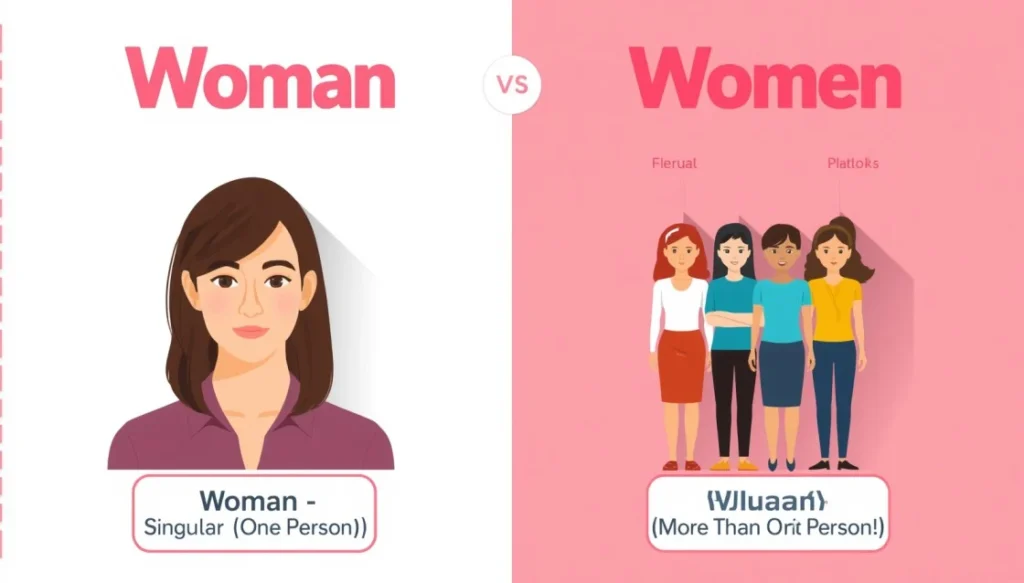
Quick Ans: The main difference between woman vs women is that woman is singular and refers to one adult female, while women is plural and refers to more than one adult female. Although the words look similar, they are used in different grammatical situations and have different pronunciations.
Many English learners struggle with woman vs women because the words are very similar in spelling. At first glance, they seem almost identical. However, their meanings and usage are different.
One word refers to a single person. The other refers to a group of people. Because only one letter changes, many writers accidentally use the wrong form.
Pronunciation creates confusion as well. While the spellings are similar, the spoken forms sound quite different. As a result, learners often make mistakes in both writing and speaking.
Understanding woman vs women is important for clear communication. Whether you are writing emails, academic papers, social media posts, or business documents, using the correct word helps your English sound professional and accurate.
This guide explains the difference in simple language. You will learn definitions, grammar rules, pronunciation tips, examples, common mistakes, exercises, and frequently asked questions.
Quick Answer: Woman vs Women
The easiest way to understand woman vs women is to remember the number of people involved.
| Word | Meaning | Number |
|---|---|---|
| Woman | One adult female | Singular |
| Women | More than one adult female | Plural |
Examples:
- The woman is a doctor.
- The women are doctors.
In short, use woman for one person and women for two or more people.
What Does Woman Mean?
The word woman is a singular noun. It refers to one adult female person.
Examples:
- The woman works at a hospital.
- A woman entered the room.
- That woman is my teacher.
Whenever you are talking about one adult female, use woman.
Pronunciation of Woman
The pronunciation is:
WUH-muhn
The first syllable sounds similar to the word “wood.”
Examples:
- Woman
- Businesswoman
- Chairwoman
Learning the pronunciation helps prevent speaking mistakes.
When to Use Woman
Use woman when:
- Referring to one adult female
- Describing a specific female person
- Talking about a single female individual
Examples:
- She is a successful woman.
- The woman owns the company.
- Every woman deserves respect.
What Does Women Mean?
The word women is the plural form of woman. It refers to two or more adult female people.
Examples:
- The women are waiting outside.
- Several women attended the meeting.
- Women play important roles in society.
Whenever multiple adult females are involved, use women.
Pronunciation of Women
The pronunciation is:
WIH-min
Notice that it sounds different from woman.
Examples:
- Women leaders
- Women athletes
- Women entrepreneurs
Because the pronunciation changes significantly, many learners find this word challenging.
When to Use Women
Use women when:
- Referring to multiple adult females
- Discussing groups of females
- Talking about female populations in general
Examples:
- Women often lead successful businesses.
- The women volunteered at the event.
- Many women enjoy outdoor activities.
Key Differences Between Woman vs Women
Number
The biggest difference between woman vs women is number.
- Woman = one person
- Women = more than one person
Grammar
Woman functions as a singular noun.
Women functions as a plural noun.
Examples:
- The woman is smiling.
- The women are smiling.
Notice how the verb changes as well.
Pronunciation
Another important difference involves pronunciation.
| Word | Pronunciation |
|---|---|
| Woman | WUH-muhn |
| Women | WIH-min |
Even native speakers occasionally hear these words incorrectly because the spellings are so similar.
Sentence Structure
Correct:
- One woman works here.
- Three women work here.
Incorrect:
- One women works here.
- Three woman work here.
Why Do People Confuse Woman and Women?
Several factors contribute to confusion.
Similar Spellings
Only one letter differs between the words. Consequently, many writers overlook the change.
Different Pronunciations
The pronunciation does not closely match the spelling change. Therefore, learners often struggle when speaking.
Fast Typing
Many mistakes occur because people type quickly and fail to proofread.
English Learning Challenges
Non native speakers may memorize the meaning but forget whether the noun should be singular or plural.
For these reasons, woman vs women remains a common grammar topic.
Advantages of Using the Correct Word
Better Grammar
Using the correct form improves sentence accuracy.
Professional Writing
Employers, teachers, and clients notice grammatical mistakes. Correct usage creates a stronger impression.
Clear Communication
Readers immediately understand whether you mean one person or multiple people.
Improved Confidence
Understanding grammar rules helps you speak and write English more confidently.
Disadvantages of Using the Wrong Word
Grammar Errors
Using the wrong form creates incorrect sentences.
Reader Confusion
The reader may not know whether you mean one female or several females.
Reduced Credibility
Repeated grammar mistakes can make writing appear less professional.
Lower Academic Scores
Students often lose marks for incorrect noun forms.
Because of these issues, mastering woman vs women is worthwhile.
Real World Examples
In the Workplace
Correct:
- The woman manages the department.
- The women manage several departments.
In News Articles
Correct:
- A woman won the award.
- Several women received awards.
In Education
Correct:
- The woman teaches mathematics.
- The women teach mathematics.
In Everyday Conversation
Correct:
- That woman lives next door.
- Those women live next door.
Real world examples help reinforce the difference.
Regional and Global Usage
American English
American English uses woman and women exactly according to singular and plural grammar rules.
British English
British English follows the same rules.
International English
Across the world, English speakers use these words in the same grammatical way.
Although accents differ, the grammar remains consistent.
Therefore, the rules for woman vs women are universal in English.
Related Concepts and Comparisons
Man vs Men
This comparison follows the same pattern.
| Singular | Plural |
|---|---|
| Man | Men |
| Woman | Women |
Examples:
- One man
- Two men
- One woman
- Two women
Girl vs Girls
Another similar comparison involves regular plural nouns.
| Singular | Plural |
|---|---|
| Girl | Girls |
| Woman | Women |
Unlike girl and girls, woman changes its spelling more significantly.
Female vs Woman
Female can function as an adjective or noun.
Examples:
- Female athlete
- Female employee
Woman specifically refers to an adult female person.
Understanding these related concepts strengthens grammar knowledge.
Common Mistakes About Woman vs Women
Using Women for One Person
Incorrect:
- The women is my teacher.
Correct:
- The woman is my teacher.
Using Woman for Multiple People
Incorrect:
- Three woman attended the meeting.
Correct:
- Three women attended the meeting.
Matching the Wrong Verb
Incorrect:
- The women is waiting.
Correct:
- The women are waiting.
Pronouncing Women Like Woman
Many learners pronounce both words the same way. However, their spoken forms differ.
Practicing pronunciation helps avoid this mistake.
Beginner to Advanced Learning Tips
Beginner Level
Remember a simple rule:
- One = woman
- More than one = women
Intermediate Level
Practice writing sentences using both forms daily.
Examples:
- The woman arrived early.
- The women arrived early.
Advanced Level
Read newspapers, books, and professional articles. Pay attention to how singular and plural nouns affect verb agreement.
Consistent practice improves accuracy over time.
Step By Step Usage Scenario
Imagine a conference event.
One female speaker arrives.
Correct sentence:
- The woman is speaking today.
Later, five female speakers arrive.
Correct sentence:
- The women are speaking today.
The number of people changes the noun form.
This simple method helps distinguish woman vs women correctly.
Exercises With Answers
Exercise 1
Choose the correct word:
The ______ is a lawyer.
Answer: Woman.
Exercise 2
Choose the correct word:
Several ______ attended the seminar.
Answer: Women.
Exercise 3
True or False:
Woman is the plural form.
Answer: False.
Exercise 4
Which sentence is correct?
A. The women is here.
B. The woman is here.
Answer: B.
Exercise 5
Which sentence is correct?
A. Three women arrived.
B. Three woman arrived.
Answer: A.
When Should You Use Woman vs Women?
Use woman when:
- Referring to one adult female
- Talking about a single person
- Using singular verbs
Use women when:
- Referring to multiple adult females
- Discussing groups
- Using plural verbs
Checking the number of people is the easiest way to choose the correct word.
FAQs About Woman vs Women
What is the difference between woman vs women?
Woman refers to one adult female, while women refers to two or more adult females.
Is woman singular or plural?
Woman is singular and refers to one person.
Is women singular or plural?
Women is plural and refers to multiple people.
How do you pronounce woman?
Woman is commonly pronounced as “WUH-muhn.”
How do you pronounce women?
Women is commonly pronounced as “WIH-min.”
Can I say one women?
No. The correct phrase is “one woman.”
Can I say three woman?
No. The correct phrase is “three women.”
Why do people confuse woman and women?
Similar spellings and different pronunciations cause confusion.
Do British and American English use these words differently?
No. Both varieties follow the same grammar rules.
What is an easy trick to remember woman vs women?
Think about the number of people. One person requires woman. More than one person requires women.
Conclusion
Understanding woman vs women is essential for correct English grammar. Although the words look very similar, they serve different purposes.
The word woman refers to one adult female. Meanwhile, women refers to two or more adult females. Number is the most important distinction between the two forms.
Pronunciation also differs. Woman sounds like “WUH-muhn,” while women sounds like “WIH-min.” Learning both the spelling and pronunciation helps improve speaking and writing accuracy.
Writers, students, professionals, and English learners benefit from mastering this rule. Correct usage improves communication, strengthens credibility, and reduces grammar mistakes.
Whenever you feel unsure, count the number of people involved. If there is one adult female, use woman. If there are multiple adult females, use women. Following this simple rule will help you use these words correctly every time.
Discover More:-
- Allergies or Cold: How to Tell the Difference and Choose the Right Treatment
- Flier or Flyer: Which Spelling Is Correct and When to Use Each

Lisa Thompson is a USA-based content writer and language specialist focused on grammar, writing improvement and digital publishing.
She holds a degree in English Language and Communication and has professional experience in educational and web content creation.
As the author of Gramtivo.Com, she aims to help readers improve their writing skills through clear and practical guidance.