
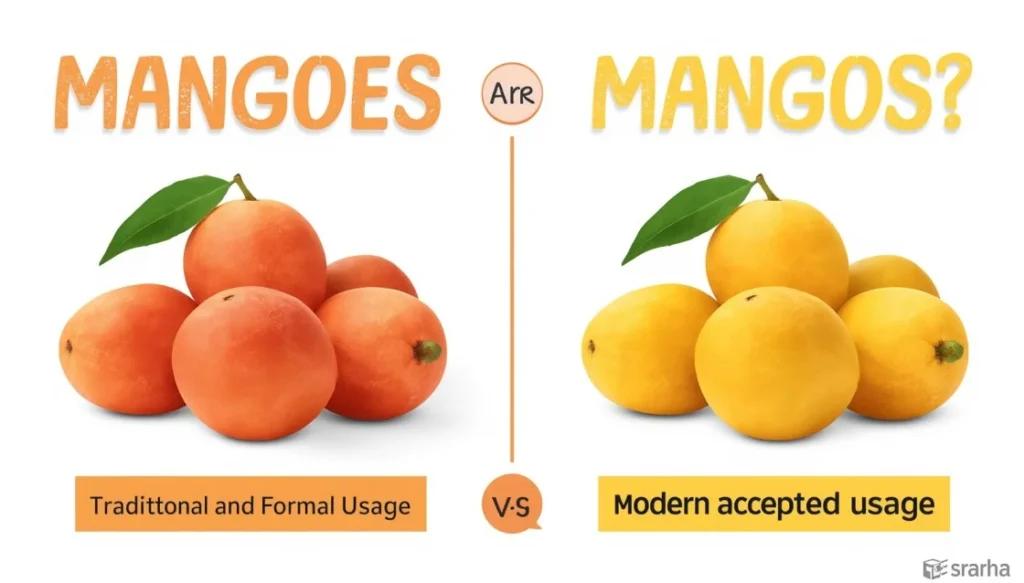
Quick Ans: Both mangoes and mangos are correct plural forms of the word mango. However, mangoes is the more traditional and widely accepted spelling in formal English, while mangos is also recognized and commonly used, especially in American English. Choosing the right form depends on style, audience, and context.
Many writers, students, and English learners wonder whether they should write mangoes or mangos. The confusion is understandable because English plural rules are not always consistent.
Some words ending in o add es to form the plural. Others simply add s. As a result, people often hesitate when writing about this popular tropical fruit.
You may have seen both spellings in books, magazines, grocery stores, and online articles. Consequently, it becomes difficult to know which version is correct.
The good news is that both forms are accepted. However, one version appears more frequently in formal writing and educational materials.
Understanding the difference between mangoes or mangos can improve your writing and help you follow the appropriate style guide. This article explains the grammar rules, usage trends, examples, common mistakes, and practical exercises so you can use the correct spelling with confidence.
Quick Answer: Mangoes or Mangos
If you need a fast answer, here it is:
| Spelling | Correct? | Common Usage |
|---|---|---|
| Mangoes | Yes | More common in formal writing |
| Mangos | Yes | More common in American English and casual writing |
In most situations, mangoes is the preferred spelling.
Nevertheless, mangos is also accepted by major dictionaries and style references.
What Does Mango Mean?
A mango is a sweet tropical fruit that grows on mango trees. It is known for its juicy flesh, bright color, and rich flavor.
Mangoes are popular around the world and are used in:
- Smoothies
- Desserts
- Salads
- Juices
- Chutneys
- Snacks
The fruit originated in South Asia and later spread to many tropical and subtropical regions.
Because mangoes are widely consumed worldwide, the plural form appears frequently in both spoken and written English.
Why Is There Confusion Between Mangoes or Mangos?
The confusion comes from English pluralization rules.
Many nouns ending in o add es when forming the plural.
Examples include:
| Singular | Plural |
|---|---|
| Tomato | Tomatoes |
| Potato | Potatoes |
| Hero | Heroes |
| Mango | Mangoes |
However, some nouns ending in o simply add s.
Examples include:
| Singular | Plural |
|---|---|
| Piano | Pianos |
| Photo | Photos |
| Radio | Radios |
| Video | Videos |
Since English contains both patterns, people naturally question whether the correct form is mangoes or mangos.
What Is the Traditional Rule?
Traditionally, words ending in o after a consonant often take es.
Under this rule:
- Mango → Mangoes
- Potato → Potatoes
- Tomato → Tomatoes
As a result, mangoes became the standard plural form in dictionaries, textbooks, and formal publications.
For many years, this spelling dominated written English.
Therefore, if you are unsure which version to use, mangoes remains the safest choice.
Why Is Mangos Also Correct?
Language evolves over time.
Many English speakers prefer simpler plural forms. Consequently, some words gradually shift toward adding only s.
The plural mangos gained acceptance because:
- It is easier to spell.
- It follows a simpler pattern.
- It became common in American usage.
- Major dictionaries recognize it.
Today, most modern dictionaries list both forms as correct.
Even so, mangoes still appears more frequently in formal writing.
Dictionary Perspectives on Mangoes or Mangos
Major dictionaries generally accept both spellings.
| Dictionary Approach | Preferred Form |
|---|---|
| Traditional English | Mangoes |
| Modern Usage | Mangoes and Mangos |
| Academic Writing | Mangoes |
| Informal Writing | Either |
Because both versions are accepted, context becomes important.
Formal audiences usually expect mangoes, while casual communication often accepts either spelling.
Usage in American and British English
American English
American English often simplifies spelling where possible.
For that reason, mangos appears more frequently in menus, advertisements, and casual writing.
However, mangoes remains common as well.
British English
British English tends to favor traditional spelling conventions.
As a result, mangoes is usually preferred.
Global English
Around the world, mangoes continues to be the dominant spelling.
Nevertheless, readers generally understand both versions without confusion.
Mangoes or Mangos in Formal Writing
When writing professionally, consistency matters.
Academic papers, business reports, educational materials, and published articles often prefer mangoes.
Examples:
- The farm exported thousands of mangoes last year.
- Mangoes are rich in vitamins and antioxidants.
- Researchers studied several varieties of mangoes.
Using mangoes in formal contexts helps align with traditional grammar expectations.
Mangoes or Mangos in Casual Writing
Casual writing offers more flexibility.
Social media posts, personal blogs, and text messages may use either form.
Examples:
- I bought some mangos today.
- These mangos taste amazing.
- Fresh mangoes are available at the market.
Since both spellings are correct, personal preference often determines the choice.
Advantages and Disadvantages
Advantages of Using Mangoes
- Traditional spelling
- Widely accepted worldwide
- Preferred in formal writing
- Common in educational materials
Disadvantages of Using Mangoes
- Slightly longer spelling
- May feel less simplified
Advantages of Using Mangos
- Shorter spelling
- Easy to type
- Common in casual American usage
Disadvantages of Using Mangos
- Less traditional
- May appear informal
- Not preferred by some editors
Therefore, understanding your audience is important when choosing between mangoes or mangos.
Real World Examples
Grocery Stores
Many grocery stores use either spelling on signs and labels.
Examples:
- Fresh Mangoes
- Organic Mangos
Customers generally recognize both forms immediately.
Food Blogs
Food bloggers often choose one spelling and use it consistently throughout the article.
Consistency matters more than the specific choice.
Academic Publications
Educational and scientific publications usually favor mangoes.
This preference reflects traditional grammar standards.
Common Mistakes About Mangoes or Mangos
Thinking One Form Is Completely Wrong
Many people assume only one spelling is correct.
In reality, both forms are accepted.
Mixing Spellings in the Same Article
Consistency is important.
Using mangoes in one paragraph and mangos in another can confuse readers.
Applying the Same Rule to Every Word Ending in O
English contains many exceptions.
For example:
- Tomato → Tomatoes
- Photo → Photos
- Piano → Pianos
Because rules vary, checking a dictionary is often helpful.
Assuming American and British English Always Agree
Different English varieties sometimes prefer different spellings.
Understanding audience expectations improves writing quality.
Related Concepts and Comparisons
Mangoes vs Tomatoes
Both typically follow the traditional es plural pattern.
Examples:
- Mango → Mangoes
- Tomato → Tomatoes
Mangos vs Photos
Both use the simplified s ending.
Examples:
- Mango → Mangos
- Photo → Photos
Mangoes or Mangos vs Other O Ending Words
| Singular | Traditional Plural |
|---|---|
| Mango | Mangoes |
| Tomato | Tomatoes |
| Potato | Potatoes |
| Hero | Heroes |
| Singular | Simplified Plural |
|---|---|
| Photo | Photos |
| Radio | Radios |
| Piano | Pianos |
| Video | Videos |
These comparisons explain why the debate over mangoes or mangos exists.
Beginner to Advanced Writing Tips
Beginner Level
Use mangoes whenever you are unsure.
This spelling works in nearly every situation.
Intermediate Level
Learn which spelling your style guide prefers.
Different organizations may have different standards.
Advanced Level
Adapt your spelling based on audience and publication requirements.
Professional editors often appreciate consistency and audience awareness.
Step By Step Decision Guide
Imagine you need to write about several mango fruits.
Ask yourself:
- Is the writing formal?
- Is it academic or professional?
- Does a style guide exist?
- Who is the audience?
If the answer points toward formal communication, choose mangoes.
If the context is casual, either spelling works.
Exercises With Answers
Exercise 1
Which spelling is traditionally preferred?
Answer: Mangoes.
Exercise 2
Is mangos considered incorrect?
Answer: No.
Exercise 3
Which spelling is more common in formal writing?
Answer: Mangoes.
Exercise 4
True or False: Both mangoes and mangos are accepted by modern dictionaries.
Answer: True.
Exercise 5
Which spelling is generally safer for academic writing?
Answer: Mangoes.
When Should You Use Mangoes or Mangos?
Use mangoes when:
- Writing academic papers
- Creating professional content
- Following traditional grammar rules
- Writing for international audiences
Use mangos when:
- Writing casually
- Following a publication style that allows it
- Maintaining consistency with existing content
Audience expectations should guide the final decision.
FAQs About Mangoes or Mangos
Which is correct: mangoes or mangos?
Both are correct plural forms of mango. However, mangoes is more common in formal writing.
Is mangos a real word?
Yes. Modern dictionaries recognize mangos as a valid plural spelling.
Why do some people write mangoes instead of mangos?
Mangoes follows the traditional English pluralization pattern for many words ending in o.
Which spelling is more common in academic writing?
Academic and professional writing usually prefers mangoes.
Do dictionaries accept both mangoes and mangos?
Yes. Most major dictionaries list both forms as correct.
Is mangoes used in British English?
Yes. British English generally favors mangoes.
Is mangos used in American English?
Yes. Mangos appears more often in casual American usage.
Should I use mangoes or mangos in SEO content?
Use the spelling that matches your audience and remain consistent throughout the content.
Are mangoes and mangos pronounced differently?
No. Both spellings share the same pronunciation.
Which spelling should students use?
Students are usually safest using mangoes unless instructed otherwise.
Conclusion
The debate over mangoes or mangos often confuses writers because both forms are correct. English pluralization rules contain many exceptions, and mango is one of the words that accepts two standard plural spellings.
Traditionally, mangoes has been the preferred form. It appears more frequently in academic writing, educational materials, and professional publications. Because of its long history and widespread acceptance, it remains the safest option for formal communication.
Meanwhile, mangos is also recognized by major dictionaries and is commonly used in casual American English. Readers generally understand either version without difficulty.
The most important rule is consistency. Choose one spelling and use it throughout your writing. For formal documents, professional content, and international audiences, mangoes is usually the better choice. For casual communication, either spelling works well.
By understanding the differences between mangoes or mangos, you can write with greater confidence and accuracy.
Discover More:-
- Theragun vs Hypervolt: Detailed Comparison, Features, and Buying Guide
- Balcony vs Patio: Differences, Uses, and Outdoor Space Guide

Jennifer Collins is a professional grammar expert and language educator at gramtivo.com, specializing in English grammar, writing skills, and language improvement. She holds a Master’s degree in English Language and Literature from a recognized university in the United States. With years of teaching and content development experience, she is dedicated to helping learners improve their communication skills with clear and practical guidance.