
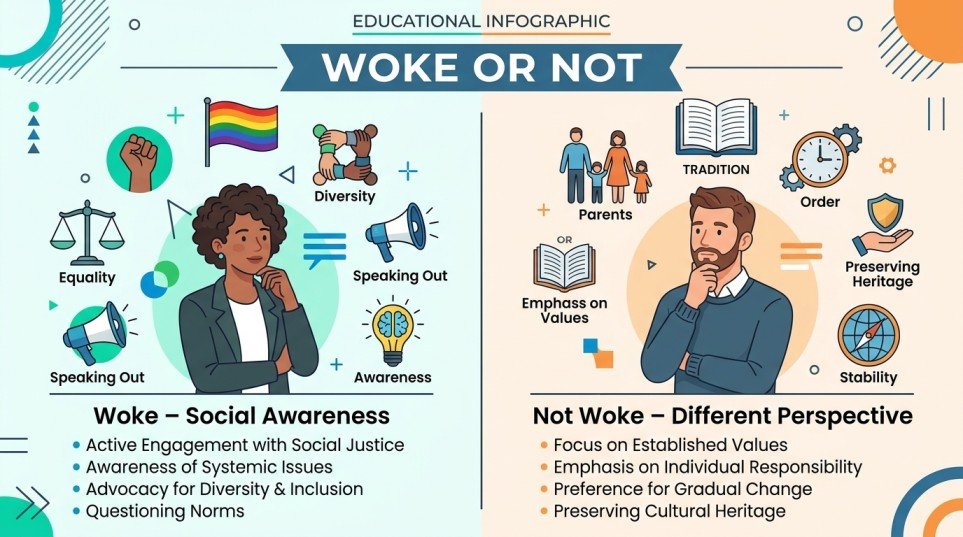
Quick Ans: The difference between woke or not depends on awareness and attitude. Being “woke” means being aware of social issues like equality and justice, while “not woke” suggests less awareness or a different viewpoint. The term is often used in modern conversations, but its meaning can change based on context.
Many people search for woke or not because the term “woke” appears often in media, social platforms, and everyday conversations. It shows up in debates about culture, politics, and society. At the same time, confusion exists because people use the word in different ways.
Originally, “woke” meant being aware of social injustice. Over time, the meaning expanded. Some people use it positively to describe awareness and empathy. Others use it negatively to criticize certain ideas or behaviors.
Because of these mixed meanings, people often wonder what woke or not truly means. One person may see it as a sign of awareness. Another may see it as an extreme viewpoint.
Understanding this topic helps you communicate better. It also helps you interpret conversations without confusion. In this guide, you will learn definitions, advantages, disadvantages, real world examples, common mistakes, and practical exercises.
Quick Answer: Woke or Not
To understand woke or not, focus on awareness and perspective.
| Feature | Woke | Not Woke |
|---|---|---|
| Awareness | High awareness of social issues | Lower or different awareness |
| Perspective | Focus on equality and justice | May focus on tradition or alternative views |
| Usage | Often positive or critical depending on context | Neutral or contrasting viewpoint |
| Context | Social and cultural discussions | Everyday or non-political views |
In simple terms, being woke means socially aware, while not woke means less focused on those issues or holding different views.
What Does “Woke” Mean?
The term “woke” originally came from African American communities. It referred to staying aware of injustice, especially related to race.
Over time, the meaning expanded. Today, “woke” can include awareness of:
- Social inequality
- Human rights
- Gender equality
- Environmental issues
- Cultural sensitivity
In modern usage, people may describe someone as “woke” if they actively support fairness and inclusion.
How the Meaning Changed
Language evolves over time. The word “woke” moved from a specific cultural context into mainstream use.
As a result:
- Some people use it as praise
- Others use it as criticism
- Media often uses it in debates
Therefore, the meaning of woke or not depends heavily on who is speaking and why.
What Does “Not Woke” Mean?
“Not woke” does not have one fixed definition. Instead, it generally refers to people who do not identify with the ideas associated with being woke.
This can include:
- Less focus on social issues
- Preference for traditional views
- Skepticism toward modern activism
- Neutral or uninterested stance
Importantly, being “not woke” does not always mean being against social progress. In many cases, it simply reflects a different perspective.
Key Differences Between Woke or Not
Awareness Level
In the woke or not comparison, awareness is the main factor. People considered “woke” tend to focus more on social and cultural issues.
Perspective
Woke perspectives often emphasize equality and inclusion. Not woke perspectives may prioritize different values such as tradition or personal responsibility.
Usage Context
The meaning changes depending on context. In some discussions, “woke” is positive. In others, it is used critically.
Emotional Tone
Conversations about woke or not can become emotional. Therefore, understanding context helps avoid misunderstandings.
Advantages and Disadvantages
Advantages of Being Woke
- Greater awareness of social issues
- Increased empathy toward others
- Encouragement of fairness and inclusion
- Active participation in social discussions
Disadvantages of Being Woke
- Can be seen as overly sensitive
- May lead to disagreements in conversations
- Sometimes misunderstood or misused
Advantages of Not Being Woke
- Simpler perspective on daily life
- Less involvement in complex debates
- Focus on personal or traditional values
Disadvantages of Not Being Woke
- May overlook important social issues
- Can appear uninformed in certain discussions
- Risk of misunderstanding modern topics
As a result, both sides of the woke or not discussion have strengths and limitations.
Real World Examples
Social Media
On social platforms, users often debate topics using the term “woke.” Some praise it, while others criticize it.
Workplace Discussions
In professional settings, awareness of social issues may influence communication and policies.
Education
Schools and universities often discuss topics related to equality, diversity, and awareness.
These examples show how woke or not appears in everyday life.
Regional and Global Usage
United States
The term “woke” is widely used in cultural and political discussions.
Global Spread
Other countries have adopted the term, especially through social media.
Cultural Differences
Different regions interpret “woke” in unique ways. Therefore, the meaning may shift depending on cultural context.
Related Concepts and Comparisons
Woke vs Awareness
Being woke is a form of awareness, but awareness can exist without using the label.
Woke vs Activism
Activism involves taking action, while being woke often refers to awareness or mindset.
Woke vs Neutral
A neutral stance avoids strong opinions, while being woke often involves clear viewpoints on social issues.
Common Mistakes About Woke or Not
Assuming One Meaning
The term “woke” has multiple meanings. Context matters greatly.
Using It Incorrectly
Some people use “woke” without understanding its origin or purpose.
Labeling Others Quickly
Assigning labels without understanding someone’s perspective can create conflict.
Ignoring Context
Meaning changes depending on the situation, audience, and tone.
Avoiding these mistakes leads to better communication.
Beginner to Advanced Understanding
Beginner Level
Learn the basic definition of “woke” as awareness of social issues.
Intermediate Level
Understand how the term is used differently in conversations.
Advanced Level
Analyze how media, culture, and politics influence the meaning of “woke.”
This progression helps build a deeper understanding of woke or not.
Step By Step Scenario
Imagine a conversation about social equality.
If someone is considered “woke”:
- They recognize social issues
- They express concern about fairness
- They support inclusive ideas
If someone is “not woke”:
- They may not focus on these issues
- They may hold different views
- They may remain neutral
Both perspectives can exist in the same discussion.
Exercises With Answers
Exercise 1
What does “woke” generally mean?
Answer: Awareness of social issues.
Exercise 2
Does “not woke” always mean being against progress?
Answer: No.
Exercise 3
Can “woke” be used positively and negatively?
Answer: Yes.
Exercise 4
Is context important in the woke or not discussion?
Answer: Yes.
Exercise 5
True or False: “Woke” has only one fixed meaning.
Answer: False.
When Should You Use Woke or Not?
Use the term carefully.
Choose “woke” when discussing awareness of social issues. Use neutral language when clarity is important. Avoid labeling people without understanding their views.
Clear communication reduces confusion in discussions about woke or not.
FAQs About Woke or Not
What does woke or not mean?
It refers to whether someone is aware of social issues or holds a different perspective.
Is being woke a good thing?
It depends on context. Some see it as positive awareness, while others view it differently.
What does not woke mean?
It usually refers to a person who is less focused on social issues or holds alternative views.
Is woke a political term?
It can be used in political discussions, but it also appears in cultural contexts.
Why do people argue about woke or not?
Different interpretations lead to disagreement.
Can someone be partially woke?
Yes. Awareness can vary depending on the issue.
Is the term woke used worldwide?
Yes, especially through global media and social platforms.
Should you use the word woke in professional settings?
Use it carefully, as meanings can vary.
Does woke always relate to politics?
No. It can relate to social and cultural awareness as well.
Can the meaning of woke change in the future?
Yes. Language evolves over time.
Conclusion
Understanding woke or not helps you navigate modern conversations with clarity. The term “woke” originally meant awareness of social injustice. Over time, its meaning expanded and became more complex.
Today, some people use it as praise for awareness and empathy. Others use it as criticism. Because of this, context plays a major role in how the term is understood.
Being “not woke” does not always mean ignorance or opposition. In many cases, it reflects a different perspective or level of interest in social topics.
Clear communication matters most. Instead of focusing on labels, understanding ideas and viewpoints leads to better discussions.
By learning the meaning of woke or not, you can interpret conversations more accurately and express your thoughts more effectively.
Discover More:-
- Hyperlipidemia vs Hypercholesterolemia: Key Differences, Causes, and Treatment Guide
- Custodian vs Janitor: Key Differences, Roles, Duties, and Career Guide

Jennifer Collins is a professional grammar expert and language educator at gramtivo.com, specializing in English grammar, writing skills, and language improvement. She holds a Master’s degree in English Language and Literature from a recognized university in the United States. With years of teaching and content development experience, she is dedicated to helping learners improve their communication skills with clear and practical guidance.

Pingback: Cerebus or Cerberus: Correct Spelling, Meaning, and Key Differences
Pingback: Gardner or Gardener: Correct Spelling, Meaning, and Usage Guide
Pingback: Upwork or Fiverr: Which Freelance Platform Is Better for You?
Pingback: Silicon or Silicone: Key Differences, Uses, and Complete Guide
Pingback: Cognisant or Cognizant: Difference, Meaning, and Correct Usage Guide