
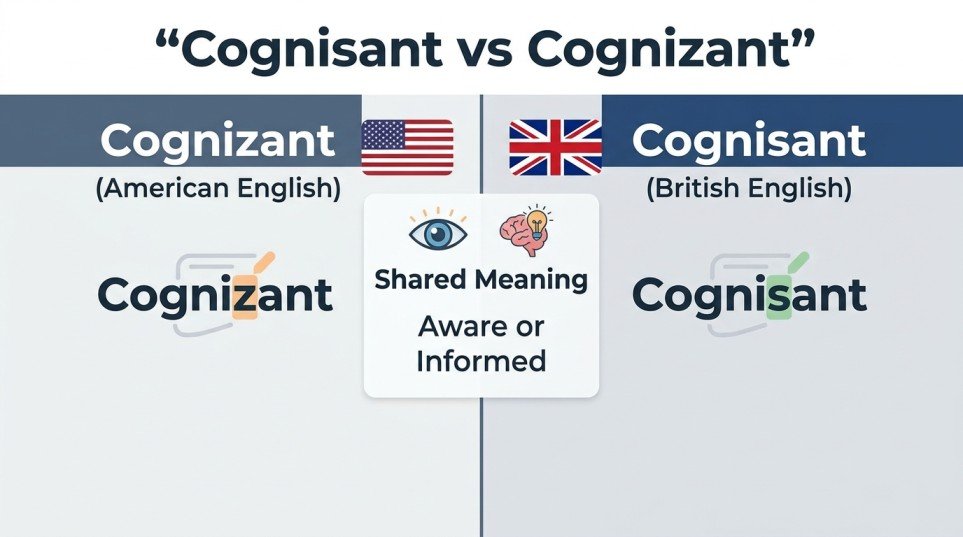
Quick Ans: The difference between cognisant or cognizant is mainly spelling and regional usage. “Cognizant” is the preferred spelling in American English, while “cognisant” is commonly used in British English. Both words have the same meaning, referring to being aware or having knowledge of something.
Many writers feel confused about cognisant or cognizant. Both words look almost the same. Both carry the same meaning.
However, the spelling changes depending on where you are.
In the United States, people use “cognizant.” In the United Kingdom and many other regions, “cognisant” appears more often. Because of this difference, writers sometimes worry about using the correct version.
The confusion grows when editing content for global audiences. Some readers expect American spelling. Others prefer British style. Choosing the wrong one can make writing feel inconsistent.
Understanding cognisant or cognizant helps improve clarity and professionalism. It also ensures your content matches your audience.
This guide explains everything in simple terms. You will learn definitions, differences, advantages, real examples, common mistakes, and exercises. By the end, you will know exactly which spelling to use.
Quick Answer: Cognisant or Cognizant
To quickly understand cognisant or cognizant, focus on spelling style.
| Feature | Cognizant | Cognisant |
|---|---|---|
| Region | American English | British English |
| Meaning | Aware or informed | Aware or informed |
| Usage | Common in US writing | Common in UK writing |
| Pronunciation | Same | Same |
In short, both words mean the same thing. The difference lies only in regional spelling.
What Does Cognizant Mean?
The word cognizant means being aware, informed, or having knowledge of something.
It is widely used in American English writing.
Example Sentences
- She is cognizant of the risks involved.
- The manager remained cognizant of customer needs.
- He became cognizant of the issue quickly.
In each case, the word shows awareness or understanding.
Usage Context
“Cognizant” appears often in:
- Business writing
- Academic papers
- Professional communication
- Legal documents
Because of its formal tone, it fits well in serious contexts.
What Does Cognisant Mean?
The word cognisant carries the same meaning as “cognizant.” It simply uses British spelling.
Writers in the UK, Australia, and other Commonwealth countries prefer this form.
Example Sentences
- She is cognisant of the risks involved.
- The team remained cognisant of safety rules.
- He became cognisant of the changes.
The meaning does not change. Only the spelling differs.
Key Differences Between Cognisant or Cognizant
Spelling Variation
The main difference in cognisant or cognizant is the letter used:
- Cognizant uses “z”
- Cognisant uses “s”
Regional Preference
American English prefers “cognizant.” British English prefers “cognisant.”
Meaning and Usage
Both words share identical meaning and usage. No difference exists in definition.
Pronunciation
Pronunciation remains the same in both versions. Therefore, the distinction is purely visual.
Advantages and Disadvantages
Cognizant Advantages
- Preferred in American English
- Common in global business writing
- Widely accepted in US publications
Cognizant Disadvantages
- May appear inconsistent in British style writing
- Not preferred in UK based publications
Cognisant Advantages
- Correct in British English
- Matches UK spelling standards
- Suitable for international audiences using British style
Cognisant Disadvantages
- Less common in American writing
- May confuse US readers if mixed with American spelling
Consistency matters more than choice when using cognisant or cognizant.
Real World Examples
Business Writing
A company based in the US uses “cognizant” in reports. Meanwhile, a UK based firm uses “cognisant.”
Academic Writing
Students follow style guides. American universities prefer “cognizant.” British institutions prefer “cognisant.”
Online Content
Websites targeting global audiences choose one style and stay consistent throughout.
These examples show how audience determines the correct spelling.
Regional and Global Usage
United States
American English strongly favors “cognizant.” It appears in most professional and academic writing.
United Kingdom
British English prefers “cognisant.” It follows standard UK spelling rules.
Other Countries
Countries like Canada and Australia may use either form. However, British spelling often dominates.
Therefore, understanding your audience is key when choosing between cognisant or cognizant.
Related Concepts and Comparisons
Cognizant vs Aware
“Cognizant” is more formal. “Aware” is simpler and used in everyday language.
Conscious vs Cognisant
“Cognisant” focuses on knowledge or awareness. “Conscious” often relates to being awake or mentally alert.
Knowledgeable vs Cognisant or Cognizant
“Knowledgeable” implies deeper understanding. “Cognisant” or “cognizant” simply indicates awareness.
These comparisons help clarify subtle differences in meaning.
Common Mistakes About Cognisant or Cognizant
Mixing Both Spellings
Some writers use both forms in the same document. This creates inconsistency.
Choosing the Wrong Style
Using American spelling in British content may look unprofessional, and vice versa.
Overusing Formal Language
“Cognizant” can sound too formal in casual writing. Simpler words may work better.
Incorrect Assumptions
Some people think the words have different meanings. In reality, they are identical in meaning.
Avoiding these mistakes improves writing quality.
Beginner to Advanced Writing Tips
Beginner Level
Choose one spelling style. Stick to it throughout your content.
Intermediate Level
Match spelling with your target audience. Use American English for US readers and British English for UK readers.
Advanced Level
Follow style guides such as:
- APA for American English
- Oxford style for British English
Consistency across all content strengthens professionalism.
Step By Step Usage Scenario
Imagine writing an article.
If your audience is American:
- Choose “cognizant”
- Apply American spelling rules
- Maintain consistency
If your audience is British:
- Choose “cognisant”
- Follow British spelling
- Keep usage consistent
Although the meaning stays the same, spelling should match the audience.
Exercises With Answers
Exercise 1
Which spelling is used in American English in the cognisant or cognizant comparison?
Answer: Cognizant.
Exercise 2
Which spelling is common in British English?
Answer: Cognisant.
Exercise 3
Do both words have the same meaning?
Answer: Yes.
Exercise 4
Should you mix both spellings in one document?
Answer: No.
Exercise 5
True or False: Cognisant and cognizant have different meanings.
Answer: False.
When Should You Choose Cognisant or Cognizant?
Choose “cognizant” if you:
- Write for American audiences
- Follow US style guides
- Create business or academic content in the US
Choose “cognisant” if you:
- Write for British audiences
- Follow UK spelling rules
- Target international readers using British English
Your audience determines the correct choice.
FAQs About Cognisant or Cognizant
What is the difference between cognisant or cognizant?
The difference is spelling. “Cognizant” is American English, while “cognisant” is British English.
Do cognisant and cognizant mean the same thing?
Yes. Both words mean being aware or informed.
Which spelling should I use in the US?
Use “cognizant” for American English writing.
Is cognisant incorrect?
No. It is correct in British English.
Can I use both spellings together?
No. Choose one style and remain consistent.
Which is more common globally?
Both are common, but usage depends on region and audience.
Is cognizant more formal than aware?
Yes. “Cognizant” sounds more formal.
Do search engines treat both spellings the same?
Yes. Search engines understand both versions.
Which spelling is better for SEO?
Use the spelling that matches your target audience.
Can I replace cognisant or cognizant with aware?
Yes. In casual writing, “aware” is often clearer.
Conclusion
Understanding cognisant or cognizant is simple once you know the key difference. Both words share the same meaning. Both describe awareness or knowledge. However, spelling changes based on regional usage.
American English prefers “cognizant.” British English uses “cognisant.” Choosing the correct version depends on your audience and writing style.
Consistency remains the most important factor. Mixing both spellings in one piece can confuse readers and reduce professionalism. Therefore, always follow a single style throughout your content.
For business, academic, and SEO writing, aligning language with your audience improves clarity and trust. Writers who understand these small differences produce more polished work.
Now that you know the difference between cognisant or cognizant, you can confidently use the correct spelling in any context.
Discover More:-
- Veneers or Crowns: Differences, Benefits, and Which One to Choose
- Woke or Not: Meaning, Difference, and Real Wolf Usage Explained

Robert Mitchell is a U.S.-based writer at Gramtivo.Com who focuses on grammar, writing improvement, and language-related content. He holds a degree in English and Linguistics from a U.S. university. His work aims to help readers enhance their writing skills with clear and practical guidance.


Pingback: Cumming or Cuming: Correct Spelling, Meaning, and Usage Explained