
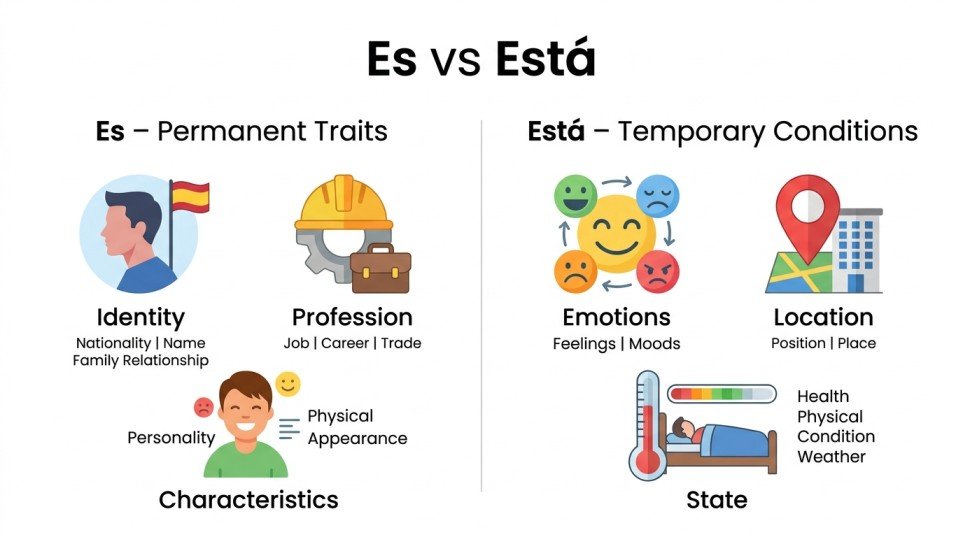
Quick Ans: The key difference between es vs está lies in permanence and condition. “Es” comes from the verb ser and describes permanent traits or identity, while “está” comes from estar and describes temporary states, conditions, or locations. Choosing the correct form depends on whether something is lasting or changing.
Many Spanish learners struggle with es vs está because both words mean “is” in English. At first glance, they seem interchangeable. However, they follow different grammar rules and express different meanings.
Spanish uses two verbs for “to be”: ser and estar. This creates confusion for beginners. English only uses one form, so learners often guess incorrectly when speaking or writing Spanish.
For example, saying “She is happy” could use either form depending on the situation. If happiness is temporary, one verb is correct. If it is part of her personality, another verb fits better.
Understanding es vs está helps you speak more naturally and avoid common mistakes. It also improves your writing and listening skills.
In this guide, you will learn clear definitions, rules, examples, comparisons, exercises, and practical tips. By the end, you will confidently know when to use each form.
Quick Answer: Es vs Está
To quickly understand es vs está, remember this:
| Word | Verb | Meaning | Use |
|---|---|---|---|
| Es | Ser | Is | Permanent traits or identity |
| Está | Estar | Is | Temporary states or location |
In simple terms, es is for what something is, while está is for how or where something is.
What Is “Es”?
“Es” is the third person singular form of the verb ser. It means “is” and describes permanent or lasting characteristics.
When to Use “Es”
Use es for:
- Identity
- Profession
- Origin
- Time and dates
- General descriptions
Examples of “Es”
- Ella es doctora. (She is a doctor.)
- El cielo es azul. (The sky is blue.)
- Hoy es lunes. (Today is Monday.)
- Él es mi amigo. (He is my friend.)
These examples show stable or long lasting qualities.
Key Idea
Use es when the information is unlikely to change quickly.
What Is “Está”?
“Está” is the third person singular form of the verb estar. It also means “is,” but it describes temporary conditions or locations.
When to Use “Está”
Use está for:
- Temporary feelings
- Physical conditions
- Location
- Ongoing actions
Examples of “Está”
- Ella está cansada. (She is tired.)
- El café está caliente. (The coffee is hot.)
- Él está en casa. (He is at home.)
- La puerta está abierta. (The door is open.)
These examples describe conditions that can change.
Key Idea
Use está when the situation is temporary or dependent on context.
Key Differences Between Es vs Está
Permanence vs Condition
The biggest difference in es vs está is permanence.
- “Es” describes permanent traits.
- “Está” describes temporary states.
Identity vs State
“Es” explains what something is.
“Está” explains how something is.
Location
“Está” is used for location.
“Es” is not used for location.
Quick Comparison
| Aspect | Es | Está |
|---|---|---|
| Meaning | Is | Is |
| Verb | Ser | Estar |
| Use | Permanent traits | Temporary states |
| Location | No | Yes |
Understanding these differences helps avoid confusion.
Advantages and Disadvantages
Using “Es” Correctly
Advantages:
- Clear description of identity
- Useful for general facts
- Helps express permanent traits
Disadvantages:
- Incorrect use can sound unnatural
- Cannot describe temporary feelings
Using “Está” Correctly
Advantages:
- Accurate for emotions and conditions
- Essential for location
- Helps describe change
Disadvantages:
- Overuse can confuse meaning
- Not suitable for permanent traits
Therefore, choosing between es vs está depends on context.
Real World Examples
For Describing a Person
- Él es alto. (He is tall.) → Permanent trait
- Él está cansado. (He is tired.) → Temporary condition
Describing Food
- La comida es deliciosa. (The food is delicious.) → General opinion
- La comida está fría. (The food is cold.) → Current condition
Describing Location
- El libro está en la mesa. (The book is on the table.)
Notice that location always uses está.
Regional and Global Usage
Spanish speakers around the world follow the same rules for es vs está. However, informal usage may vary slightly.
In Latin America, speakers may use estar more frequently for emphasis. In Spain, both forms follow standard grammar rules.
Despite regional differences, the core distinction remains consistent.
Related Concepts and Comparisons
Ser vs Estar
“Es” and “está” are part of a larger concept: ser vs estar.
- Ser describes identity
- Estar describes condition
Es vs Está vs Fue
- Es = present permanent
- Está = present temporary
- Fue = past (was)
Comparison Table
| Word | Meaning | Use |
|---|---|---|
| Es | Is | Permanent |
| Está | Is | Temporary |
| Fue | Was | Past |
These related forms help build deeper understanding.
Common Mistakes About Es vs Está
Using “Es” for Location
Incorrect: El libro es en la mesa.
Correct: El libro está en la mesa.
Using “Está” for Identity
Incorrect: Ella está doctora.
Correct: Ella es doctora.
Mixing Permanent and Temporary Traits
Incorrect: Él está alto.
Correct: Él es alto.
Forgetting Context
Choosing the wrong form changes meaning. Therefore, always think about permanence.
Beginner to Advanced Tips
Beginner Level
Focus on basic rules:
- Es = permanent
- Está = temporary
Intermediate Level
Learn exceptions and practice real sentences.
Advanced Level
Understand subtle meaning changes:
- Es aburrido (He is boring)
- Está aburrido (He is bored)
These differences improve fluency.
Step By Step Usage Scenario
Imagine describing a person.
If you describe identity:
- Think about permanent trait
- Use ser
- Choose “es”
If you describe condition:
- Think about temporary state
- Use estar
- Choose “está”
Following this process ensures correct usage.
Exercises With Answers
Exercise 1
Choose the correct word: Ella ___ feliz (temporary).
Answer: Está.
Exercise 2
Choose the correct word: Él ___ profesor.
Answer: Es.
Exercise 3
Choose the correct word: El gato ___ en la casa.
Answer: Está.
Exercise 4
True or False: “Es” is used for location.
Answer: False.
Exercise 5
Choose the correct word: La mesa ___ grande.
Answer: Es.
When Should You Use Es vs Está?
Use es when:
- Describing identity
- Talking about permanent traits
- Giving general facts
Use está when:
- Describing feelings
- Talking about location
- Explaining temporary conditions
Understanding context makes the choice easier.
FAQs About Es vs Está
What is the difference between es vs está?
“Es” describes permanent traits, while “está” describes temporary conditions or location.
Can es and está be used interchangeably?
No. In the es vs está comparison, each word serves a different purpose.
Which one is used for location?
“Está” is always used for location.
Is es used for emotions?
No. Emotions are temporary, so “está” is correct.
Why does Spanish have two words for “is”?
Spanish separates permanent identity from temporary condition, unlike English.
Is “es” always permanent?
Mostly yes, but context can influence meaning.
Can “está” describe people?
Yes, when describing temporary states like mood or health.
What is an easy rule for es vs está?
Use “es” for what something is, and “está” for how or where it is.
Does this rule apply in all Spanish speaking countries?
Yes, the rule is consistent worldwide.
How can I practice es vs está?
Practice sentences daily and focus on context and meaning.
Conclusion
Understanding es vs está is essential for learning Spanish correctly. Both words mean “is,” but they serve different purposes. “Es” describes permanent traits such as identity, profession, or general characteristics. In contrast, “está” describes temporary conditions, emotions, or location.
This distinction may feel confusing at first. However, with practice, the difference becomes natural. Always think about whether the situation is permanent or temporary before choosing a verb.
Using the correct form improves clarity and helps you sound more fluent. It also prevents misunderstandings in conversation.
For beginners, start with simple rules and examples. Intermediate learners should focus on context. Advanced learners can explore subtle meaning differences.
By mastering es vs está, you build a strong foundation in Spanish grammar. This skill will support your speaking, writing, and comprehension in real world situations.
Discover More:-
- Custodian vs Janitor: Key Differences, Roles, Duties, and Career Guide
- Hyperlipidemia vs Hypercholesterolemia: Key Differences, Causes, and Treatment Guide

Lisa Thompson is a USA-based content writer and language specialist focused on grammar, writing improvement and digital publishing.
She holds a degree in English Language and Communication and has professional experience in educational and web content creation.
As the author of Gramtivo.Com, she aims to help readers improve their writing skills through clear and practical guidance.