
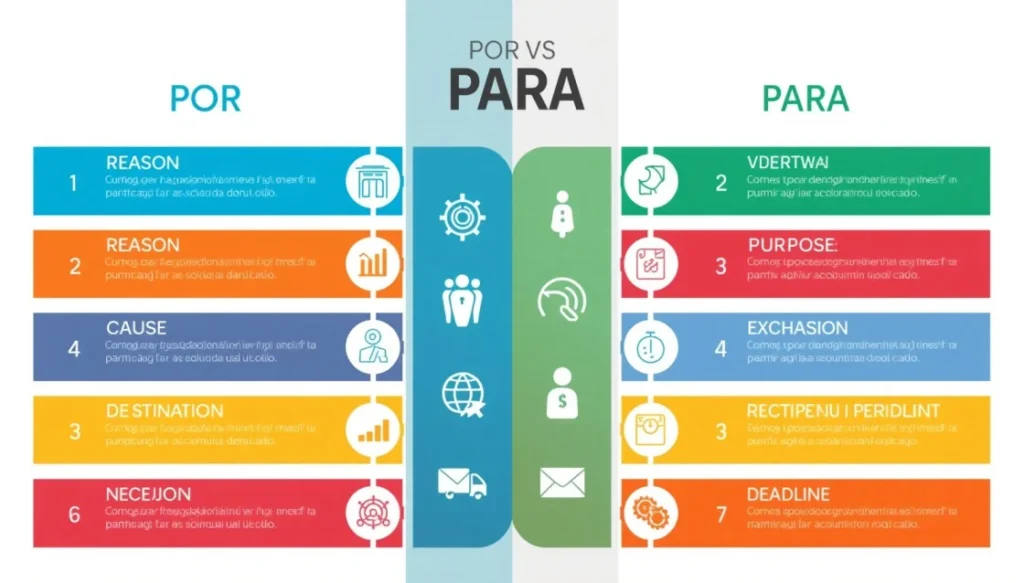
Quick Ans: The main difference between por vs para is purpose and direction. Por usually expresses cause, reason, exchange, duration, or movement through something, while para typically expresses purpose, destination, deadline, or intended recipient. Although both translate to “for” in English, they are used in very different situations in Spanish.
Many Spanish learners struggle with por vs para. Both words often translate to “for” in English. As a result, it can be difficult to know which one to use.
The confusion becomes even greater because there is no single English rule that always works. Sometimes por means “for.” In other cases, para also means “for.” Therefore, translating word by word often leads to mistakes.
Fortunately, understanding the difference is easier than many people think. Instead of memorizing hundreds of examples, learners can focus on the purpose of each preposition.
Think of it this way. Por often explains why something happens or how something happens. Meanwhile, para usually explains the goal, destination, or intended purpose of something.
This guide will explain por vs para in simple language. You will learn definitions, rules, examples, common mistakes, exercises, and practical tips that can help you use both words with confidence.
Quick Answer: Por vs Para
A simple way to remember por vs para is this:
- Use por for reasons, causes, exchanges, duration, and movement.
- Use para for goals, destinations, deadlines, and intended recipients.
Quick Comparison Table
| Usage | Por | Para |
|---|---|---|
| Reason or cause | Yes | No |
| Purpose or goal | No | Yes |
| Destination | No | Yes |
| Exchange | Yes | No |
| Duration of time | Yes | No |
| Deadline | No | Yes |
| Means of communication | Yes | No |
| Recipient | No | Yes |
In short, por looks backward to the reason, while para looks forward to the goal.
What Does Por Mean?
The Spanish preposition por has several meanings. Most commonly, it explains a reason, cause, method, exchange, or movement.
Common Uses of Por
You can use por to express:
- Cause
- Reason
- Duration
- Exchange
- Means of communication
- Movement through a place
Por for Cause or Reason
When explaining why something happened, use por.
Examples:
- Estudio español por mi trabajo.
- I study Spanish because of my job.
- Cancelaron el vuelo por la lluvia.
- They canceled the flight because of the rain.
In these examples, por introduces the reason.
Por for Duration
Use por when talking about a period of time.
Examples:
- Viví allí por cinco años.
- I lived there for five years.
- Trabajó por dos horas.
- He worked for two hours.
Por for Exchange
Use por when one thing is exchanged for another.
Examples:
- Compré el libro por diez dólares.
- I bought the book for ten dollars.
- Cambié mi coche por una motocicleta.
- I exchanged my car for a motorcycle.
Por for Communication
Use por with methods of communication.
Examples:
- Hablamos por teléfono.
- Envié el documento por correo electrónico.
Por for Movement
Use por to describe movement through or around a place.
Examples:
- Caminamos por el parque.
- Pasamos por la ciudad.
What Does Para Mean?
The Spanish preposition para focuses on goals, destinations, purposes, and intended recipients.
Common Uses of Para
You can use para to express:
- Purpose
- Goal
- Destination
- Deadline
- Recipient
- Intended use
Para for Purpose
When explaining the purpose of an action, use para.
Examples:
- Estudio español para viajar.
- I study Spanish to travel.
- Trabajo para ganar dinero.
- I work to earn money.
The action points toward a goal.
Para for Destination
Use para when showing where someone or something is going.
Examples:
- Salimos para Madrid mañana.
- Este tren va para Barcelona.
Para for Deadlines
Use para when indicating a due date.
Examples:
- La tarea es para el lunes.
- Necesito el informe para mañana.
Para for Recipients
Use para to identify who receives something.
Examples:
- Este regalo es para Ana.
- Compré flores para mi madre.
Key Differences Between Por vs Para
Reason vs Purpose
This is the most important distinction.
Por = Why?
Example:
- Lo hice por amor.
- I did it because of love.
Para = What for?
Example:
- Lo hice para ayudarte.
- I did it to help you.
Duration vs Deadline
Por expresses how long something lasts.
Example:
- Estudié por tres horas.
Para expresses when something is due.
Example:
- Necesito terminarlo para mañana.
Movement vs Destination
Por indicates movement through a location.
Example:
- Caminamos por el bosque.
Para indicates the final destination.
Example:
- Salimos para México.
Advantages and Disadvantages of Learning Por and Para Separately
Advantages
- Easier understanding of Spanish grammar
- Better speaking accuracy
- More natural writing
- Improved listening comprehension
Disadvantages
- Requires practice and repetition
- English translations can be misleading
- Some expressions must be memorized
However, mastering por vs para dramatically improves Spanish fluency.
Comparison Table of Common Expressions
| Expression | Correct Word |
|---|---|
| For two hours | Por |
| For tomorrow | Para |
| Because of rain | Por |
| For my friend | Para |
| Through the city | Por |
| To travel | Para |
| By email | Por |
| Intended for children | Para |
This table helps learners identify common situations quickly.
Real World Examples
At Work
Imagine you are writing an email.
- Envié el documento por correo electrónico.
- Este informe es para el gerente.
The first sentence uses a communication method. The second identifies the recipient.
While Traveling
Consider a travel situation.
- Caminamos por el centro histórico.
- Salimos para Sevilla mañana.
The first describes movement through a place. The second indicates a destination.
At School
Students often use both words.
- Estudié por tres horas.
- Necesito terminar el proyecto para viernes.
One refers to duration. The other refers to a deadline.
Regional and Global Usage
Spain
Spanish speakers in Spain use por and para according to the same grammatical rules taught worldwide.
Latin America
Across Latin America, the distinction remains largely the same. Some expressions may vary regionally, but the core meanings do not change.
Spanish Learning Programs
Most language courses teach por vs para as one of the most important grammar topics. Consequently, learners encounter these prepositions early in their studies.
Related Concepts and Comparisons
Por vs Para vs English “For”
English uses “for” in many situations.
Spanish divides those situations between por and para.
For example:
| English Sentence | Spanish |
|---|---|
| This gift is for Maria | Para María |
| I waited for two hours | Por dos horas |
| I bought it for ten dollars | Por diez dólares |
| I study for my future | Para mi futuro |
This difference explains why English speakers often make mistakes.
Por vs Para vs A
Another common confusion involves the preposition a.
- Voy a Madrid.
- Salimos para Madrid mañana.
Although both may indicate direction, they are not always interchangeable.
Common Mistakes About Por vs Para
Using Por for Goals
Incorrect:
- Estudio español por viajar.
Correct:
- Estudio español para viajar.
The sentence expresses purpose, not cause.
Using Para for Reasons
Incorrect:
- Cancelaron el vuelo para la tormenta.
Correct:
- Cancelaron el vuelo por la tormenta.
The storm is the reason.
Confusing Duration and Deadlines
Incorrect:
- Trabajé para tres horas.
Correct:
- Trabajé por tres horas.
Duration requires por.
Translating Directly From English
Many learners translate word for word. Unfortunately, that approach often causes errors.
Instead, focus on meaning and context.
Beginner to Advanced Learning Tips
Beginner Level
Start by memorizing one basic rule:
- Por = reason
- Para = purpose
Intermediate Level
Learn common expressions and practice with real sentences.
Examples:
- Por favor
- Por supuesto
- Para mí
- Para siempre
Advanced Level
Study subtle differences in native conversations. Additionally, read Spanish books and listen to podcasts.
Over time, choosing between por vs para becomes automatic.
Step By Step Decision Method
When deciding between por and para, ask yourself these questions.
Step 1
Is it a reason or cause?
If yes, use por.
Step 2
Is it a goal or purpose?
If yes, use para.
Step 3
Is it duration?
Use por.
Step 4
Is it a deadline or recipient?
Use para.
Following this process helps reduce mistakes.
Exercises With Answers
Exercise 1
Choose the correct word:
Estudio español ___ viajar.
Answer: Para
Exercise 2
Choose the correct word:
Cancelaron el partido ___ la lluvia.
Answer: Por
Exercise 3
Choose the correct word:
Este regalo es ___ mi hermano.
Answer: Para
Exercise 4
Choose the correct word:
Viví allí ___ cinco años.
Answer: Por
Exercise 5
Choose the correct word:
Necesito el proyecto ___ mañana.
Answer: Para
When Should You Use Por vs Para?
Use por when discussing:
- Reasons
- Causes
- Duration
- Exchange
- Communication methods
- Movement through places
Use para when discussing:
- Goals
- Purpose
- Deadlines
- Recipients
- Destinations
- Intended use
Remembering these categories makes the choice much easier.
FAQs About Por vs Para
What is the main difference between por vs para?
The main difference is that por usually expresses reason or cause, while para expresses purpose or destination.
Do por and para both mean “for”?
Yes. However, they are used in different situations and cannot always replace each other.
When should I use por in Spanish?
Use por for reasons, duration, exchange, communication methods, and movement through places.
When should I use para in Spanish?
Use para for goals, deadlines, recipients, destinations, and intended purposes.
Is por vs para difficult to learn?
Many beginners find it challenging at first. Nevertheless, consistent practice makes it much easier.
How can I remember por vs para?
Think of por as explaining why something happens and para as explaining the goal or destination.
Can por and para be interchangeable?
In most situations, no. Changing one for the other often changes the meaning completely.
Does para always mean purpose?
Not always. It can also indicate recipients, destinations, and deadlines.
Does por always mean because of?
No. It can also indicate duration, exchange, movement, and communication methods.
Why do English speakers struggle with por vs para?
English often uses one word, “for,” where Spanish uses two different prepositions.
Conclusion
Understanding por vs para is one of the most important steps in learning Spanish. Although both words frequently translate to “for,” they serve different grammatical functions.
Generally, por explains reasons, causes, duration, exchange, and movement. Meanwhile, para focuses on goals, purposes, recipients, destinations, and deadlines.
The easiest way to remember the difference is to think about direction. Por often looks back at the reason something happens. In contrast, para points toward the intended result or destination.
Regular practice is essential. Reading Spanish, listening to native speakers, and completing exercises will strengthen your understanding. Over time, choosing between por and para will feel natural.
Once you master por vs para, your Spanish will sound more accurate, fluent, and confident.
Discover More:-
- Allergies or Cold: How to Tell the Difference and Choose the Right Treatment
- Flier or Flyer: Which Spelling Is Correct and When to Use Each

Lisa Thompson is a USA-based content writer and language specialist focused on grammar, writing improvement and digital publishing.
She holds a degree in English Language and Communication and has professional experience in educational and web content creation.
As the author of Gramtivo.Com, she aims to help readers improve their writing skills through clear and practical guidance.