
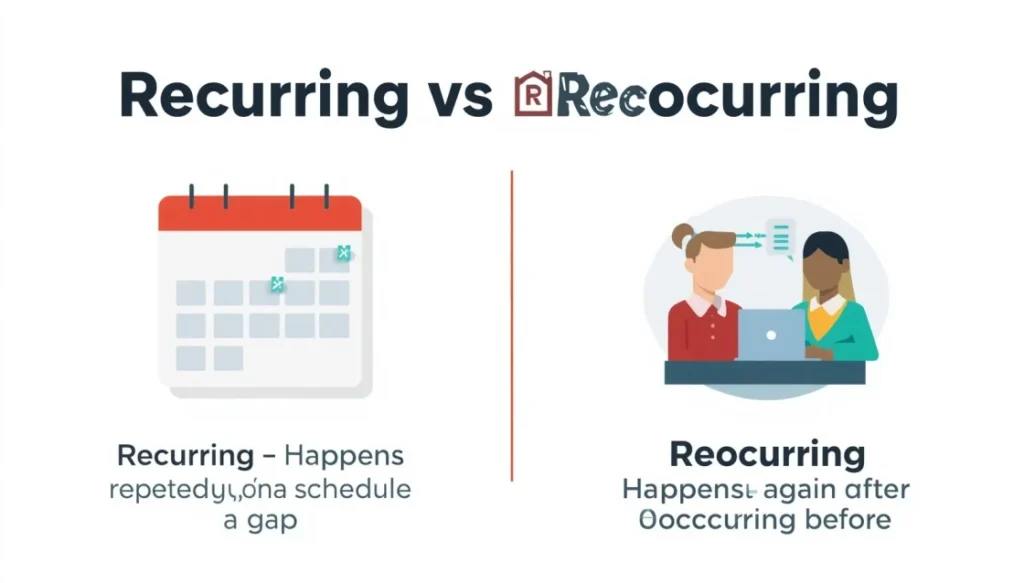
Quick Ans: The difference between recurring or reoccurring is subtle but important. Recurring refers to something that happens repeatedly at regular intervals, while reoccurring means something happens again after occurring once before. In most business, writing, and everyday situations, recurring is the preferred and more commonly used word.
Many writers, students, and professionals struggle with the choice between recurring or reoccurring. At first glance, the two words seem identical. Both involve events happening more than once. Both appear in dictionaries.
However, they are not always interchangeable.
The confusion often arises because the words share a similar meaning. As a result, people frequently use one when the other would be more accurate. This can create uncertainty in business communication, academic writing, and everyday conversations.
For example, should you say a recurring meeting or a reoccurring meeting? Is a recurring payment the same as a reoccurring payment? These questions are common because the distinction is not immediately obvious.
Fortunately, the difference is easier to understand than many people think. Once you learn the meanings and usage patterns, choosing the correct word becomes simple.
This guide explains recurring or reoccurring in detail. You will learn definitions, examples, advantages and disadvantages of each term, common mistakes, exercises, and practical usage tips.
Quick Answer: Recurring or Reoccurring
If you need a quick answer, use this rule:
| Word | Meaning | Common Usage |
|---|---|---|
| Recurring | Happening repeatedly, often on a regular schedule | Very common |
| Reoccurring | Happening again after occurring before | Less common |
In most situations:
- Use recurring for scheduled or repeated events.
- Use reoccurring when emphasizing that something occurs again.
Therefore, a recurring payment, recurring meeting, or recurring subscription sounds more natural than using reoccurring.
What Does Recurring Mean?
The word recurring describes something that happens repeatedly over time.
The repetition may occur:
- Daily
- Weekly
- Monthly
- Yearly
- At regular intervals
A recurring event often follows a predictable pattern.
Examples of Recurring
Consider these examples:
- A recurring monthly bill
- A recurring calendar reminder
- A recurring software subscription
- A recurring staff meeting
- A recurring dream
Each example involves something that repeats multiple times.
Why Recurring Is So Common
Businesses frequently use the word recurring because many processes happen on schedules.
Examples include:
- Recurring payments
- Recurring invoices
- Recurring memberships
- Recurring appointments
Consequently, recurring has become the preferred term in professional communication.
What Does Reoccurring Mean?
The word reoccurring means happening again after a previous occurrence.
Unlike recurring, reoccurring does not necessarily suggest a regular schedule.
Instead, it simply indicates repetition.
Examples of Reoccurring
Examples include:
- A reoccurring problem
- A reoccurring error message
- A reoccurring illness symptom
- A reoccurring weather pattern
In these situations, the event appears again, but not necessarily according to a predictable schedule.
Understanding the Prefix “Re”
The prefix re means “again.”
Because of this, reoccurring literally means “occurring again.”
As a result, many people use it when emphasizing a repeated appearance rather than an ongoing pattern.
Key Differences Between Recurring or Reoccurring
Frequency
Recurring often implies repeated frequency.
Reoccurring simply means happening again.
Scheduling
Recurring events are commonly scheduled.
Reoccurring events may happen unexpectedly.
Business Usage
Businesses overwhelmingly prefer recurring.
Reoccurring appears less frequently in professional writing.
Reader Expectations
When readers see recurring, they expect regular repetition.
When readers see reoccurring, they simply understand that something happened again.
Comparison Table: Recurring or Reoccurring
| Feature | Recurring | Reoccurring |
|---|---|---|
| Repeats Over Time | Yes | Yes |
| Implies Schedule | Usually | Not necessarily |
| Business Usage | Very common | Rare |
| Everyday Usage | Common | Less common |
| Preferred in Professional Writing | Yes | Usually no |
Because of these differences, recurring is the safer choice in most contexts.
Advantages and Disadvantages
Advantages of Using Recurring
- Widely accepted
- Common in business writing
- Easy for readers to understand
- Preferred in professional communication
Disadvantages of Using Recurring
- May not emphasize “happening again” as strongly
- Sometimes less precise in special contexts
Advantages of Using Reoccurring
- Highlights repetition after a previous event
- Can provide extra emphasis
Disadvantages of Using Reoccurring
- Less common
- Can sound awkward
- Often replaced by recurring
Therefore, recurring remains the preferred option in most writing situations.
Real World Examples
Business Example
A company charges customers every month.
Correct phrase:
- Recurring payment
Less common phrase:
- Reoccurring payment
Most businesses choose recurring because payments follow a schedule.
Healthcare Example
A patient experiences symptoms repeatedly.
Possible phrase:
- Reoccurring symptoms
This works because symptoms may return unpredictably.
Education Example
A school conducts a meeting every Friday.
Correct phrase:
- Recurring meeting
The event follows a regular pattern.
Technology Example
A software bug appears repeatedly.
Possible phrase:
- Reoccurring bug
The issue returns but may not follow a schedule.
Regional and Global Usage
United States
American English strongly favors recurring in business and professional settings.
United Kingdom
British English also commonly uses recurring.
International Business
Across global industries, recurring appears more frequently in contracts, software platforms, and financial documents.
Therefore, international communication generally prefers recurring over reoccurring.
Related Concepts and Comparisons
Recurring vs Repeating
Both words involve repetition.
However, recurring often suggests intervals or cycles.
Repeating simply means happening again.
Recurring vs Continuous
Recurring means something happens multiple times.
Continuous means something never stops.
Reoccurring vs Returning
Returning implies coming back.
Reoccurring emphasizes happening again.
Understanding these related terms helps clarify the difference between recurring or reoccurring.
Common Mistakes About Recurring or Reoccurring
Using Reoccurring for Scheduled Events
Many people write:
- Reoccurring payment
- Reoccurring subscription
In most cases, recurring is the better choice.
Assuming the Words Are Identical
Although the meanings overlap, subtle differences exist.
Recurring often implies regular repetition.
Reoccurring focuses on happening again.
Overusing Reoccurring
Because recurring is more familiar, excessive use of reoccurring can sound unnatural.
Ignoring Context
Word choice should match the situation.
Scheduled events usually require recurring.
Unexpected returns may fit reoccurring better.
Beginner to Advanced Usage Tips
Beginner Level
When uncertain, choose recurring.
It works correctly in most situations.
Intermediate Level
Look for schedules or patterns.
If a regular interval exists, use recurring.
Advanced Level
Consider the nuance.
Use reoccurring when you specifically want to emphasize that an event happened again after a previous occurrence.
This approach creates greater precision in writing.
Step By Step Usage Scenario
Imagine you need to describe an event.
First, ask whether the event follows a schedule.
If yes:
- Use recurring.
Examples:
- Recurring meeting
- Recurring charge
- Recurring subscription
If no:
- Consider reoccurring.
Examples:
- Reoccurring problem
- Reoccurring symptom
- Reoccurring error
This simple method helps you choose the correct word.
Exercises With Answers
Exercise 1
Which word is usually preferred for monthly billing?
Answer: Recurring.
Exercise 2
Which word emphasizes that something happened again?
Answer: Reoccurring.
Exercise 3
Choose the better phrase:
Monthly recurring payment or monthly reoccurring payment?
Answer: Monthly recurring payment.
Exercise 4
A software bug keeps appearing unexpectedly. Which word may fit?
Answer: Reoccurring.
Exercise 5
True or False: Recurring is more common in professional writing.
Answer: True.
When Should You Use Recurring or Reoccurring?
Use recurring when:
- The event follows a schedule
- The repetition is regular
- You are writing professionally
- You are discussing subscriptions or payments
Use reoccurring when:
- Something happens again unexpectedly
- You want to emphasize repetition
- The event lacks a regular schedule
Following these guidelines improves clarity and accuracy.
FAQs About Recurring or Reoccurring
What is the difference between recurring or reoccurring?
Recurring means happening repeatedly, often on a schedule. Reoccurring means happening again after occurring before.
Which is more common, recurring or reoccurring?
Recurring is far more common in business, academic, and everyday writing.
Should I say recurring payment or reoccurring payment?
Recurring payment is the preferred and widely accepted phrase.
Is reoccurring grammatically correct?
Yes. Reoccurring is a correct English word, although it is less commonly used.
Why do businesses prefer recurring?
Businesses often discuss scheduled activities such as recurring subscriptions, recurring invoices, and recurring charges.
Can recurring and reoccurring be interchangeable?
Sometimes. However, recurring is usually the safer choice.
What is a recurring meeting?
A recurring meeting is a meeting scheduled to happen repeatedly at regular intervals.
What is a reoccurring problem?
A reoccurring problem is an issue that appears again after previously occurring.
Which word should I use in professional writing?
In most professional situations, recurring is the recommended option.
Is recurring used in software and finance?
Yes. Terms such as recurring revenue, recurring billing, and recurring subscriptions are extremely common.
Conclusion
Understanding recurring or reoccurring can improve both writing accuracy and communication clarity. Although the words share similar meanings, they are not always used the same way.
Recurring refers to something that happens repeatedly, often according to a schedule. Reoccurring, by contrast, emphasizes that something happens again after occurring before. This distinction may seem small, but it matters in professional and academic contexts.
For most situations, recurring is the preferred choice. Businesses use it for subscriptions, invoices, meetings, and payments because it clearly communicates ongoing repetition. Reoccurring remains useful when discussing events, problems, or conditions that return unexpectedly.
When deciding between recurring or reoccurring, consider whether the event follows a predictable pattern. If it does, recurring is usually correct. If the focus is simply on something happening again, reoccurring may work better.
By applying these guidelines, you can write with greater confidence and choose the right word every time.
Discover More:-
- Allergies or Cold: How to Tell the Difference and Choose the Right Treatment
- Flier or Flyer: Which Spelling Is Correct and When to Use Each

Lisa Thompson is a USA-based content writer and language specialist focused on grammar, writing improvement and digital publishing.
She holds a degree in English Language and Communication and has professional experience in educational and web content creation.
As the author of Gramtivo.Com, she aims to help readers improve their writing skills through clear and practical guidance.