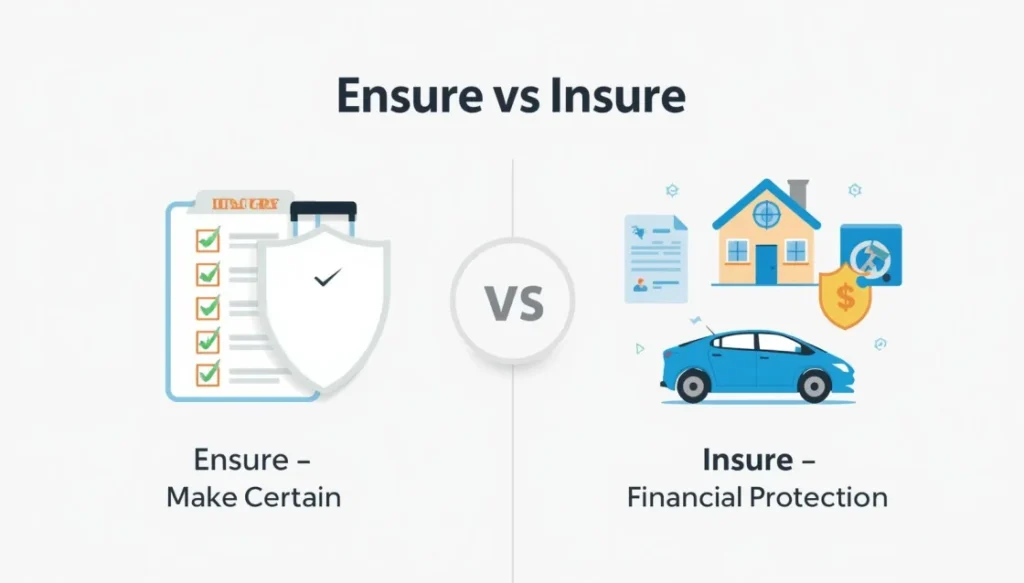
Quick Ans: The difference between ensure or insure is simple but important. Ensure means to make certain that something happens, while insure means to provide or obtain financial protection through insurance. Although the words sound similar, they are used in different situations and should not be confused in professional writing.
Many English learners and even native speakers struggle with ensure or insure. The words sound almost identical. Their meanings also seem related because both involve protection or certainty.
However, they are not interchangeable.
Using the wrong word can change the meaning of a sentence. For example, if you write “I insured the project is completed on time,” the sentence becomes incorrect because insured refers to insurance coverage. In that situation, ensured is the proper choice.
Writers often encounter this confusion in business emails, academic papers, legal documents, and everyday conversations. Therefore, understanding the difference is important for clear communication.
Fortunately, the distinction is easy once you learn the basic rule. One word relates to making something certain. The other relates to insurance and financial protection.
This guide explains ensure or insure in detail. You will learn definitions, examples, common mistakes, usage tips, comparisons, exercises, and frequently asked questions.
Quick Answer: Ensure or Insure
The easiest way to remember ensure or insure is this:
| Word | Meaning | Example |
|---|---|---|
| Ensure | Make certain or guarantee | Please ensure the door is locked. |
| Insure | Provide insurance coverage | I insured my car last year. |
In short:
- Ensure = Make sure
- Insure = Protect with insurance
Whenever you mean “make certain,” use ensure. Whenever you mean “cover financially against risk,” use insure.
What Does Ensure Mean?
The word ensure means to make certain that something happens. It is used when someone wants to guarantee a result or confirm that a condition is met.
Common Uses of Ensure
You can use ensure in situations involving:
- Instructions
- Procedures
- Planning
- Safety
- Quality control
- Business communication
Examples of Ensure
Consider these examples:
- Please ensure all windows are closed.
- The manager ensured the project stayed on schedule.
- We must ensure customer satisfaction.
- Regular maintenance helps ensure safety.
In each example, the goal is to make something certain.
How Ensure Works
Think of ensure as another way of saying:
- Make sure
- Guarantee
- Confirm
- Secure
For example:
“Please ensure the report is submitted.”
This sentence could also mean:
“Please make sure the report is submitted.”
Because the meanings match, ensure is correct.
What Does Insure Mean?
The word insure refers to providing financial protection through an insurance policy.
People insure valuable assets against loss, damage, theft, or accidents.
Common Uses of Insure
The word insure is commonly used for:
- Cars
- Homes
- Businesses
- Health coverage
- Travel protection
- Property coverage
Examples of Insure
Here are some examples:
- I insure my home against fire damage.
- The company insured its equipment.
- You should insure your vehicle.
- Many travelers insure expensive belongings.
Unlike ensure, these examples involve actual insurance policies.
How Insure Works
Think of insure as protection against financial risk.
For example:
“I insured my car.”
This means an insurance company provides coverage if certain losses occur.
Key Differences Between Ensure or Insure
Meaning
The primary difference between ensure or insure is meaning.
Ensure means making something certain.
Insure means providing insurance coverage.
Usage
Ensure is used in instructions, procedures, and guarantees.
Insure is used in finance, property, and insurance situations.
Context
Business reports often use ensure.
Insurance documents often use insure.
Example Comparison
| Sentence | Correct Word |
|---|---|
| Please _____ everyone receives training. | Ensure |
| We need to _____ the building. | Insure |
| The system helps _____ accuracy. | Ensure |
| They decided to _____ their property. | Insure |
Understanding context makes the choice much easier.
Advantages and Disadvantages of Using Ensure and Insure Correctly
Advantages of Using Ensure Correctly
- Improves clarity
- Strengthens professional writing
- Prevents misunderstandings
- Creates precise instructions
Disadvantages of Misusing Ensure
- Confuses readers
- Weakens credibility
- Changes sentence meaning
Advantages of Using Insure Correctly
- Communicates financial protection accurately
- Improves legal and business writing
- Avoids costly misunderstandings
Disadvantages of Misusing Insure
- Creates ambiguity
- May cause confusion in contracts
- Can appear unprofessional
Therefore, choosing correctly between ensure or insure improves communication quality.
Real World Examples
Business Communication
A manager might write:
“Please ensure all employees complete training.”
The goal is certainty, not insurance.
Insurance Industry
An agent might say:
“You should insure your vehicle.”
Here, financial protection is the focus.
School Environment
Teachers often write:
“Ensure students understand the instructions.”
No insurance coverage is involved.
Homeownership
A homeowner may decide to insure a house against storm damage.
The word refers to an insurance policy.
These examples show how context determines the correct choice.
Regional and Global Usage
American English
In American English, both ensure and insure are commonly used according to their specific meanings.
British English
British English follows the same distinction. However, some publications occasionally use insure when referring to making something certain.
Modern Writing Standards
Most style guides recommend:
- Use ensure for certainty.
- Use insure for insurance coverage.
As a result, this distinction remains the preferred approach in professional writing worldwide.
Related Concepts and Comparisons
Ensure vs Assure
Many writers confuse these words.
- Ensure = Make certain
- Assure = Reassure a person
Example:
- I assured her everything was fine.
- I ensured the report was accurate.
Insure vs Assure
Insure relates to insurance coverage.
Assure relates to giving confidence.
Example:
- The company insured the building.
- The manager assured employees about job security.
Ensure vs Insure vs Assure
| Word | Meaning | Typical Use |
|---|---|---|
| Ensure | Make certain | Processes and outcomes |
| Insure | Provide insurance | Financial protection |
| Assure | Reassure someone | Communication with people |
Learning all three words helps improve grammar accuracy.
Common Mistakes About Ensure or Insure
Using Insure Instead of Ensure
Incorrect:
- Please insure the doors are locked.
Correct:
- Please ensure the doors are locked.
The sentence refers to certainty, not insurance.
Using Ensure for Insurance Coverage
Incorrect:
- I ensured my car last month.
Correct:
- I insured my car last month.
The sentence involves insurance protection.
Assuming the Words Are Interchangeable
Although the words sound similar, they have different meanings.
Professional writing requires choosing the correct term.
Ignoring Context
Context determines which word works best.
Always ask yourself:
“Am I making something certain or protecting it with insurance?”
The answer reveals the correct word.
Beginner to Advanced Usage Tips
Beginner Level
Remember this simple rule:
- Ensure = Make sure
- Insure = Insurance
Intermediate Level
Check whether money, risk, or coverage is involved.
If financial protection exists, use insure.
Advanced Level
Study style guides and professional publications.
Most editors prefer maintaining a clear distinction between the two words.
This approach improves accuracy and readability.
Step By Step Decision Process
Imagine you need to choose between ensure or insure.
Follow these steps:
- Read the sentence carefully.
- Identify the intended meaning.
- Ask whether insurance coverage is involved.
- If yes, use insure.
- If no, use ensure.
Example:
“Please _____ all employees arrive on time.”
No insurance exists here.
Therefore, the correct answer is ensure.
Exercises With Answers
Exercise 1
Choose the correct word:
Please _____ all documents are signed.
Answer: Ensure.
Exercise 2
Choose the correct word:
We need to _____ the office building.
Answer: Insure.
Exercise 3
Choose the correct word:
The manager worked hard to _____ quality.
Answer: Ensure.
Exercise 4
Choose the correct word:
They decided to _____ their new car.
Answer: Insure.
Exercise 5
True or False: Ensure and insure always mean the same thing.
Answer: False.
When Should You Use Ensure or Insure?
Use ensure when you want to:
- Make something certain
- Guarantee a result
- Confirm a condition
- Improve accuracy
Use insure when you want to:
- Protect property
- Obtain insurance coverage
- Manage financial risk
- Cover potential losses
Understanding the purpose of the sentence makes the choice straightforward.
FAQs About Ensure or Insure
What is the difference between ensure or insure?
Ensure means to make something certain, while insure means to provide insurance protection against financial loss.
Can ensure and insure be used interchangeably?
No. Modern writing standards recommend using ensure for certainty and insure for insurance coverage.
When should I use ensure?
Use ensure when you mean make sure, guarantee, or confirm an outcome.
When should I use insure?
Use insure when discussing insurance policies, coverage, or financial protection.
Is it correct to say “ensure my car”?
No. Cars are covered by insurance policies, so “insure my car” is correct.
What is an easy way to remember ensure or insure?
Think of the word insurance. If insurance is involved, use insure. Otherwise, use ensure.
Do professional writers distinguish between ensure and insure?
Yes. Most editors and style guides recommend keeping the meanings separate.
Is ensure used in business writing?
Yes. Business documents frequently use ensure when discussing procedures, compliance, and quality control.
Can insure mean make certain?
Historically it sometimes did. However, modern usage strongly favors ensure for that meaning.
Which word appears more often in instructions?
Ensure appears much more frequently because instructions focus on making something happen correctly.
Conclusion
Understanding ensure or insure is essential for accurate English writing. Although the words sound similar, they serve different purposes.
Ensure means making something certain. It is commonly used in instructions, procedures, planning, and professional communication. Insure refers to insurance coverage and financial protection against risk.
The easiest way to remember the difference is to connect insure with insurance. Whenever financial coverage is involved, choose insure. For all other situations involving certainty or guarantees, choose ensure.
Writers, students, business professionals, and English learners benefit from mastering this distinction. Correct usage improves clarity, credibility, and professionalism.
Before choosing between ensure or insure, simply ask yourself one question: “Am I guaranteeing an outcome or protecting against financial loss?” The answer will almost always point you to the correct word.
Discover More:-
- Allergies or Cold: How to Tell the Difference and Choose the Right Treatment
- Flier or Flyer: Which Spelling Is Correct and When to Use Each

Robert Mitchell is a U.S.-based writer at Gramtivo.Com who focuses on grammar, writing improvement, and language-related content. He holds a degree in English and Linguistics from a U.S. university. His work aims to help readers enhance their writing skills with clear and practical guidance.