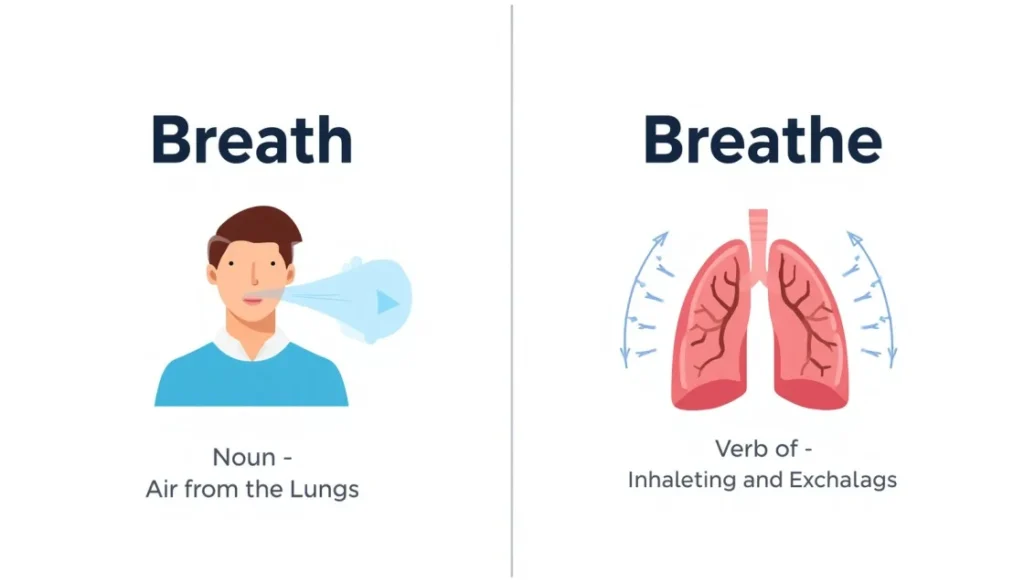
Quick Ans: The difference between breath or breathe is simple but important. Breath is a noun that refers to the air you take in and out of your lungs, while breathe is a verb that means the action of inhaling and exhaling air. Understanding this distinction helps improve both writing and speaking accuracy.
Many English learners and native speakers confuse breath or breathe. The words look very similar. Their meanings are closely related. However, they have different grammatical functions.
This confusion often appears in emails, essays, social media posts, and professional writing. Someone might write “take a deep breathe” when the correct phrase is “take a deep breath.” Another person may write “I need to breath” when the correct form is “I need to breathe.”
Although the spelling difference is only one letter, using the wrong word can make writing appear less polished. Fortunately, the distinction is easy to learn.
The key is remembering that one word names a thing and the other describes an action. Once you understand this rule, choosing between breath or breathe becomes much easier.
In this guide, you will learn definitions, grammar rules, pronunciation differences, examples, common mistakes, exercises, and practical tips. By the end, you will know exactly when to use each word.
Quick Answer: Breath or Breathe
The easiest way to remember breath or breathe is to identify whether you need a noun or a verb.
| Word | Part of Speech | Meaning | Example |
|---|---|---|---|
| Breath | Noun | Air taken into or out of the lungs | Take a deep breath. |
| Breathe | Verb | To inhale and exhale air | Please breathe slowly. |
In short:
- Breath = a thing (noun)
- Breathe = an action (verb)
What Does Breath Mean?
The word breath is a noun. It refers to the air that moves in and out of your lungs.
You cannot use breath as an action word. Instead, it names something.
Common Meanings of Breath
Breath may refer to:
- A single inhalation or exhalation
- The ability to breathe
- A brief pause
- Air coming from the lungs
Examples of Breath in Sentences
Consider these examples:
- Take a deep breath before speaking.
- She held her breath underwater.
- After running, he was out of breath.
- The cold air took my breath away.
Each sentence uses breath as a thing rather than an action.
Why Breath Is a Noun
Think of breath as something you can count or describe.
For example:
- One breath
- Two breaths
- A deep breath
- A quick breath
Because you can describe it, the word functions as a noun.
What Does Breathe Mean?
The word breathe is a verb. It describes the action of taking air into the lungs and releasing it.
Whenever someone performs this action, breathe is the correct choice.
Common Meanings of Breathe
Breathe can mean:
- To inhale and exhale air
- To live and function normally
- To relax and calm down
- To allow air circulation
Examples of Breathe in Sentences
Look at these examples:
- Remember to breathe deeply.
- He could barely breathe after the race.
- The doctor asked her to breathe slowly.
- Plants help us breathe cleaner air.
In every example, breathe describes an action.
Why Breathe Is a Verb
Verbs show actions.
Examples include:
- Run
- Walk
- Talk
- Breathe
Since breathing is something you do, breathe is always a verb.
Key Differences Between Breath or Breathe
Grammar Function
The biggest difference between breath or breathe is grammar.
- Breath is a noun.
- Breathe is a verb.
Meaning
Breath refers to the air itself.
Breathe refers to the action involving that air.
Sentence Position
Breath often appears after articles and adjectives.
Examples:
- A breath
- The breath
- Deep breath
Breathe commonly follows subjects.
Examples:
- I breathe
- They breathe
- We breathe
Spelling
The only spelling difference is the letter e at the end.
- Breath
- Breathe
Although the change seems small, it completely changes the word’s role.
Pronunciation Differences
Many people confuse breath or breathe because the spellings look almost identical. However, the pronunciation differs.
| Word | Pronunciation |
|---|---|
| Breath | BRETH |
| Breathe | BREETHE |
Breath Pronunciation
The ending sounds similar to:
- Death
- Health
- Wealth
Breathe Pronunciation
The ending sounds similar to:
- Seethe
- Teethe
- Wreathe
Listening carefully helps you recognize the difference during conversations.
Advantages of Understanding Breath or Breathe
Learning the difference provides several benefits.
Better Writing
Correct grammar makes writing more professional.
Improved Communication
Readers understand your message more clearly.
Higher Academic Accuracy
Students often lose marks for grammar mistakes. Using the correct word helps avoid those errors.
Stronger Professional Image
Employers and clients notice polished communication. Therefore, proper word choice matters.
Real World Examples
Workplace Email
Incorrect:
I need to catch my breathe before the meeting.
Correct:
I need to catch my breath before the meeting.
Medical Context
Incorrect:
The patient could not breath normally.
Correct:
The patient could not breathe normally.
Fitness Training
A coach may say:
Take a deep breath.
Then the coach might add:
Now breathe slowly through your nose.
Notice how both words appear together but serve different purposes.
Regional and Global Usage
American English
American English uses both breath and breathe according to standard grammar rules.
British English
British English follows exactly the same distinction.
International English
English learners around the world often struggle with these words because many languages do not have separate noun and verb forms.
Despite regional differences in vocabulary, the rules for breath or breathe remain consistent worldwide.
Related Concepts and Comparisons
Breath vs Air
Air exists in the atmosphere.
Breath refers specifically to air moving into or out of the lungs.
Breathe vs Respire
Respire is a scientific term.
Breathe is the everyday English word.
Breath vs Breathing
Breath is a noun.
Breathing can function as a noun or gerund describing the activity.
Breath or Breathe vs Inhale
Inhale means taking air in.
Breathe includes both inhaling and exhaling.
Common Mistakes About Breath or Breathe
Using Breath as a Verb
Incorrect:
I cannot breath properly.
Correct:
I cannot breathe properly.
Using Breathe as a Noun
Incorrect:
Take a deep breathe.
Correct:
Take a deep breath.
Ignoring Context
Many writers focus only on spelling.
Instead, ask yourself whether the sentence needs a noun or a verb.
Forgetting Pronunciation Clues
The extra “e” in breathe changes the sound and function.
Remembering this pattern reduces mistakes.
Beginner to Advanced Learning Tips
Beginner Level
Memorize this rule:
- Breath = noun
- Breathe = verb
Intermediate Level
Practice writing sentences using both words together.
Example:
Take a deep breath and breathe slowly.
Advanced Level
Review professional writing and identify how each word is used in context.
This exercise strengthens long term retention.
Step By Step Usage Scenario
Imagine someone feels nervous before a presentation.
First, they take a deep breath.
Next, they breathe slowly.
Afterward, they take another breath.
Then they continue to breathe calmly.
This example shows how the noun and verb work together naturally.
Exercises With Answers
Exercise 1
Which word is a noun?
Answer: Breath.
Exercise 2
Which word is a verb?
Answer: Breathe.
Exercise 3
Fill in the blank:
Take a deep ______ before speaking.
Answer: Breath.
Exercise 4
Fill in the blank:
Please ______ slowly.
Answer: Breathe.
Exercise 5
True or False: Breath and breathe have the same grammatical function.
Answer: False.
When Should You Use Breath or Breathe?
Use breath when referring to air or a single inhalation and exhalation.
Examples:
- Catch your breath.
- Hold your breath.
- Take a deep breath.
Use breathe when describing the action.
Examples:
- Breathe slowly.
- I can breathe better now.
- She learned how to breathe properly during yoga.
Determining whether you need a noun or a verb will guide you to the correct choice.
FAQs About Breath or Breathe
What is the difference between breath or breathe?
Breath is a noun referring to air from the lungs, while breathe is a verb meaning to inhale and exhale.
Is it take a deep breath or take a deep breathe?
The correct phrase is “take a deep breath” because breath is the noun.
How do I remember breath or breathe?
Remember that breathe has an extra “e” and represents an action, making it the verb.
Can breath be used as a verb?
No. Breath functions only as a noun in standard English.
Can breathe be used as a noun?
No. Breathe is a verb and describes an action.
Why do people confuse breath or breathe?
The spellings are nearly identical, which makes them easy to mix up.
Is breathe present tense?
Yes. Breathe is the present tense verb form.
What does out of breath mean?
It means someone is breathing heavily or struggling to catch their breath after physical activity.
Do British and American English use breath or breathe differently?
No. Both varieties follow the same grammar rules.
Can breath and breathe appear in the same sentence?
Yes. Example: Take a deep breath and breathe slowly.
Conclusion
Understanding breath or breathe is essential for clear and accurate English communication. Although the words look similar, they serve completely different grammatical purposes.
Breath is a noun that refers to air moving in and out of the lungs. Breathe is a verb that describes the action of inhaling and exhaling. Recognizing this distinction helps improve writing, speaking, and grammar accuracy.
Whenever you are unsure which word to use, identify whether the sentence requires a thing or an action. If you need a noun, choose breath. If you need a verb, choose breathe.
Practice using both words in everyday sentences. Over time, the difference will become natural. With consistent usage, you can avoid one of the most common English grammar mistakes and communicate with greater confidence.
Discover More:-
- Allergies or Cold: How to Tell the Difference and Choose the Right Treatment
- Flier or Flyer: Which Spelling Is Correct and When to Use Each

Jennifer Collins is a professional grammar expert and language educator at gramtivo.com, specializing in English grammar, writing skills, and language improvement. She holds a Master’s degree in English Language and Literature from a recognized university in the United States. With years of teaching and content development experience, she is dedicated to helping learners improve their communication skills with clear and practical guidance.