
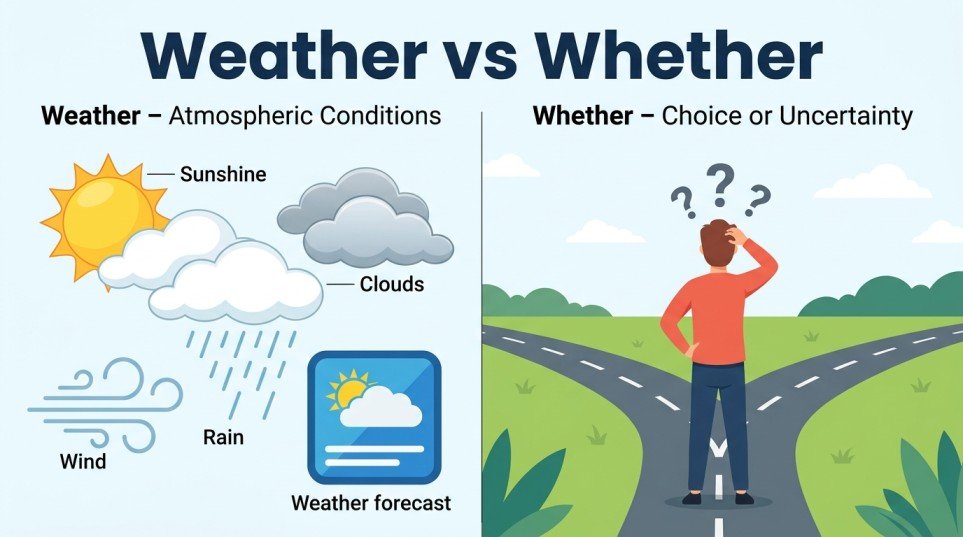
Quick Ans: The difference between weather or whether is simple: weather refers to atmospheric conditions such as rain, sunshine, wind, or temperature, while whether is a conjunction used to express a choice, possibility, or uncertainty. Although the words sound the same, they have completely different meanings and grammatical functions.
Many English learners struggle with weather or whether because the two words sound exactly alike. They are homophones, which means they share the same pronunciation but have different meanings and spellings.
This confusion is common among students, professionals, and even native English speakers. For example, someone might write, “I don’t know weather I should go,” when the correct word is actually “whether.”
The challenge becomes even greater because both words appear frequently in everyday conversations and writing. One belongs to discussions about climate and atmospheric conditions. The other helps introduce choices, alternatives, and uncertain situations.
Fortunately, learning the difference is not difficult. Once you understand the purpose of each word, choosing the correct spelling becomes much easier.
In this guide, you will learn everything about weather or whether, including definitions, examples, common mistakes, practical exercises, grammar tips, and real world usage scenarios. By the end, you will be able to use both words confidently and accurately.
Quick Answer: Weather or Whether
The easiest way to understand weather or whether is to remember their meanings.
| Word | Meaning | Part of Speech | Example |
|---|---|---|---|
| Weather | Atmospheric conditions | Noun or verb | The weather is sunny today. |
| Whether | Expresses choice or uncertainty | Conjunction | I don’t know whether to stay or leave. |
In short:
- Weather = climate, rain, sun, wind, temperature
- Whether = if, choice, uncertainty, alternatives
What Does Weather Mean?
Weather refers to the condition of the atmosphere at a particular time and place.
It describes things such as:
- Rain
- Sunshine
- Wind
- Clouds
- Temperature
- Humidity
- Storms
When people discuss forecasts, seasons, or climate conditions, they use the word weather.
Weather as a Noun
Most commonly, weather functions as a noun.
Examples:
- The weather is beautiful today.
- Cold weather arrived early this year.
- We canceled the picnic because of bad weather.
- The weather forecast predicts heavy rain.
In each sentence, weather refers to atmospheric conditions.
Weather as a Verb
Less commonly, weather can function as a verb.
Examples:
- The boat weathered the storm.
- The building weathered years of harsh conditions.
- She weathered the crisis successfully.
Here, weather means to endure or survive difficult conditions.
What Does Whether Mean?
Whether is a conjunction that introduces alternatives, choices, possibilities, or uncertainty.
It often appears when someone is deciding between options.
Examples:
- I don’t know whether to go.
- She asked whether the meeting was canceled.
- We are deciding whether to buy the house.
Unlike weather, whether has nothing to do with climate or atmospheric conditions.
Whether and Choices
Whether frequently introduces two possibilities.
Examples:
- I can’t decide whether to study or rest.
- They discussed whether to expand the business.
- He wondered whether the plan would work.
Each example presents uncertainty or alternatives.
Whether and Indirect Questions
Whether often introduces indirect questions.
Examples:
- Tell me whether you agree.
- She asked whether he was available.
- We need to know whether the project is approved.
In these situations, whether helps connect the question to the sentence.
Key Differences Between Weather or Whether
Meaning
The biggest difference between weather or whether is meaning.
Weather relates to atmospheric conditions. Whether relates to choices or uncertainty.
Grammar Function
Weather usually functions as a noun.
Whether functions as a conjunction.
Usage
Weather appears in discussions about climate and forecasts.
Whether appears in discussions about decisions and possibilities.
Example Comparison
| Incorrect | Correct |
|---|---|
| I don’t know weather to leave. | I don’t know whether to leave. |
| The whether is sunny today. | The weather is sunny today. |
Therefore, understanding context helps you choose the correct word.
Advantages and Disadvantages of Learning the Difference
Advantages
Learning the difference between weather or whether helps you:
- Improve writing accuracy
- Avoid embarrassing mistakes
- Strengthen grammar skills
- Communicate more clearly
- Perform better on exams
Disadvantages of Confusing Them
Using the wrong word can:
- Create confusion
- Reduce credibility
- Cause grammatical errors
- Affect professional writing
Because these words sound identical, many writers make mistakes without noticing.
Real World Examples
Workplace Communication
Incorrect:
“I am not sure weather the report is complete.”
Correct:
“I am not sure whether the report is complete.”
Travel Planning
Incorrect:
“Check the whether before traveling.”
Correct:
“Check the weather before traveling.”
Academic Writing
Incorrect:
“The researcher examined weather participants understood the instructions.”
Correct:
“The researcher examined whether participants understood the instructions.”
These examples demonstrate how context determines the correct choice.
Regional and Global Usage
American English
Both weather and whether follow the same rules in American English.
British English
British English also uses the words identically.
International English Learning
Students around the world frequently confuse these terms because pronunciation does not reveal spelling differences.
As a result, weather or whether remains one of the most common homophone challenges in English.
Related Concepts and Comparisons
Weather vs Climate
People often confuse weather and climate.
Weather refers to short term atmospheric conditions.
Climate refers to long term weather patterns.
Example:
- Today’s weather is rainy.
- The climate of the region is tropical.
Whether vs If
Whether and if sometimes overlap.
Examples:
- I don’t know whether he is coming.
- I don’t know if he is coming.
However, whether is often preferred when presenting alternatives.
Example:
- I don’t know whether to stay or leave.
Using “if” in this sentence sounds less natural.
Weather vs Whether vs Climate
| Word | Meaning |
|---|---|
| Weather | Daily atmospheric conditions |
| Whether | Choice or uncertainty |
| Climate | Long term weather patterns |
Understanding these related terms improves vocabulary accuracy.
Common Mistakes About Weather or Whether
Using Weather for Uncertainty
Incorrect:
- I don’t know weather she will come.
Correct:
- I don’t know whether she will come.
Using Whether for Climate
Incorrect:
- The whether is cold today.
Correct:
- The weather is cold today.
Relying Only on Pronunciation
Since both words sound identical, pronunciation cannot help determine spelling.
Instead, focus on meaning.
Ignoring Context
Many errors occur because writers choose words based on sound rather than sentence purpose.
Always ask yourself:
“Am I talking about climate or uncertainty?”
The answer usually reveals the correct spelling.
Beginner to Advanced Usage Tips
Beginner Level
Remember a simple rule:
- Weather = atmosphere
- Whether = choice
Intermediate Level
Look for alternative options.
Example:
- Whether to buy or rent
The presence of alternatives often signals whether.
Advanced Level
Analyze grammatical function.
If the word introduces a clause expressing uncertainty, whether is usually correct.
If it refers to environmental conditions, weather is correct.
This approach works in almost every situation.
Step By Step Memory Trick
Use this simple method whenever you encounter weather or whether.
Step 1
Ask whether the sentence discusses rain, temperature, or climate.
If yes, choose weather.
Step 2
Ask whether the sentence involves uncertainty or alternatives.
If yes, choose whether.
Step 3
Read the sentence again.
If it sounds logical and matches the meaning, your choice is likely correct.
Exercises With Answers
Exercise 1
Choose the correct word:
“The _____ forecast predicts snow.”
Answer: Weather
Exercise 2
Choose the correct word:
“I don’t know _____ she will attend.”
Answer: Whether
Exercise 3
Choose the correct word:
“The bad _____ delayed our flight.”
Answer: Weather
Exercise 4
Choose the correct word:
“They discussed _____ to move abroad.”
Answer: Whether
Exercise 5
True or False:
Weather and whether have the same meaning.
Answer: False
When Should You Use Weather or Whether?
Use weather when discussing:
- Rain
- Wind
- Snow
- Sunshine
- Forecasts
- Temperature
Use whether when discussing:
- Decisions
- Alternatives
- Possibilities
- Uncertainty
- Indirect questions
Understanding the topic of the sentence makes the choice straightforward.
FAQs About Weather or Whether
What is the difference between weather or whether?
Weather refers to atmospheric conditions, while whether introduces choices, alternatives, or uncertainty.
Is weather or whether used for rain and temperature?
Weather is the correct word when discussing rain, temperature, storms, or climate conditions.
Can whether mean the same as if?
Sometimes. Whether and if can both express uncertainty, although whether is often preferred when alternatives are involved.
Why do people confuse weather or whether?
The words are homophones, meaning they sound the same but have different meanings and spellings.
How can I remember weather or whether?
Associate weather with climate and whether with choices or uncertainty.
Can weather be a verb?
Yes. Weather can mean to survive or endure difficult conditions.
Is whether a noun?
No. Whether functions as a conjunction.
Which word belongs in ‘I don’t know ___ to go’?
Whether is correct because the sentence expresses uncertainty.
Which word belongs in ‘The ___ is sunny today’?
Weather is correct because the sentence describes atmospheric conditions.
Are weather and whether interchangeable?
No. Despite sounding identical, they have completely different meanings and grammatical roles.
Conclusion
Understanding weather or whether is essential for accurate English writing. Although the two words sound exactly alike, their meanings differ completely.
Weather refers to atmospheric conditions such as rain, sunshine, wind, and temperature. Whether, by contrast, introduces uncertainty, alternatives, and decisions.
Many writers confuse these words because pronunciation offers no clues about spelling. Fortunately, context provides the answer. If the sentence discusses climate, choose weather. If the sentence presents a choice or uncertainty, choose whether.
Practicing with examples, exercises, and memory tricks can help reinforce the distinction. Over time, selecting the correct word becomes automatic.
Whenever you encounter weather or whether, focus on meaning rather than sound. Doing so will improve your grammar, strengthen your writing, and help you communicate more confidently in both academic and professional settings.
Discover More:-
- Start or Sit: Complete Fantasy Football Decision Making Guide
- Complement or Compliment: Difference, Meaning, Examples, and Usage Guide

Robert Mitchell is a U.S.-based writer at Gramtivo.Com who focuses on grammar, writing improvement, and language-related content. He holds a degree in English and Linguistics from a U.S. university. His work aims to help readers enhance their writing skills with clear and practical guidance.