
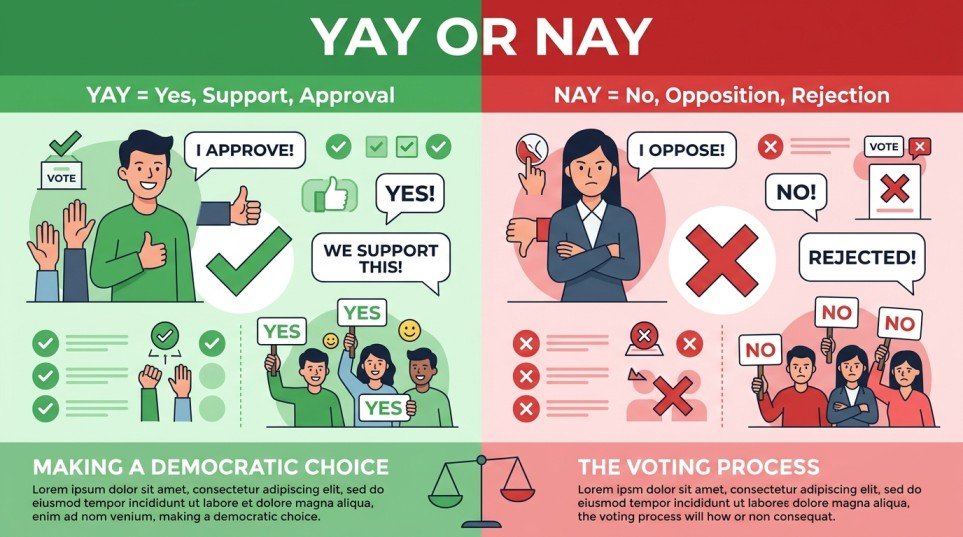
Quick Ans: Yay or nay is a common phrase used to ask whether someone agrees or disagrees with an idea, decision, or proposal. The word yay means yes, approval, or support, while nay means no, rejection, or opposition. People use the phrase in everyday conversations, voting, business discussions, and online polls.
You have probably heard someone ask, “Yay or nay?” before making a decision. The phrase appears in casual conversations, workplace meetings, social media polls, and even formal voting situations.
Although the expression sounds simple, many people are unsure about its exact meaning. Some assume it is only slang. Others wonder whether it is appropriate in professional settings. In addition, many people confuse nay with other words because it is not commonly used in everyday speech.
The phrase itself is a quick way to ask for approval or disapproval. Rather than requesting a long explanation, it encourages a simple yes or no response.
Understanding yay or nay can improve communication in both personal and professional situations. It also helps you recognize the phrase when reading articles, participating in discussions, or responding to surveys.
This guide explains the meaning, origin, usage, advantages, disadvantages, examples, common mistakes, and related concepts. By the end, you will know exactly when and how to use yay or nay correctly.
Quick Answer: What Does Yay or Nay Mean?
The phrase yay or nay means asking someone whether they support or oppose something.
| Word | Meaning |
|---|---|
| Yay | Yes, approval, agreement, support |
| Nay | No, rejection, disagreement, opposition |
For example:
“Should we order pizza tonight? Yay or nay?”
In this case:
- Yay = Yes, let’s order pizza.
- Nay = No, let’s choose something else.
Therefore, yay or nay is simply another way of saying “yes or no.”
What Does Yay Mean?
The word yay expresses approval, excitement, agreement, or support.
People often use it when they are happy about something.
Examples of Yay
- Yay, we won the game!
- Yay, the project was approved.
- My vote is yay.
- I am definitely a yay on this idea.
In many situations, yay functions as a positive response.
Common Situations Where Yay Is Used
People frequently use yay in:
- Voting situations
- Team decisions
- Online polls
- Celebrations
- Social media posts
Because the word sounds enthusiastic, it often conveys positivity as well as agreement.
What Does Nay Mean?
The word nay means no, disagreement, opposition, or rejection.
Unlike yay, nay appears less frequently in modern everyday conversations. However, it remains common in voting contexts and formal decisions.
Examples of Nay
- My vote is nay.
- The proposal received several nay votes.
- I am a nay on that suggestion.
- The committee voted nay.
Although the word sounds old-fashioned, many organizations still use it during official voting procedures.
Common Situations Where Nay Is Used
You may hear nay in:
- Government voting
- Board meetings
- Formal resolutions
- Surveys
- Decision making discussions
As a result, understanding nay helps you interpret formal language more accurately.
The Origin of Yay or Nay
The word nay has existed in English for centuries. Historically, it served as a standard way of saying “no.”
Meanwhile, yay developed as an expression of approval and excitement. Over time, the two words became paired together in voting and decision-making situations.
Today, the phrase yay or nay functions as a quick request for an opinion.
For example:
“Should we move forward with the project? Yay or nay?”
Instead of asking for lengthy feedback, the speaker requests a simple choice.
Key Differences Between Yay and Nay
Meaning
The most obvious difference is meaning.
- Yay means yes.
- Nay means no.
Tone
Yay often sounds positive and enthusiastic.
Nay usually sounds neutral or negative.
Usage
Yay commonly appears in casual conversation and celebrations.
Nay appears more often in voting and formal discussions.
Purpose
Both words simplify decision making. However, they represent opposite positions.
Comparison Table: Yay vs Nay
| Feature | Yay | Nay |
|---|---|---|
| Basic Meaning | Yes | No |
| Sentiment | Positive | Negative |
| Indicates | Approval | Rejection |
| Common Use | Supporting an idea | Opposing an idea |
| Voting Outcome | In favor | Against |
This comparison makes the distinction between yay or nay easy to remember.
Advantages and Disadvantages of Using Yay or Nay
Advantages
Using yay or nay offers several benefits:
- Quick communication
- Easy decision making
- Clear responses
- Useful in polls and voting
- Simple for large groups
Because the phrase is concise, discussions often move faster.
Disadvantages
There are also limitations:
- Oversimplifies complex issues
- Provides limited feedback
- May feel informal in some situations
- Does not explain reasoning
Consequently, detailed discussions may require more than a simple yay or nay response.
Real World Examples of Yay or Nay
Workplace Decisions
Managers often seek quick approval.
Example:
“Should we approve the marketing campaign? Yay or nay?”
Family Discussions
Families frequently use the phrase for simple choices.
Example:
“Movie night tonight. Yay or nay?”
Social Media Polls
Online creators often ask followers for feedback.
Example:
“New logo design. Yay or nay?”
Product Reviews
Consumers sometimes use the phrase when recommending products.
Example:
“New smartphone update. Yay or nay?”
These examples show how versatile the expression can be.
Regional and Global Usage
United States
The phrase appears frequently in casual conversation, business meetings, and online content.
United Kingdom
British speakers understand the expression, although “yes or no” is often more common.
Online Communities
Social media users worldwide frequently use yay or nay when gathering opinions.
Formal Voting Systems
Many organizations continue using yea and nay votes during official proceedings.
Therefore, the phrase remains relevant across different regions and communication styles.
Common Situations Where People Say Yay or Nay
People often use the phrase when:
- Choosing a restaurant
- Voting on proposals
- Selecting products
- Planning events
- Reviewing designs
- Evaluating ideas
- Making team decisions
- Gathering customer feedback
Whenever a simple approval or rejection is needed, yay or nay works well.
Related Concepts and Comparisons
Yay or Nay vs Yes or No
The meanings are nearly identical.
However, yay or nay sounds more conversational and engaging.
Yay or Nay vs Agree or Disagree
Agree or disagree focuses on opinions.
Yay or nay focuses on approval or rejection.
Yay or Nay vs For or Against
For or against often appears in debates.
Yay or nay commonly appears in polls and voting.
Common Mistakes About Yay or Nay
Confusing Nay With Yay
Some people mishear the words because they sound somewhat similar.
Remember:
- Yay = Yes
- Nay = No
Using Nay Incorrectly
A few people mistakenly use nay as a positive response.
The word always indicates rejection or disagreement.
Thinking Nay Is Obsolete
Although less common in daily speech, nay still appears in formal voting situations.
Using Yay or Nay for Complex Issues
Some decisions require detailed discussion.
A simple yay or nay response may not provide enough information.
Avoiding these mistakes improves communication and decision making.
Beginner to Advanced Communication Tips
Beginner Level
Use yay or nay for simple choices.
Example:
“Coffee or tea tomorrow? Yay or nay?”
Intermediate Level
Use it during group discussions to gather quick opinions.
Example:
“Should we launch the project next month? Yay or nay?”
Advanced Level
Combine the phrase with follow-up questions.
Example:
“Yay or nay on the proposal? If nay, what changes would you recommend?”
This approach provides both quick feedback and valuable insights.
Step By Step Example Scenario
Imagine your team is choosing a new website design.
- Present Design A
- Ask for feedback
- Request a yay or nay vote
- Count responses
- Discuss improvements if necessary
This method simplifies the decision-making process.
Exercises With Answers
Exercise 1
What does yay mean?
Answer: Yes, approval, or support.
Exercise 2
What does nay mean?
Answer: No, rejection, or opposition.
Exercise 3
Which response indicates agreement?
Answer: Yay.
Exercise 4
Which response indicates disagreement?
Answer: Nay.
Exercise 5
True or False: Yay or nay means the same as yes or no.
Answer: True.
When Should You Use Yay or Nay?
Use yay or nay when you:
- Need a quick opinion
- Conduct a poll
- Gather group feedback
- Make simple decisions
- Request approval
Avoid using it when:
- Complex explanations are required
- Detailed analysis is needed
- Formal legal documentation is involved
The phrase works best for straightforward choices.
FAQs About Yay or Nay
What does yay or nay mean?
Yay or nay means asking whether someone approves or disapproves of something. It is another way of saying yes or no.
Is yay or nay formal or informal?
The phrase is usually informal, although nay still appears in formal voting situations.
What does yay mean in voting?
A yay vote means support, approval, or agreement with a proposal.
What does nay mean in voting?
A nay vote means opposition or rejection of a proposal.
Is yay the same as yes?
Yes. In most situations, yay represents a positive response or agreement.
Is nay the same as no?
Yes. Nay indicates disagreement, rejection, or opposition.
Can yay or nay be used in business meetings?
Yes. Many teams use it when seeking quick feedback on proposals or ideas.
Why do people say yay or nay instead of yes or no?
The phrase sounds more engaging and conversational while still providing clear choices.
Is nay an old English word?
Yes. Nay has existed in English for centuries and was historically a standard word for no.
When should I avoid using yay or nay?
Avoid it when a topic requires detailed discussion, analysis, or explanation rather than a simple vote.
Conclusion
Understanding yay or nay is useful because the phrase appears in many areas of daily life. Whether you are voting, making a group decision, conducting a survey, or asking friends for opinions, the expression provides a quick way to gather feedback.
The meaning is simple. Yay represents approval, support, or agreement. Nay represents rejection, opposition, or disagreement.
Although the phrase is often informal, it remains common in professional settings, online polls, and formal voting procedures. Because it encourages clear responses, it helps people make decisions efficiently.
However, not every situation can be reduced to a simple yes or no answer. Complex topics may require additional discussion and explanation.
When used appropriately, yay or nay remains one of the easiest ways to ask for an opinion. Understanding its meaning and proper usage will help you communicate more effectively in both personal and professional situations.
Discover More:-
- Start or Sit: Complete Fantasy Football Decision Making Guide
- Complement or Compliment: Difference, Meaning, Examples, and Usage Guide

Lisa Thompson is a USA-based content writer and language specialist focused on grammar, writing improvement and digital publishing.
She holds a degree in English Language and Communication and has professional experience in educational and web content creation.
As the author of Gramtivo.Com, she aims to help readers improve their writing skills through clear and practical guidance.