
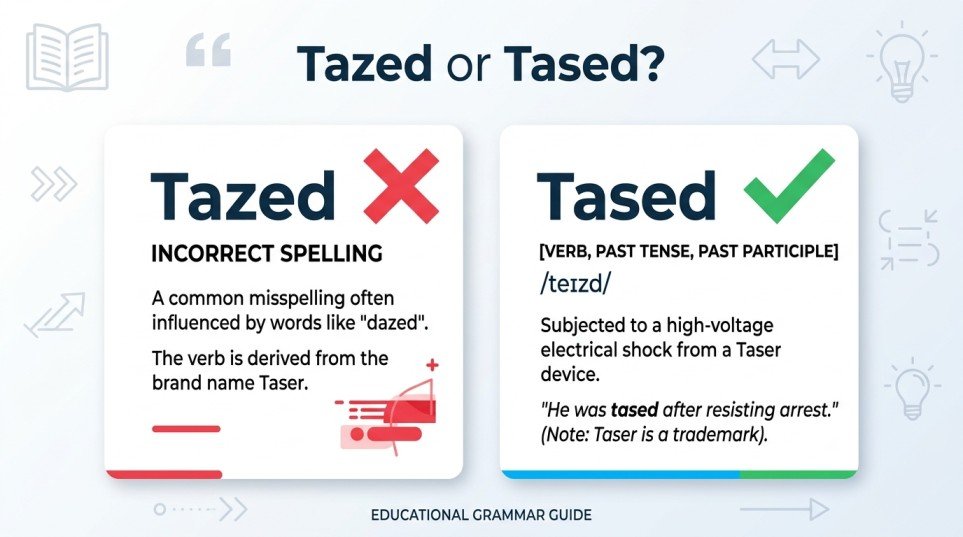
Quick Ans: The correct spelling is usually “tased”, not “tazed.” The word comes from the brand name TASER, which stands for “Thomas A. Swift’s Electric Rifle.” Therefore, the past tense form commonly used in English is “tased.”
Many people search for tazed or tased because both spellings appear online. One version uses the letter “s,” while the other uses “z.” At first glance, both may seem correct.
However, only one spelling is widely accepted in standard English.
The confusion happens because the word sounds like it could use either letter. English often changes “s” sounds into “z” sounds during pronunciation. As a result, many people naturally type “tazed” instead of “tased.”
Writers, students, bloggers, and even journalists sometimes make this mistake. Understanding the correct spelling helps improve grammar, professionalism, and search accuracy.
In this guide, you will learn the meaning of the word, why the confusion exists, grammar rules, pronunciation tips, real world examples, common mistakes, and practical exercises. By the end, you will confidently know when to use tased and why “tazed” is usually considered incorrect.
Quick Answer: Tazed or Tased
Here is the short answer to tazed or tased:
| Word | Correct? | Meaning |
|---|---|---|
| Tased | Yes | Hit with a TASER device |
| Tazed | Usually incorrect | Misspelling of “tased” |
Therefore, the standard and accepted spelling is tased.
What Does “Tased” Mean?
The word tased refers to someone being shocked with a TASER device. A TASER is an electronic device used to temporarily disable a person using electric current.
The term is commonly used in:
- News reports
- Police reports
- Legal discussions
- Everyday conversation
Example Sentences
- The suspect was tased by police officers.
- Security guards tased the attacker.
- The man claimed he was wrongly tased.
Because the word comes from the trademark TASER, the spelling keeps the letter “s.”
Why People Write “Tazed”
Many English speakers hear a “z” sound when the word is pronounced. Consequently, they spell it with the letter “z.”
For example:
- Raised
- Dazed
- Amazed
These words use “z” sounds in pronunciation and spelling. Therefore, people assume “tazed” follows the same pattern.
However, English spelling does not always match pronunciation perfectly.
The official word remains tased because it comes directly from TASER.
Origin of the Word TASER
Understanding the history helps explain tazed or tased more clearly.
The word TASER originally came from a fictional story. It stands for:
Thomas A. Swift’s Electric Rifle
The device later became a real electronic weapon used by law enforcement.
Eventually, people began using the noun as a verb.
For example:
- Police used a TASER.
- Police tased the suspect.
This process happens often in English.
Other examples include:
- Google → Googled
- Email → Emailed
- Text → Texted
Similarly, TASER became “tased.”
Grammar Rules Behind Tased
Verb Form
“Tased” is the past tense and past participle form of the verb “tase.”
Present Tense Examples
- Police tase dangerous suspects.
- Officers may tase aggressive individuals.
Past Tense Examples
- The suspect was tased yesterday.
- Security personnel tased the attacker.
Continuous Form
- Officers were tasing the suspect.
Therefore, “tase” functions like a regular English verb.
Pronunciation of Tased
The word “tased” is commonly pronounced:
TAYZD
Because the pronunciation sounds similar to “dazed,” confusion happens easily.
However, pronunciation does not change the official spelling.
English contains many similar examples:
| Pronunciation | Correct Spelling |
|---|---|
| Rayzd | Raised |
| Clozd | Closed |
| Tayzd | Tased |
As a result, pronunciation alone should not determine spelling.
Key Differences Between Tazed or Tased
Accepted Usage
“Tased” appears in dictionaries, journalism, and professional writing. “Tazed” rarely appears in formal English.
Search Engine Results
Most grammar tools and spell checkers recognize “tased.” Many mark “tazed” as incorrect.
Professional Writing
News organizations, legal reports, and academic sources overwhelmingly prefer “tased.”
Therefore, writers should avoid using “tazed” in professional contexts.
Real World Examples
News Reporting
Journalists frequently use “tased” in crime reports and police coverage.
Example:
- The suspect was tased after refusing arrest.
Legal Documents
Court documents and police records also use the standard spelling.
Social Media
On social media, both spellings appear. However, informal posts often contain spelling mistakes.
These examples show why understanding tazed or tased matters in professional communication.
Regional and Global Usage
United States
“Tased” is the standard spelling used in American English.
United Kingdom
British publications also generally use “tased.”
Online Usage
Search engines display both versions because many users misspell the word. Nevertheless, dictionaries and editors continue to prefer “tased.”
Therefore, global English usage strongly supports the spelling “tased.”
Related Concepts and Comparisons
Tased vs Shocked
“Tased” specifically refers to a TASER device. “Shocked” has a broader meaning and may describe electricity, surprise, or emotional reaction.
Tased vs Stunned
“Tased” involves electrical force. “Stunned” can happen from impact, surprise, or other causes.
Taser vs Stun Gun
| Device | Feature |
|---|---|
| TASER | Shoots electrical probes |
| Stun Gun | Requires direct contact |
Although people sometimes confuse these devices, they work differently.
Common Mistakes About Tazed or Tased
Using “Tazed” in Professional Writing
Many people mistakenly assume “tazed” is correct because of pronunciation. However, professional editors prefer “tased.”
Capitalization Errors
“TASER” is a trademarked brand name. However, the verb “tased” is usually lowercase in regular writing.
Correct example:
- The suspect was tased.
Incorrect example:
- The suspect was Tased.
Confusing Verb Forms
Some writers incorrectly use:
- Tazes
- Tazzed
- Tasered
The standard forms are:
- Tase
- Tased
- Tasing
Avoiding these mistakes improves writing accuracy.
Beginner to Advanced Grammar Tips
Beginner Level
Remember this simple rule:
“Tased” comes from TASER, so keep the “s.”
Intermediate Level
Use spell check tools to catch incorrect forms like “tazed.”
Advanced Level
Understand how trademarked nouns become verbs in English grammar.
Examples include:
- Google → Googled
- Photoshop → Photoshopped
- TASER → Tased
This pattern explains why the spelling stays consistent.
Step By Step Memory Trick
Here is a simple way to remember tazed or tased.
- Think of the word TASER
- Remove the final “R”
- Add “d” for past tense
- Result: Tased
Because the original word uses “s,” the verb keeps the same spelling.
Exercises With Answers
Exercise 1
Which spelling is correct in professional English?
Answer: Tased.
Exercise 2
True or False: “Tazed” is the preferred dictionary spelling.
Answer: False.
Exercise 3
Which word comes from the TASER brand name?
Answer: Tased.
Exercise 4
Fill in the blank:
The suspect was _____ by police officers.
Answer: Tased.
Exercise 5
Which spelling appears more often in journalism?
Answer: Tased.
When Should You Use Tased?
Use “tased” when describing someone being shocked with a TASER device.
Correct examples:
- Officers tased the suspect.
- The attacker was tased during the incident.
Avoid “tazed” in:
- School writing
- Professional articles
- Legal reports
- Business communication
Standard spelling improves clarity and credibility.
FAQs About Tazed or Tased
Which spelling is correct: tazed or tased?
The correct and widely accepted spelling is “tased.”
Why do people write “tazed”?
People often spell it that way because the pronunciation sounds like it contains a “z.”
Is “tazed” a real word?
Most dictionaries and grammar guides do not recognize “tazed” as the standard spelling.
What does “tased” mean?
It means someone was shocked using a TASER device.
Is “tased” used in legal writing?
Yes. Police reports and legal documents commonly use “tased.”
Does “tased” come from the word TASER?
Yes. The verb comes directly from the TASER brand name.
Can I use “tazed” informally?
Some people use it online, but professional writing should use “tased.”
How do you pronounce “tased”?
It is commonly pronounced “tayzd.”
Why is the spelling not “tazed” if it sounds like a z?
English spelling often keeps original word forms even when pronunciation changes slightly.
Do spell checkers accept “tazed”?
Many spell checkers flag “tazed” as incorrect and recommend “tased.”
Conclusion
Understanding tazed or tased is important for accurate writing and communication. Although both spellings appear online, “tased” is the accepted standard in dictionaries, journalism, and professional English.
The confusion happens because pronunciation sounds similar to words containing “z.” However, the spelling stays connected to the original word TASER.
Using the correct spelling improves professionalism, grammar accuracy, and reader trust. Writers, students, journalists, and bloggers should therefore use “tased” in formal communication.
Whenever you feel uncertain, remember the simple rule: the verb comes from TASER, so the spelling keeps the letter “s.”
By understanding the grammar, history, and usage behind tazed or tased, you can avoid common spelling mistakes and write with greater confidence.
Discover More:-
- Nikon or Canon: Differences, Camera Comparison, and Buying Guide
- Hemsworth or Pratt: Comparing Acting Style, Movies, and Hollywood Success

Lisa Thompson is a USA-based content writer and language specialist focused on grammar, writing improvement and digital publishing.
She holds a degree in English Language and Communication and has professional experience in educational and web content creation.
As the author of Gramtivo.Com, she aims to help readers improve their writing skills through clear and practical guidance.