
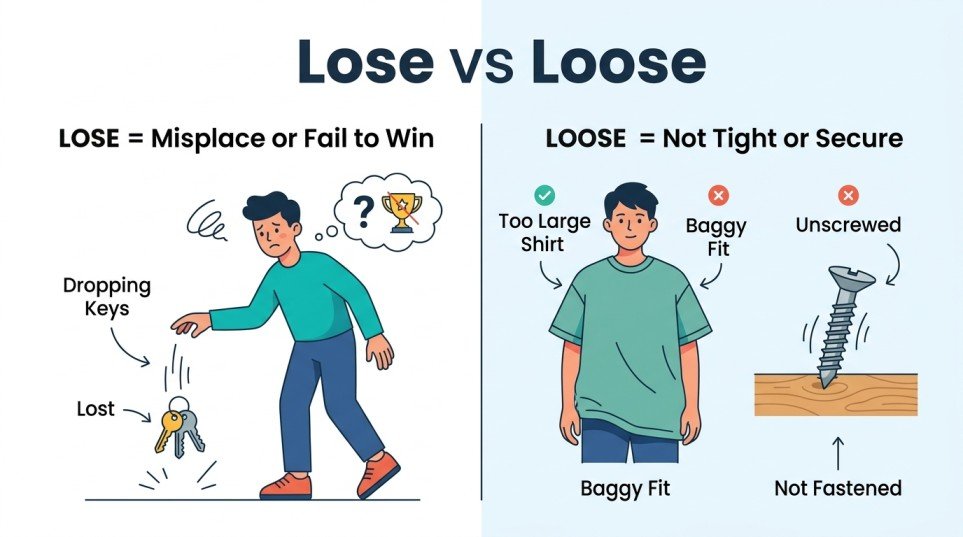
Quick Ans: The difference between lose or loose is simple but important. Lose is a verb that means to misplace something, fail to win, or no longer have something. Loose is usually an adjective that describes something not tight, not fixed, or free-fitting. Although the words look similar, they have different meanings and uses.
Many English learners and native speakers struggle with lose or loose. The words look almost identical. Their spelling differs by only one letter. However, their meanings are completely different.
This mistake appears everywhere. Students make it in essays. Professionals sometimes use the wrong word in emails. Social media posts often contain the confusion as well.
For example, someone may write, “I don’t want to loose my keys.” The correct word should be “lose” because the sentence refers to misplacing something. Meanwhile, “loose” would describe keys that are not tightly attached to something.
Because the two words sound somewhat similar, many people accidentally swap them. As a result, writing can become confusing or appear less professional.
Understanding lose or loose helps improve grammar, communication, and writing accuracy. In this complete guide, you will learn definitions, differences, examples, common mistakes, exercises, and practical tips for remembering the correct usage.
Quick Answer: Lose or Loose
The easiest way to understand lose or loose is to remember their functions.
| Word | Part of Speech | Meaning |
|---|---|---|
| Lose | Verb | To misplace, fail to win, or no longer have |
| Loose | Adjective | Not tight, free, or relaxed |
Simple Examples
| Correct Usage | Meaning |
|---|---|
| I do not want to lose my wallet. | Misplace something |
| These shoes are loose. | Not tight |
| Our team might lose the game. | Fail to win |
| The screw is loose. | Not firmly attached |
In short, lose refers to an action, while loose usually describes a condition.
What Does Lose Mean?
Lose is a verb. It describes the action of no longer having something, failing to keep something, or not winning.
Common Meanings of Lose
Lose can mean:
- Misplace something
- Fail to win
- Become separated from something
- Reduce an amount
Examples of Lose
Consider these examples:
- I do not want to lose my phone.
- Our team may lose the championship.
- She hopes to lose weight this year.
- We could lose valuable data if we do not back up the files.
In each sentence, lose describes an action rather than a physical condition.
Common Situations Where Lose Is Used
You might use lose when talking about:
- Losing a game
- Losing money
- Losing keys
- Losing weight
- Losing focus
- Losing a job
Because lose is a verb, it often appears after a subject and before an object.
What Does Loose Mean?
Loose is usually an adjective. It describes something that is not tight, secure, or firmly attached.
Common Meanings of Loose
Loose can describe:
- Clothing that is not tight
- Objects that are not secure
- Something free or unrestricted
- Relaxed movement
Examples of Loose
Here are some examples:
- My jacket feels loose.
- The bolt is loose.
- The dog got loose from the yard.
- She prefers loose fitting clothes.
Notice that loose describes a condition or characteristic.
Common Situations Where Loose Is Used
People frequently use loose when discussing:
- Clothing
- Screws and bolts
- Animals escaping
- Hair styles
- Relaxed objects
Therefore, loose usually answers the question, “What is it like?”
Key Differences Between Lose or Loose
Meaning
The most important difference between lose or loose involves meaning.
- Lose means to misplace, fail, or no longer have.
- Loose means not tight or not secured.
Grammar Function
Lose functions as a verb.
Loose functions primarily as an adjective.
Sentence Usage
Consider these examples:
- I might lose my wallet.
- My wallet is loose in my pocket.
The first sentence describes an action. The second describes a condition.
Pronunciation
The pronunciation also differs.
| Word | Pronunciation |
|---|---|
| Lose | Looz |
| Loose | Loos |
Although the difference is small, paying attention to the ending sound helps distinguish them.
Why People Confuse Lose or Loose
Similar Spelling
The words differ by only one letter. Consequently, many writers type the wrong version without noticing.
Similar Pronunciation
The sounds are close enough to create confusion, especially for English learners.
Fast Typing
Many mistakes happen during quick texting, social media posting, or email writing.
Lack of Proofreading
Writers often focus on ideas rather than spelling. Therefore, lose and loose mistakes can slip through unnoticed.
Advantages of Learning the Difference
Better Writing
Using the correct word improves grammar and clarity.
More Professional Communication
Accurate spelling creates a stronger impression in business communication.
Improved Academic Performance
Students earn better grades when grammar errors are reduced.
Increased Confidence
Understanding common word mistakes makes writing easier and more reliable.
Real World Examples
Workplace Example
Incorrect:
- We cannot afford to loose customers.
Correct:
- We cannot afford to lose customers.
Fitness Example
Incorrect:
- I want to loose ten pounds.
Correct:
- I want to lose ten pounds.
Clothing Example
Incorrect:
- These pants are lose.
Correct:
- These pants are loose.
Home Repair Example
Incorrect:
- The door handle feels lose.
Correct:
- The door handle feels loose.
These examples demonstrate how one letter changes the entire meaning.
Regional and Global Usage
American English
Both words follow the same rules in American English.
British English
British English also uses lose and loose in the same way.
International English Learning
English learners worldwide commonly confuse these words. Therefore, grammar teachers frequently address the difference early in language instruction.
Because the rules remain consistent across regions, learning them once helps everywhere.
Related Concepts and Comparisons
Lose vs Lost
Lose is present tense.
Examples:
- I may lose my wallet.
- Yesterday I lost my wallet.
Loose vs Loosen
Loose is an adjective.
Loosen is a verb.
Examples:
- The bolt is loose.
- Please loosen the bolt.
Lose vs Loose vs Loosen
| Word | Type | Meaning |
|---|---|---|
| Lose | Verb | Misplace or fail to keep |
| Loose | Adjective | Not tight |
| Loosen | Verb | Make less tight |
Understanding these related terms helps avoid additional grammar mistakes.
Common Mistakes About Lose or Loose
Using Loose When You Mean Lose
Incorrect:
- I hope I do not loose my passport.
Correct:
- I hope I do not lose my passport.
Using Lose to Describe Something Not Tight
Incorrect:
- My shirt is lose.
Correct:
- My shirt is loose.
Forgetting Grammar Function
Many writers forget that lose is a verb and loose is usually an adjective.
Relying Only on Spell Check
Some spelling tools may not catch mistakes because both words are correctly spelled English words.
Careful proofreading remains important.
Easy Memory Tricks
Trick One: Lose Lost an O
The word lose has one fewer “o” than loose.
Think of it this way:
- When you lose something, you lose an “o” too.
Trick Two: Loose Has Extra Space
The extra “o” in loose creates extra room.
Extra room means something is not tight.
Trick Three: Lose Is an Action
If the sentence describes something happening, the correct choice is usually lose.
These simple tricks help many learners remember the difference.
Beginner to Advanced Usage Tips
Beginner Level
Ask yourself whether the sentence describes an action or a condition.
Intermediate Level
Check the part of speech before choosing the word.
Advanced Level
Review sentences for context and meaning rather than relying only on spelling checks.
Strong writers develop a habit of verifying commonly confused words.
Step By Step Decision Process
Suppose you are unsure which word to use.
Step 1: Determine the meaning.
Step 2: Ask whether the sentence describes an action.
If yes, use lose.
Step 3: Ask whether the sentence describes something not tight.
If yes, use loose.
Example
Sentence:
- I do not want to _____ my wallet.
The sentence describes an action. Therefore, the correct answer is lose.
Another example:
- My shoelaces are _____.
This sentence describes a condition. Therefore, the correct answer is loose.
Exercises With Answers
Exercise 1
Choose the correct word:
I do not want to _____ my keys.
Answer: Lose.
Exercise 2
Choose the correct word:
My shirt feels _____.
Answer: Loose.
Exercise 3
Choose the correct word:
The team might _____ the match.
Answer: Lose.
Exercise 4
Choose the correct word:
The wheel appears _____.
Answer: Loose.
Exercise 5
True or False:
Lose is usually an adjective.
Answer: False.
When Should You Use Lose or Loose?
Use lose when you mean:
- Misplace something
- Fail to win
- No longer have something
- Reduce an amount
Use loose when you mean:
- Not tight
- Not secured
- Free moving
- Relaxed fitting
Checking the meaning first will usually lead to the correct choice.
FAQs About Lose or Loose
What is the difference between lose or loose?
Lose is a verb meaning to misplace or fail to win. Loose is an adjective meaning not tight or not secure.
Is it lose weight or loose weight?
The correct phrase is “lose weight” because lose refers to reducing something.
Do you lose a game or loose a game?
You lose a game. The word lose means to fail to win.
Is loose a verb?
Loose is usually an adjective. However, it can occasionally function differently in specific contexts, though this usage is less common.
How do I remember lose or loose?
Remember that lose has one fewer “o.” When you lose something, you lose an “o” too.
Why do people confuse lose and loose?
The words look similar and sound somewhat alike, which causes frequent spelling mistakes.
Is my shirt lose or loose?
The correct phrase is “my shirt is loose” because it describes how the shirt fits.
Can spell check catch lose or loose mistakes?
Not always. Since both are real English words, some tools may miss the error.
What part of speech is lose?
Lose is a verb.
What part of speech is loose?
Loose is primarily an adjective.
Conclusion
Understanding lose or loose is essential for clear and professional writing. Although the words differ by only one letter, their meanings are completely different.
Lose is a verb. It refers to misplacing something, failing to win, or no longer having something. Loose is usually an adjective that describes something not tight, secure, or fixed.
Many writers confuse these words because of their similar spelling and pronunciation. Fortunately, a few simple memory tricks can make the distinction easier to remember.
Whenever you are unsure, focus on the sentence meaning. If the sentence describes an action, choose lose. If it describes a condition or fit, choose loose.
Practicing these rules regularly will improve your grammar, strengthen your writing, and help you avoid one of the most common English language mistakes.
Discover More:-
- Swifty or Swiftie: Which Spelling Is Correct for Taylor Swift Fans?
- Smash or Pass Meaning: Origins, Rules, Examples, and Social Media Impac

Robert Mitchell is a U.S.-based writer at Gramtivo.Com who focuses on grammar, writing improvement, and language-related content. He holds a degree in English and Linguistics from a U.S. university. His work aims to help readers enhance their writing skills with clear and practical guidance.