
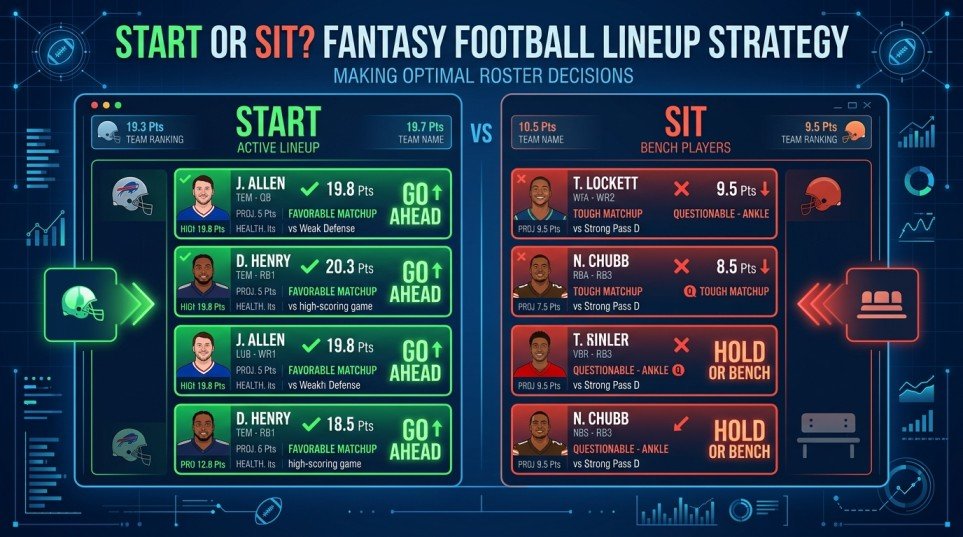
Quick Ans: The term start or sit refers to one of the most important decisions in fantasy football. A “start” player is someone you place in your active lineup for the week, while a “sit” player remains on your bench. Making the correct start or sit choice can significantly impact your fantasy football score and season success.
Fantasy football managers face many decisions throughout a season. Among them, the start or sit decision is often the most important. Every week, managers must choose which players belong in the starting lineup and which players should stay on the bench.
At first glance, the choice may seem simple. A star player should start, and a weaker player should sit. However, fantasy football rarely works that way.
Matchups change. Injuries happen. Weather conditions affect games. In addition, player performance can vary from week to week. Because of these factors, choosing the correct start or sit option becomes a strategic challenge.
Many fantasy matchups are decided by only a few points. As a result, one wrong lineup decision can mean the difference between winning and losing.
Understanding how start or sit decisions work helps both beginners and experienced managers improve their results. This guide explains the concept, provides practical examples, highlights common mistakes, and offers strategies for making smarter lineup choices.
Quick Answer: Start or Sit
The basic meaning of start or sit is straightforward.
| Term | Meaning |
|---|---|
| Start | Place a player in your active lineup |
| Sit | Keep a player on your bench |
| Goal | Maximize weekly fantasy points |
| Decision Factors | Matchup, injuries, opportunity, trends |
In simple terms, a start player is expected to contribute meaningful fantasy points. A sit player is less likely to perform well during that week.
What Does Start Mean in Fantasy Football?
A “start” player is someone you place in an active lineup position before games begin.
When you start a player:
- Their fantasy points count toward your total.
- Their performance affects your matchup outcome.
- You are trusting them to produce results.
Common Reasons to Start a Player
Fantasy managers often start players because:
- They have favorable matchups.
- They receive high volume opportunities.
- They are healthy and active.
- Recent performance trends are strong.
For example, a running back facing one of the league’s weakest run defenses is often considered a strong start candidate.
Benefits of Starting the Right Player
Making good start decisions can:
- Increase weekly scoring.
- Improve win percentage.
- Strengthen playoff chances.
- Create a competitive advantage.
Therefore, start decisions require careful analysis rather than guesswork.
What Does Sit Mean in Fantasy Football?
A “sit” player remains on your bench and does not contribute points to your active lineup.
Although sitting a player may feel risky, it is often the smarter move.
Common Reasons to Sit a Player
Managers frequently bench players because:
- They face difficult defenses.
- Injury concerns exist.
- Playing time is uncertain.
- Weather conditions may limit production.
For instance, a wide receiver facing an elite cornerback may become a sit candidate despite having a recognizable name.
Why Sitting a Player Can Be Smart
Many fantasy managers focus only on who to start. However, avoiding poor performers can be equally important.
A good sit decision can:
- Prevent low scores.
- Reduce lineup risk.
- Increase consistency.
- Improve weekly outcomes.
Key Factors in Start or Sit Decisions
Matchup Analysis
Matchups often drive start or sit recommendations.
Consider:
- Defensive rankings
- Position-specific performance allowed
- Home versus away games
- Historical results
A favorable matchup can boost a player’s value significantly.
Injury Status
Player health matters every week.
Questions to consider include:
- Is the player fully healthy?
- Will playing time be limited?
- Is there a risk of re-injury?
Managers should monitor injury reports closely before making lineup decisions.
Opportunity and Volume
Fantasy points often follow opportunity.
Key indicators include:
- Targets for receivers
- Carries for running backs
- Red zone opportunities
- Snap counts
Even talented players struggle when volume decreases.
Recent Performance
Recent trends provide valuable insight.
Look for:
- Increased usage
- Growing chemistry with quarterbacks
- Improved efficiency
- Consistent production
Recent performance should complement matchup analysis rather than replace it.
Advantages and Disadvantages of Following Start or Sit Advice
Advantages
Following start or sit recommendations can:
- Save research time
- Provide expert insight
- Highlight overlooked matchups
- Reduce emotional decisions
Disadvantages
However, there are potential drawbacks:
- Experts can be wrong
- Advice may become outdated
- League settings vary
- Unique roster situations differ
Therefore, fantasy managers should combine expert advice with their own analysis.
Real World Start or Sit Examples
Example One: Running Back Decision
You have two options:
- Running Back A versus a top defense
- Running Back B versus a weak defense
Although Running Back A has the bigger name, Running Back B may offer the better weekly outlook.
Example Two: Wide Receiver Choice
Suppose a receiver averages eight targets per game and faces a struggling secondary.
In that situation, starting the receiver becomes a logical decision.
Example Three: Quarterback Selection
One quarterback plays in poor weather conditions. Another quarterback plays indoors.
Because passing often becomes easier indoors, the second quarterback may be the stronger start option.
Regional and Global Usage
Fantasy Football in North America
The phrase start or sit is most commonly associated with fantasy football leagues in the United States and Canada.
Growth of Fantasy Sports Worldwide
Fantasy sports continue expanding globally.
Many international players now participate in:
- Fantasy football
- Fantasy soccer
- Fantasy cricket
- Fantasy basketball
As fantasy gaming grows, start or sit decisions remain a central strategy component.
Related Concepts and Comparisons
Start or Sit vs Waiver Wire
Start or sit focuses on lineup choices.
Waiver wire decisions focus on adding or dropping players.
Start or Sit vs Trade Decisions
Trades affect long term roster value.
Start or sit decisions affect weekly performance.
Start or Sit vs DFS
Daily fantasy sports require lineup decisions for a single contest.
Traditional fantasy football requires start or sit decisions throughout an entire season.
Common Start or Sit Mistakes
Starting Players Based Only on Name Value
Many managers trust famous players regardless of matchup.
Strong analysis should consider current conditions rather than reputation alone.
Ignoring Injury Reports
A player may be active but not fully healthy.
Limited usage can reduce fantasy production significantly.
Chasing Last Week’s Points
One great game does not guarantee future success.
Instead, focus on opportunity and matchup quality.
Overreacting to One Bad Performance
Even elite players occasionally struggle.
Managers should evaluate long term trends before benching proven performers.
Beginner to Advanced Start or Sit Strategies
Beginner Level
Focus on:
- Matchups
- Injury reports
- Expert rankings
These factors provide a solid foundation.
Intermediate Level
Expand your analysis by reviewing:
- Target share
- Snap percentage
- Red zone usage
These metrics reveal valuable trends.
Advanced Level
Experienced managers often examine:
- Defensive schemes
- Pace of play
- Game scripts
- Advanced analytics
Small details can create meaningful advantages.
Step By Step Start or Sit Process
Use this process every week.
Step 1
Check injury reports.
Step 2
Review matchup difficulty.
Step 3
Analyze recent performance.
Step 4
Compare projected opportunities.
Step 5
Make lineup decisions before kickoff.
Following a consistent process reduces emotional decision making.
Exercises With Answers
Exercise 1
A running back faces the league’s worst rushing defense. Start or sit?
Answer: Start.
Exercise 2
A receiver is questionable with a hamstring injury and may play limited snaps. Start or sit?
Answer: Sit.
Exercise 3
A quarterback plays indoors against a weak secondary. Start or sit?
Answer: Start.
Exercise 4
A player scored one touchdown last week but receives very few opportunities. Start or sit?
Answer: Usually sit.
Exercise 5
True or False: Matchups should be considered when making lineup decisions.
Answer: True.
When Should You Start or Sit a Player?
Start a player when:
- Opportunity is high
- Matchup is favorable
- Health is not a concern
- Usage trends are positive
Sit a player when:
- Matchup is difficult
- Playing time is uncertain
- Injury risk exists
- Production has declined significantly
Using these guidelines helps improve lineup quality throughout the season.
FAQs About Start or Sit
What does start or sit mean in fantasy football?
Start or sit refers to deciding whether a player should be placed in your active lineup or kept on the bench.
How do I make better start or sit decisions?
Review matchups, injury reports, recent performance, and player opportunity before setting your lineup.
Should I always start my best players?
Not necessarily. Matchups and usage sometimes make lower ranked players better weekly options.
How important are start or sit decisions?
They are extremely important because weekly matchups are often decided by small scoring margins.
Can a star player become a sit candidate?
Yes. Difficult matchups, injuries, or reduced opportunities can make even elite players risky starts.
Do experts always get start or sit picks right?
No. Fantasy football contains uncertainty, so expert predictions are never guaranteed.
What matters more, matchup or talent?
Both matter. The strongest decisions usually balance player talent with matchup quality.
Should weather affect start or sit choices?
Yes. Severe weather can reduce passing production and change offensive game plans.
What is the biggest start or sit mistake?
Many managers rely on player reputation instead of current matchup and opportunity.
How often should I check my lineup before kickoff?
Review your lineup shortly before games begin to account for injury updates and late news.
Conclusion
Understanding start or sit decisions is essential for fantasy football success. Every week presents new challenges, and managers must evaluate players based on matchups, health, opportunity, and recent performance.
Starting the right players can increase scoring and improve win rates. Equally important, sitting risky players helps avoid disappointing performances that can cost valuable matchups.
Successful managers follow a consistent process. They research injury reports, study defensive matchups, analyze player usage, and avoid emotional decisions. Rather than relying solely on player reputation, they focus on current circumstances and projected opportunities.
Whether you are new to fantasy football or an experienced competitor, improving your start or sit strategy can provide a significant advantage. Small lineup decisions often determine season outcomes.
By applying the principles in this guide, you can make smarter weekly choices and put your fantasy team in a stronger position to win.
Discover More:-
- TheraBreath vs Listerine: Differences, Ingredients, Benefits, and Best Mouthwash Guide
- Beemer or Beamer: Meaning, Differences, and Correct BMW Nicknames

Robert Mitchell is a U.S.-based writer at Gramtivo.Com who focuses on grammar, writing improvement, and language-related content. He holds a degree in English and Linguistics from a U.S. university. His work aims to help readers enhance their writing skills with clear and practical guidance.