
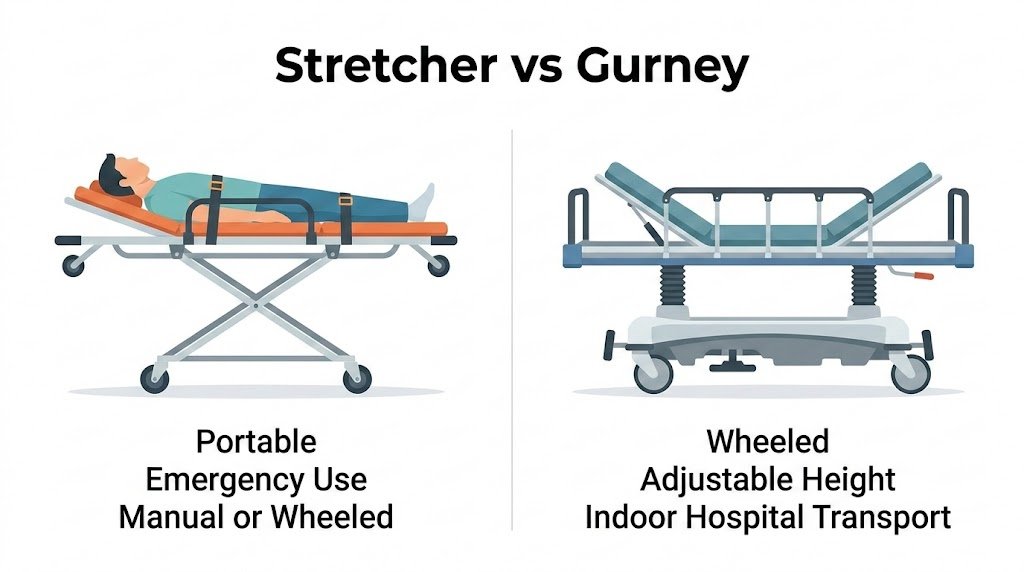
Quick Ans: The main difference between stretcher vs gurney is mobility and structure. A stretcher is a flat device used to carry injured or sick patients, often by hand, while a gurney is a wheeled stretcher with adjustable height used mainly in hospitals. Although the terms are sometimes used interchangeably, their design and purpose can differ.
Many people search for stretcher vs gurney because the words sound similar. In movies and hospitals, both used to move patients. Both have wheels in many cases. Stretcher and Gurney are seen in emergency situations.
However, they are not exactly the same.
The confusion usually happens because modern hospital stretchers often look like gurneys. At the same time, medical staff sometimes use the words casually. As a result, patients and families may not know the real difference.
Understanding stretcher vs gurney matters for medical professionals, students, and even regular people. For example, emergency responders use specific equipment in ambulances. Hospitals use different devices in operating rooms and corridors.
In this complete guide, you will learn clear definitions, advantages, disadvantages, real world examples, and common mistakes. By the end, you will confidently understand the difference between a stretcher and a gurney.
Quick Answer: Stretcher vs Gurney
Here is a simple comparison to clarify stretcher vs gurney.
| Feature | Stretcher | Gurney |
|---|---|---|
| Basic Design | Flat frame for carrying | Wheeled hospital bed |
| Wheels | Sometimes | Always |
| Height Adjustment | Usually fixed | Adjustable |
| Main Use | Emergency transport | Hospital transport |
| Portability | Lightweight options available | Heavier and stable |
In short, a stretcher is primarily for carrying patients, while a gurney is a wheeled device designed for hospital movement and procedures.
What Is a Stretcher?
A stretcher is a medical device used to move injured, sick, or unconscious people. Traditionally, it consists of a flat surface with handles on each side so that rescuers can carry a patient.
Over time, stretcher designs have evolved. Some now include wheels, straps, and folding mechanisms. However, the core purpose remains the same: safe patient transport.
Types of Stretchers
There are several types used in healthcare and emergency settings:
- Basic manual stretcher
- Folding stretcher
- Scoop stretcher
- Basket stretcher for rescue missions
- Ambulance stretcher with wheels
Each type serves a specific situation. For example, rescue teams use basket stretchers in mountain operations. Meanwhile, ambulances rely on wheeled stretchers for rapid loading.
How It Is Used
First, responders secure the patient with straps.
Next, they lift or roll the stretcher.
Then, they transport the patient to an ambulance or medical facility.
Because stretchers focus on portability, they are common in emergencies.
What Is a Gurney?
Gurney is a wheeled medical transport bed used mainly inside hospitals. Unlike basic stretchers, gurneys almost always have adjustable height and side rails.
In many modern hospitals, gurneys resemble narrow hospital beds. However, they are designed specifically for short distance transport rather than long term patient stay.
Key Features of a Gurney
- Four wheels for smooth movement
- Adjustable height controls
- Locking brakes
- Side safety rails
- Padded mattress
Because of these features, gurneys provide more stability and comfort than simple stretchers.
Where It Is Used
Gurneys are commonly used in:
- Emergency rooms
- Operating rooms
- Hospital corridors
- Diagnostic imaging departments
Therefore, when discussing stretcher vs gurney, location is an important factor.
Key Differences Between Stretcher vs Gurney
Mobility
Stretchers can be carried or wheeled. In contrast, gurneys are always wheeled and meant for smooth indoor surfaces.
Design
Stretchers focus on portability. Gurneys focus on comfort and adjustability.
Environment
Emergency responders use stretchers in the field. Hospitals mainly use gurneys inside controlled environments.
Adjustability
Most stretchers have limited height adjustment. Meanwhile, gurneys often include hydraulic systems to raise or lower the patient.
Advantages and Disadvantages
Stretcher Advantages
- Lightweight
- Portable
- Suitable for rough terrain
- Essential for emergency rescue
Stretcher Disadvantages
- Less comfortable
- Limited adjustability
- May require multiple people to carry
Gurney Advantages
- Adjustable height
- More comfortable padding
- Easy movement on hospital floors
- Built in safety rails
Gurney Disadvantages
- Heavier
- Not suitable for rough outdoor use
- Requires smooth surfaces
Thus, the choice in stretcher vs gurney depends on the situation.
Technical Comparison Table
| Specification | Stretcher | Gurney |
|---|---|---|
| Weight | Light to moderate | Heavy |
| Wheels | Optional | Standard |
| Terrain Use | Outdoor and indoor | Indoor only |
| Height Control | Limited | Adjustable |
| Emergency Use | Yes | Rarely outside hospital |
This table highlights how each device serves a different role.
Real World Examples
Ambulance Transport
Paramedics use a wheeled stretcher to load a patient into an ambulance. Although it has wheels, it is still classified as a stretcher because it is designed for emergency field transport.
Hospital Emergency Room
Once the patient arrives at the hospital, staff may transfer them to a gurney. The adjustable height allows doctors to examine the patient comfortably.
Disaster Rescue
In mountain rescue, teams use basket stretchers. A gurney would not work in that environment.
Therefore, stretcher vs gurney differences become clear in real life situations.
Regional and Global Usage
In the United States, both terms are common. However, many people casually call all wheeled patient beds stretchers.
In the United Kingdom and some other countries, the term trolley is sometimes used instead of gurney.
Globally, stretcher remains the more universal medical term. Meanwhile, gurney is more commonly heard in American hospitals.
Thus, language differences also influence the stretcher vs gurney discussion.
Related Concepts and Comparisons
Stretcher vs Hospital Bed
A hospital bed is used for long term patient care. In contrast, a stretcher is used for temporary transport.
Gurney vs Trolley
In some regions, a gurney is called a trolley. The design and purpose are similar.
Stretcher vs Gurney vs Wheelchair
| Device | Purpose | Long Term Use | Adjustable |
|---|---|---|---|
| Stretcher | Emergency transport | No | Limited |
| Gurney | Hospital transport | Short term | Yes |
| Wheelchair | Patient mobility | Yes | Limited |
Understanding these related tools helps clarify stretcher vs gurney further.
Common Mistakes About Stretcher vs Gurney
Using the Terms Interchangeably
Although similar, the devices are not identical in design or purpose.
Assuming All Stretchers Have Wheels
Some stretchers are carried by hand and have no wheels.
Thinking Gurneys Are for Outdoor Rescue
Gurneys are not designed for rough terrain.
Ignoring Safety Features
Gurneys usually include locking brakes and rails. Stretchers may not have advanced safety features.
Avoiding these mistakes ensures accurate communication in medical settings.
Beginner to Advanced Knowledge
Beginner Level
At a basic level, remember this: stretchers are for emergency transport. Gurneys are for hospital movement.
Intermediate Level
Understand that modern ambulance stretchers often have wheels and adjustable height. However, they are still categorized as stretchers because of their field use.
Advanced Level
In advanced medical logistics, equipment choice depends on terrain, patient condition, and facility design. For example, trauma centers use specialized stretchers with shock absorbing systems. Meanwhile, surgical departments rely on gurneys compatible with operating tables.
As knowledge increases, the distinction in stretcher vs gurney becomes more precise.
Step By Step Scenario Comparison
Imagine a car accident.
First, paramedics arrive with a stretcher. They secure the patient and transport them to the ambulance.
Next, upon hospital arrival, staff move the patient onto a gurney. Doctors adjust the height for examination.
Although both devices look similar, their roles are clearly different.
Exercises With Answers
Exercise 1
Which device is mainly used in emergency field transport?
Answer: Stretcher.
Exercise 2
Which device usually has adjustable height controls?
Answer: Gurney.
Exercise 3
True or False: All stretchers are heavy and used only inside hospitals.
Answer: False.
Exercise 4
Which device is better for rough outdoor terrain?
Answer: Stretcher.
Exercise 5
In stretcher vs gurney comparison, which is more comfortable for short hospital transport?
Answer: Gurney.
When Should You Choose Stretcher vs Gurney?
Choose a stretcher when:
- You are in an emergency setting
- The terrain is uneven
- Quick portability is required
Choose a gurney when:
- You are inside a hospital
- Height adjustment is needed
- Patient comfort is important
Ultimately, the correct equipment depends on the environment and medical need.
FAQs About Stretcher vs Gurney
What is the main difference between stretcher vs gurney?
The main difference is design and purpose. A stretcher is primarily for emergency transport, while a gurney is a wheeled hospital transport bed.
Are stretcher and gurney the same thing?
They are similar but not identical. In stretcher vs gurney comparison, a gurney is a type of wheeled transport device used mainly inside hospitals.
Do all stretchers have wheels?
No. Some stretchers are carried by hand, especially in rescue operations.
Is a gurney more comfortable than a stretcher?
Generally yes, because gurneys have padding, rails, and adjustable height.
Why do ambulances use stretchers instead of gurneys?
Ambulances need equipment suitable for outdoor and emergency use. Stretchers are built for that purpose.
Can a gurney be used outside?
It is possible but not ideal, since gurneys are designed for smooth indoor floors.
Which is heavier, stretcher or gurney?
Gurneys are usually heavier due to their frame and adjustment systems.
Is a hospital bed the same as a gurney?
No. A hospital bed is for long term patient care, while a gurney is for short term transport.
What do doctors call a stretcher in the UK?
In some cases, it may be called a trolley instead of a gurney.
Which is safer, stretcher or gurney?
Both are safe when used properly. However, gurneys often include more built in safety features for hospital use.
Conclusion
The difference between stretcher vs gurney becomes clear when you examine purpose and environment. Stretchers are designed for emergency and field transport. They prioritize portability and flexibility. Gurneys, on the other hand, are built for hospital settings, offering adjustable height, smooth wheels, and added comfort.
Although the terms are sometimes used interchangeably, understanding their distinction improves communication in medical and emergency contexts. For healthcare workers, choosing the correct equipment ensures patient safety. For students and the general public, knowing the difference builds clarity.
In simple terms, use a stretcher for emergency rescue and outdoor transport. Use a gurney for indoor hospital movement and short term care. With this knowledge, the stretcher vs gurney comparison is no longer confusing.

Lisa Thompson is a USA-based content writer and language specialist focused on grammar, writing improvement and digital publishing.
She holds a degree in English Language and Communication and has professional experience in educational and web content creation.
As the author of Gramtivo.Com, she aims to help readers improve their writing skills through clear and practical guidance.


Pingback: Goats vs Sheep: Key Differences, Farming Uses, Behavior, and Identification Guide
Pingback: H11 vs 9005: Differences, Brightness, and Headlight Bulb Comparison
Pingback: Castellano vs Spanish: Meaning, Differences, and Language History Guide
Pingback: Commutation vs Pardon: Key Legal Differences Explained
Pingback: OD vs Ophthalmologist: Key Differences, Training, and Eye Care Guide