
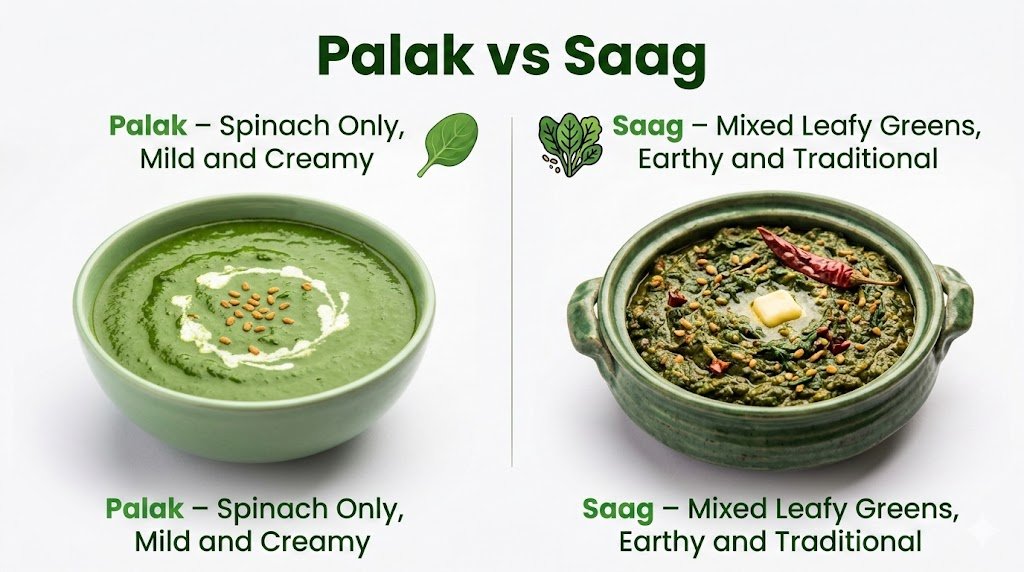
Quick Ans: The main difference between palak vs saag is that palak refers specifically to spinach, while saag is a broader term for leafy greens used in South Asian cooking. Palak dishes use only spinach, whereas saag dishes may combine mustard greens, spinach, fenugreek, or other greens. In short, all palak is saag, but not all saag is palak.
Many people feel confused about palak vs saag. Both words appear in Indian and Pakistani menus. Both are green. Both are often cooked with spices. So, are they the same?
Not exactly.
The confusion usually begins when someone orders palak paneer and saag paneer and expects identical dishes. Although they look similar, the ingredients can differ. This difference changes the flavor, texture, and even nutrition.
Understanding palak vs saag helps you order correctly in restaurants. It also helps if you cook South Asian food at home. Moreover, knowing the difference gives you deeper insight into regional cuisine.
In this complete guide, you will learn definitions, cooking styles, regional uses, advantages, disadvantages, examples, common mistakes, and more. By the end, you will clearly understand how palak and saag differ and when to use each one.
Quick Answer: Palak vs Saag
Here is the simple comparison.
| Feature | Palak | Saag |
|---|---|---|
| Meaning | Spinach | Leafy greens |
| Specific or General | Specific | General |
| Main Ingredient | Spinach only | Can include mustard greens, spinach, fenugreek, bathua |
| Flavor | Mild and smooth | Earthy and bold |
| Popular Dish | Palak Paneer | Sarson da Saag |
In short, palak means spinach. In contrast, saag means leafy greens in general.
What Is Palak?
Palak is the Hindi and Urdu word for spinach. In cooking, it refers specifically to dishes made primarily with spinach leaves.
Palak dishes are common in Indian and Pakistani cuisine. Typically, the spinach is blanched, pureed, and cooked with spices such as:
- Garlic
- Ginger
- Cumin
- Garam masala
- Green chilies
Because spinach has a mild taste, palak dishes are smooth and creamy when blended.
Popular Palak Dishes
- Palak paneer
- Palak chicken
- Palak dal
- Palak soup
Among these, palak paneer is the most famous internationally.
How Palak Is Cooked
First, fresh spinach is washed and chopped.
Next, it is boiled or blanched briefly.
Then, it is blended into a puree.
After that, spices are sautéed in oil or ghee.
Finally, the spinach puree is added and cooked.
As a result, the dish becomes smooth and bright green.
What Is Saag?
Saag is a general term used in Punjabi, Hindi, and Urdu for leafy green vegetables. Unlike palak, saag does not refer to a single plant.
Saag can include:
- Mustard greens
- Spinach
- Fenugreek leaves
- Bathua
- Collard greens
Therefore, saag is a category, not a specific ingredient.
Traditional Saag Dish
One of the most famous dishes is sarson da saag, made mainly from mustard greens. It is especially popular in Punjab, both in India and Pakistan.
Because mustard greens taste stronger and more earthy than spinach, saag dishes often have a deeper flavor.
How Saag Is Cooked
The greens are washed and chopped.
Then, they are slow cooked until soft.
Sometimes, they are coarsely mashed rather than fully blended.
Finally, spices, butter, or ghee are added.
Consequently, saag often has a thicker and slightly textured consistency compared to palak.
Key Differences Between Palak vs Saag
Ingredient Specificity
Palak refers only to spinach.
Saag refers to many types of leafy greens.
Flavor Profile
Palak tastes mild and slightly sweet.
Saag, especially mustard based saag, tastes earthy and sometimes slightly bitter.
Texture
Palak dishes are usually smooth and creamy.
Saag dishes can be thicker and more rustic.
Regional Preference
Palak dishes are popular across India and Pakistan.
Saag is especially traditional in Punjab.
Thus, the palak vs saag debate depends largely on ingredients and regional cooking style.
Advantages and Disadvantages
Palak Advantages
- Mild taste suitable for beginners
- Smooth texture
- Easy to find spinach in markets
- Quick cooking time
Palak Disadvantages
- Less complex flavor
- May taste bland if under seasoned
Saag Advantages
- Rich and earthy flavor
- More traditional in some regions
- Higher variety of greens
- Stronger nutritional diversity
Saag Disadvantages
- Some greens may taste bitter
- Takes longer to cook
- Ingredients may not always be available
Therefore, your choice between palak vs saag depends on taste preference and ingredient access.
Nutritional Comparison
Both palak and saag are healthy. However, the nutrient profile may vary.
| Nutrient | Palak (Spinach) | Saag (Mixed Greens) |
|---|---|---|
| Iron | High | High |
| Fiber | Moderate | High |
| Vitamin A | High | Very High |
| Vitamin C | High | High |
| Calories | Low | Low |
Because saag may combine multiple greens, it can offer a broader range of nutrients. On the other hand, palak alone still provides excellent iron and vitamins.
Real World Examples
At a Restaurant
If you see palak paneer and saag paneer on a menu, the difference is usually the type of greens used. Palak paneer uses only spinach. Saag paneer may include mustard greens or a mix.
At Home Cooking
If you only have spinach, make palak.
If you have mustard greens and fenugreek, try saag.
During Winter in Punjab
Traditionally, families prepare sarson da saag in winter because mustard greens grow in cold weather.
Thus, climate and agriculture influence the palak vs saag choice.
Regional and Global Usage
In India
Palak dishes are popular across many states. Saag, especially mustard based saag, is strongly connected to Punjab.
In Pakistan
Saag is a common winter dish in Punjab and rural areas. Palak dishes are also widely enjoyed.
Internationally
Outside South Asia, many restaurants label spinach based dishes as saag because the term sounds traditional. However, technically, palak is more accurate when only spinach is used.
Therefore, menu labeling can add to the palak vs saag confusion.
Related Concepts and Comparisons
Palak vs Saag Paneer
Palak paneer uses pure spinach.
Saag paneer may include mixed greens.
Saag vs Spinach
Spinach is a specific plant.
Saag can include spinach but also other leafy vegetables.
Palak vs Methi
Palak means spinach.
Methi refers to fenugreek leaves, which have a slightly bitter taste.
Understanding these related terms helps avoid ordering mistakes.
Common Mistakes About Palak vs Saag
Thinking They Are Identical
Although similar in appearance, they differ in ingredients and flavor.
Assuming Saag Always Means Spinach
Saag can include spinach, but it may also include mustard greens or other leaves.
Ignoring Texture Differences
Palak is usually smooth.
Saag may be coarse or thick.
Overcooking Spinach
Overcooked spinach loses bright color. Therefore, blanch quickly for best results.
Beginner to Advanced Cooking Tips
Beginner Level
Start with palak paneer using fresh spinach. It is simple and mild.
Intermediate Level
Try mixing spinach and mustard greens for a balanced saag.
Advanced Level
Slow cook traditional sarson da saag and finish with butter and garlic tempering for authentic flavor.
As your skill grows, experiment with spice levels and texture control.
Step By Step Comparison Cooking Scenario
Suppose you have spinach and mustard greens at home.
If you prepare palak:
- Use only spinach.
- Blanch and puree it.
- Cook with spices.
If you prepare saag:
- Mix spinach and mustard greens.
- Slow cook until soft.
- Mash coarsely.
- Add butter and spices.
Even with similar cooking steps, the taste changes significantly. Therefore, the palak vs saag difference becomes clear in the final flavor.
Exercises With Answers
Exercise 1
Is palak a specific vegetable or a general category?
Answer: Specific vegetable, spinach.
Exercise 2
Can saag include mustard greens?
Answer: Yes.
Exercise 3
Which dish usually has a smoother texture?
Answer: Palak.
Exercise 4
Which is more traditional in Punjab during winter?
Answer: Sarson da saag.
Exercise 5
True or False: All saag dishes are made only with spinach.
Answer: False.
When Should You Choose Palak vs Saag?
Choose palak if you:
- Prefer mild flavor
- Want smooth texture
- Only have spinach
Choose saag if you:
- Enjoy earthy taste
- Want traditional Punjabi style
- Have access to mixed greens
Ultimately, both are nutritious and delicious. The best choice depends on availability and personal preference.
FAQs About Palak vs Saag
What is the main difference between palak vs saag?
Palak means spinach specifically, while saag refers to leafy greens in general.
Is palak the same as saag?
Not exactly. In the palak vs saag comparison, palak is one type of saag.
Which is healthier, palak or saag?
Both are healthy. However, saag may provide more nutrient variety if multiple greens are used.
Does saag always contain mustard greens?
No. Saag can include different leafy vegetables depending on region.
Why does saag taste stronger than palak?
Because mustard greens and other leaves have a more earthy and sometimes bitter flavor.
Can I substitute palak for saag in recipes?
Yes, but the flavor will be milder compared to traditional saag.
Is palak paneer different from saag paneer?
Yes. Palak paneer uses spinach only, while saag paneer may use mixed greens.
Which cooks faster, palak or saag?
Palak cooks faster because spinach softens quickly.
Why is saag popular in winter?
Mustard greens grow in cold weather, making saag a seasonal favorite.
Are palak and saag used outside South Asia?
Yes. Many international Indian restaurants serve both dishes.
Conclusion
The difference between palak vs saag is simple but important. Palak refers specifically to spinach. Saag refers to a variety of leafy greens.
Although both dishes look green and share spices, the flavor and texture can differ greatly. Palak is smooth and mild. Saag is earthy and sometimes stronger in taste.
If you want something light and creamy, choose palak. However, if you want traditional Punjabi flavor and deeper taste, choose saag.
For home cooks, start with palak for simplicity. Then, gradually experiment with mixed greens to make authentic saag.
Now that you understand palak vs saag clearly, you can order confidently and cook with better knowledge.

Lisa Thompson is a USA-based content writer and language specialist focused on grammar, writing improvement and digital publishing.
She holds a degree in English Language and Communication and has professional experience in educational and web content creation.
As the author of Gramtivo.Com, she aims to help readers improve their writing skills through clear and practical guidance.


Pingback: TheraBreath vs Listerine: Differences, Ingredients, Benefits, and Best Mouthwash Guide