
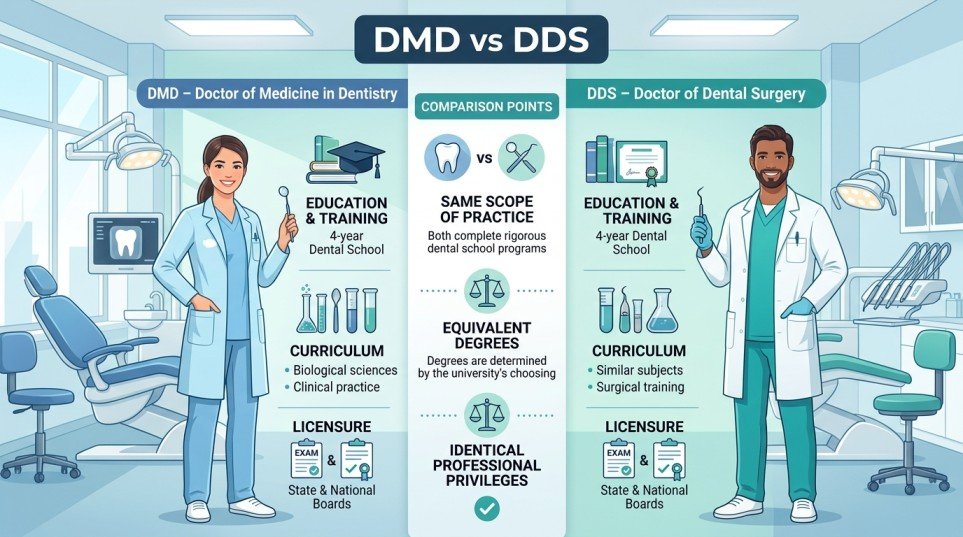
Quick Ans: The difference between DMD or DDS is mainly the degree title, not the dentist’s skill or education. DMD stands for Doctor of Medicine in Dentistry, while DDS stands for Doctor of Dental Surgery. Both degrees require the same training, licensing, and professional qualifications in modern dentistry.
Many patients feel confused when choosing between a dentist with a DMD or DDS degree. The titles sound different. One includes “medicine,” while the other includes “surgery.” Because of this, people often assume one dentist is more qualified than the other.
However, that is not true.
Both DMD and DDS dentists complete the same level of dental education. They study oral health, teeth, gums, dental procedures, and patient care. After graduation, both must pass licensing exams before treating patients.
The confusion usually comes from university traditions rather than differences in skill. Some dental schools award the DDS title, while others award the DMD title. Despite the different names, the education standards remain equal.
Understanding DMD or DDS helps patients choose dentists with confidence. It also helps students exploring dental careers understand the profession better.
This guide explains everything clearly. You will learn definitions, history, similarities, differences, career paths, common myths, practical examples, and FAQs.
Quick Answer: DMD or DDS
To quickly understand DMD or DDS, focus on the degree title rather than training differences.
| Feature | DMD | DDS |
|---|---|---|
| Full Form | Doctor of Medicine in Dentistry | Doctor of Dental Surgery |
| Education Level | Same as DDS | Same as DMD |
| Licensing Exams | Same | Same |
| Clinical Training | Same | Same |
| Professional Rights | Same | Same |
In simple terms, DMD and DDS are equal dental degrees.
What Is a DMD?
A DMD stands for Doctor of Medicine in Dentistry. Some universities use the Latin phrase Dentariae Medicinae Doctor, which translates to DMD.
Dentists with this degree complete:
- Dental school education
- Clinical training
- Patient care practice
- Licensing examinations
Despite the name, DMD dentists are not medical doctors in the traditional physician sense. Instead, they are fully licensed dental professionals.
Why Some Schools Use DMD
The distinction comes from academic tradition.
Harvard University originally preferred Latin based degree names. Because of that choice, the school adopted DMD instead of DDS. Later, several other universities followed the same approach.
Common Responsibilities of DMD Dentists
DMD dentists perform many dental procedures such as:
- Teeth cleaning
- Fillings
- Crowns
- Root canals
- Tooth extractions
- Cosmetic dentistry
Therefore, patients receive the same treatment standards from DMD professionals as they would from DDS professionals.
What Is a DDS?
A DDS stands for Doctor of Dental Surgery. This degree has existed longer historically and remains widely used across dental schools.
Like DMD graduates, DDS dentists complete extensive training in oral health and dental care.
What DDS Dentists Study
Dental school education includes:
- Oral anatomy
- Dental surgery
- Gum health
- X ray interpretation
- Patient diagnosis
- Preventive care
Clinical practice also forms a major part of training.
Common Responsibilities of DDS Dentists
DDS dentists commonly provide:
- Routine checkups
- Fillings and crowns
- Teeth whitening
- Orthodontic referrals
- Oral surgery procedures
As a result, DDS dentists work in the same professional field as DMD dentists.
Key Differences Between DMD or DDS
Degree Name
The main difference in DMD or DDS is the wording of the degree title.
- DMD means Doctor of Medicine in Dentistry.
- DDS means Doctor of Dental Surgery.
Education
Education standards are identical. Both degrees require:
- Four years of dental school
- Clinical experience
- National licensing exams
Skills and Training
Neither degree is superior. Dentists from both programs learn the same procedures and patient care techniques.
Career Opportunities
Graduates with either degree can pursue:
- General dentistry
- Orthodontics
- Oral surgery
- Pediatric dentistry
- Cosmetic dentistry
Consequently, career paths remain the same.
Advantages and Disadvantages
DMD Advantages
DMD dentists benefit from:
- Recognized professional qualification
- Equal licensing opportunities
- Full dental practice rights
- Access to dental specialties
DMD Disadvantages
Potential drawbacks include:
- Public confusion about the title
- Misunderstanding about medical training
DDS Advantages
DDS dentists enjoy:
- Long historical recognition
- Strong public familiarity
- Equal professional authority
- Access to specialty training
DDS Disadvantages
Some people incorrectly assume DDS focuses only on surgery, which is inaccurate.
Ultimately, there is no practical quality difference between DMD or DDS.
Educational Path for DMD and DDS
Undergraduate Education
Most future dentists first complete a bachelor’s degree.
Common majors include:
- Biology
- Chemistry
- Health sciences
Dental Admission Test
Students usually take the Dental Admission Test, often called the DAT.
Dental School
Dental school typically lasts four years.
Students study:
- Oral disease
- Dental procedures
- Pharmacology
- Patient care
- Clinical practice
Licensing
After graduation, both DMD and DDS graduates must pass licensing exams before practicing dentistry.
Because licensing standards are equal, patients receive similar care quality.
Real World Examples
Visiting a Local Dentist
You may notice one clinic lists a dentist as DDS while another lists DMD. In practice, both dentists can perform the same treatments.
Cosmetic Dentistry
Whether your cosmetic dentist holds a DMD or DDS degree does not determine treatment quality. Experience and patient reviews matter more.
Orthodontic Treatment
Braces and aligner treatment can be provided by specialists who originally earned either degree title.
These examples show why the DMD or DDS distinction rarely affects patient care.
Regional and Global Usage
United States
Both DMD and DDS degrees are widely recognized across the United States.
Canada
Canadian dental schools may award either degree depending on university tradition.
International Dentistry
Other countries often use different degree systems entirely. However, DMD and DDS remain respected dental qualifications internationally.
Therefore, the difference mostly reflects naming conventions rather than skill levels.
Related Concepts and Comparisons
DMD vs Medical Doctor
Dentists focus on oral health, while physicians focus on general medical care.
DDS vs Orthodontist
Orthodontists first earn either a DMD or DDS degree before completing specialty training.
DMD or DDS vs Oral Surgeon
Oral surgeons also begin with DMD or DDS degrees before advanced surgical education.
DMD vs DDS Comparison Table
| Feature | DMD | DDS |
|---|---|---|
| Degree Type | Dental degree | Dental degree |
| Education Length | Same | Same |
| Licensing | Same | Same |
| Clinical Skills | Same | Same |
| Specialty Access | Same | Same |
This comparison highlights how similar the two degrees truly are.
Common Mistakes About DMD or DDS
Assuming DDS Is Better
Some patients think DDS dentists have more surgical expertise. In reality, education standards are the same.
Believing DMD Means Medical Doctor
DMD dentists are licensed dental professionals, not general physicians.
Choosing Dentists Based Only on Degree Title
Experience, communication, and patient care quality matter more than whether a dentist has a DMD or DDS degree.
Ignoring Specialization
A general dentist and specialist may both hold the same degree title, but their advanced training differs significantly.
Avoiding these misunderstandings helps patients make informed decisions.
Beginner to Advanced Career Insights
Beginner Level
Students interested in dentistry should focus on science education and strong academic performance.
Intermediate Level
Dental students develop clinical skills through supervised patient care.
Advanced Level
Experienced dentists may specialize in areas such as:
- Orthodontics
- Pediatric dentistry
- Oral surgery
- Prosthodontics
- Endodontics
Both DMD and DDS graduates can pursue these advanced careers.
Step By Step Career Scenario
Imagine a student wants to become a dentist.
The process usually includes:
- Complete undergraduate education
- Pass the Dental Admission Test
- Attend dental school
- Earn DMD or DDS degree
- Pass licensing exams
- Begin clinical practice or specialization
Although schools award different titles, the professional path remains nearly identical.
Exercises With Answers
Exercise 1
What does DDS stand for?
Answer: Doctor of Dental Surgery.
Exercise 2
What does DMD stand for?
Answer: Doctor of Medicine in Dentistry.
Exercise 3
Do DMD and DDS dentists complete the same education?
Answer: Yes.
Exercise 4
Can both DMD and DDS dentists specialize in orthodontics?
Answer: Yes.
Exercise 5
True or False: DDS dentists are automatically more qualified than DMD dentists.
Answer: False.
When Should You Choose DMD or DDS?
Patients should focus on factors such as:
- Experience
- Reputation
- Communication skills
- Patient reviews
- Office environment
The degree title alone should not determine your decision.
Choose a dentist who makes you feel comfortable and explains treatment clearly.
FAQs About DMD or DDS
What is the main difference between DMD or DDS?
The main difference is the degree title. Education and licensing standards are the same.
Is a DMD better than a DDS?
No. Both degrees provide equal professional qualifications in dentistry.
Do DMD and DDS dentists perform the same procedures?
Yes. Both can provide cleanings, fillings, crowns, extractions, and many other treatments.
Why do some schools use DMD instead of DDS?
The difference comes from university tradition and Latin terminology preferences.
Can both DMD and DDS become specialists?
Yes. Graduates from either program can specialize in orthodontics, oral surgery, and other fields.
Is DDS older than DMD?
Yes. DDS existed first historically, but both are equally recognized today.
Do patients receive different treatment quality from DMD or DDS dentists?
No. Treatment quality depends more on experience and skill than degree title.
Can DMD or DDS dentists prescribe medication?
Yes. Licensed dentists can prescribe medications related to dental treatment.
Which degree is more common, DMD or DDS?
DDS is slightly more common historically, although many schools now award DMD degrees.
Should patients worry about choosing DMD or DDS?
No. Patients should focus on the dentist’s experience, reviews, and communication skills instead.
Conclusion
Understanding DMD or DDS becomes simple once you know the difference is mostly in the degree name. Both titles represent fully trained and licensed dentists who complete the same educational standards and clinical training.
A DMD means Doctor of Medicine in Dentistry. A DDS means Doctor of Dental Surgery. Despite the different wording, neither degree is better or more advanced.
Patients should therefore focus less on titles and more on professional experience, patient comfort, communication, and treatment quality. A skilled and caring dentist matters far more than the letters after their name.
For students considering dentistry, both paths offer equal opportunities for specialization and career growth. Whether a school awards DMD or DDS depends mainly on institutional tradition.
By understanding the facts behind DMD or DDS, patients and future dental professionals can make more informed decisions with confidence.
Discover More:-

Robert Mitchell is a U.S.-based writer at Gramtivo.Com who focuses on grammar, writing improvement, and language-related content. He holds a degree in English and Linguistics from a U.S. university. His work aims to help readers enhance their writing skills with clear and practical guidance.