
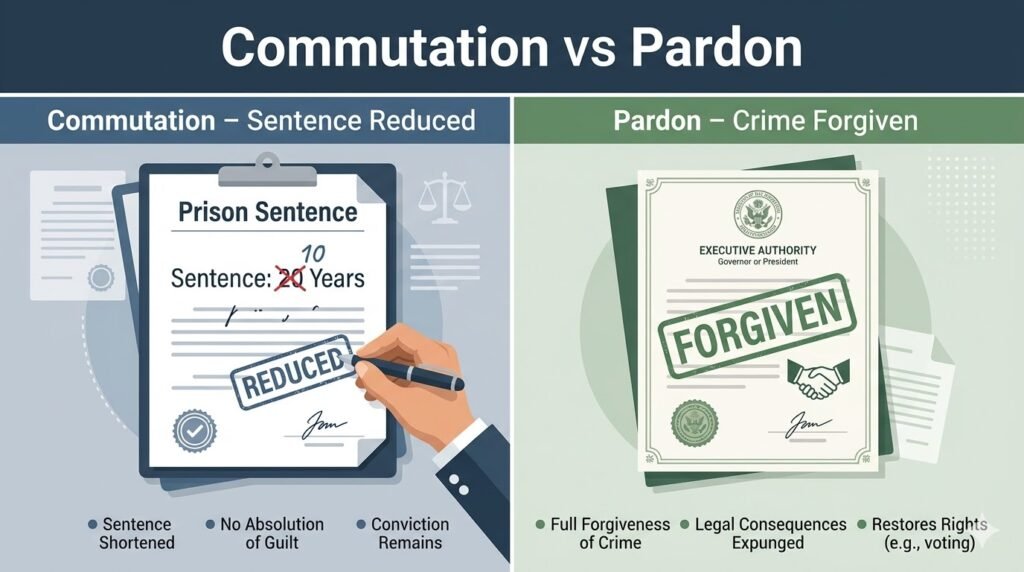
Quick Ans: The key difference between commutation vs pardon is how each affects a criminal sentence. A commutation reduces or changes a punishment without removing the conviction. A pardon, however, forgives the crime and restores certain rights after a conviction.
People often search for commutation vs pardon when learning about criminal justice or executive powers. Both actions come from government leaders such as presidents or governors. Both provide relief to someone convicted of a crime. Despite these similarities, they are not the same.
A commutation changes a sentence. A pardon forgives a crime. Because these outcomes differ, the legal impact also changes.
Many news stories mention pardons or commutations, especially when political leaders grant them to prisoners. As a result, confusion develops about what each term actually means. Some people think both actions erase a conviction. Others assume they automatically free someone from prison.
Understanding commutation vs pardon helps clarify how legal mercy works in the justice system. It also explains how executive power can reduce punishments or restore civil rights.
This guide explains both terms in simple language. You will learn definitions, advantages, disadvantages, real world examples, common mistakes, and related concepts.
Quick Answer: Commutation vs Pardon
The easiest way to understand commutation vs pardon is by looking at how they affect punishment and criminal records.
| Feature | Commutation | Pardon |
|---|---|---|
| Definition | Reduction of sentence | Forgiveness of crime |
| Conviction Status | Remains on record | Still exists but forgiven |
| Prison Release | May shorten prison time | May occur but not guaranteed |
| Rights Restoration | Usually no | Often restores civil rights |
| Authority | President or governor | President or governor |
In simple terms, commutation reduces punishment, while pardon forgives the offense.
What Is a Commutation?
A commutation reduces the severity of a criminal sentence. It does not cancel the conviction. Instead, it changes the punishment to something less severe.
For example, a life sentence might become a 20 year sentence. A death penalty sentence might change to life imprisonment.
The person remains legally guilty even after receiving a commutation.
Key Features of Commutation
Several characteristics define commutations:
- Sentence reduction rather than forgiveness
- Conviction remains on record
- Prison release may occur earlier
- Granted by executive authority
Because the conviction stays in place, the legal record still shows the crime.
How Commutation Works
The process typically involves several steps:
- A prisoner submits a clemency request
- Authorities review the case
- A president or governor evaluates the request
- If approved, the sentence is reduced
Commutations often occur when leaders believe the punishment was too harsh.
What Is a Pardon?
A pardon is an act of forgiveness granted by a government leader. Unlike commutation, a pardon focuses on forgiving the crime rather than reducing the sentence.
The conviction still exists in the historical record. However, the government formally forgives the offense.
Key Features of Pardons
Several important characteristics define pardons:
- Official forgiveness of a crime
- Possible restoration of civil rights
- Symbolic recognition of rehabilitation
- Granted by executive authority
A pardon may occur after a person completes their sentence.
How Pardons Work
The process generally follows these steps:
- A person applies for a pardon
- Officials review the application
- Evidence of rehabilitation is considered
- A president or governor makes the final decision
Pardons often reward good behavior and rehabilitation.
Key Differences Between Commutation vs Pardon
Purpose
The primary purpose of commutation is reducing punishment. The purpose of a pardon is forgiving the offense.
Effect on Sentence
Commutation shortens or changes a sentence. A pardon does not necessarily alter the sentence.
Effect on Rights
Pardons often restore civil rights such as voting or holding public office. Commutations usually do not restore these rights.
Legal Status
Both actions leave the conviction in place. However, a pardon provides formal forgiveness while commutation simply changes punishment.
Advantages and Disadvantages
Commutation Advantages
Commutations offer several benefits:
- Reduce overly harsh sentences
- Provide relief for deserving prisoners
- Allow earlier release from prison
- Address unfair punishments
Commutation Disadvantages
However, some limitations exist:
- Conviction remains on record
- Civil rights may not be restored
- Public criticism may arise
Pardon Advantages
Pardons provide different benefits:
- Official forgiveness from the government
- Restoration of civil rights
- Recognition of rehabilitation
- Improved employment opportunities
Pardon Disadvantages
Certain challenges also appear:
- Conviction still appears in historical records
- Political controversy may occur
- Approval rates remain low
Understanding these points helps explain the legal impact of commutation vs pardon.
Real World Examples
Presidential Commutation
A president might commute the sentence of a prisoner serving life for a nonviolent offense. The punishment becomes shorter, allowing earlier release.
Presidential Pardon
A president might pardon someone convicted of a past crime after the person demonstrates rehabilitation.
State Level Clemency
Governors also grant commutations and pardons at the state level. Many states maintain boards that review applications before approval.
These examples show how commutation vs pardon functions in real legal systems.
Regional and Global Usage
United States
In the United States, the president can grant pardons and commutations for federal crimes. Governors usually handle clemency for state crimes.
Other Countries
Different countries have similar systems. Monarchs, presidents, or justice ministers may hold clemency powers.
Historical Context
Historically, rulers used pardons to show mercy or correct injustices. Modern systems continue this tradition under constitutional rules.
Therefore, the idea behind commutation vs pardon appears in many legal systems worldwide.
Related Concepts and Comparisons
Clemency
Clemency is the broader term that includes both commutation and pardon.
Amnesty
Amnesty applies to groups of people rather than individuals. Governments sometimes grant amnesty after political conflicts.
Parole
Parole allows prisoners to serve part of their sentence outside prison under supervision.
Comparison Table
| Concept | Meaning | Key Feature |
|---|---|---|
| Commutation | Reduced sentence | Punishment changes |
| Pardon | Forgiveness of crime | Rights may be restored |
| Clemency | General mercy power | Includes both actions |
| Parole | Conditional release | Prison supervision continues |
These related ideas help clarify the full meaning of commutation vs pardon.
Common Mistakes About Commutation vs Pardon
Assuming They Are Identical
Some people believe both actions erase criminal convictions. In reality, each serves a different purpose.
Thinking Pardons Remove Criminal Records
A pardon forgives the offense but does not completely erase the conviction.
Believing Commutations Restore Rights
Commutations reduce punishment but rarely restore civil rights.
Ignoring Legal Authority
Only specific government leaders can grant these actions. Courts cannot issue pardons or commutations.
Avoiding these misunderstandings helps people interpret legal news more accurately.
Beginner to Advanced Legal Insights
Beginner Level
At a basic level, remember one key rule: commutation changes punishment while pardon forgives the crime.
Intermediate Level
Legal scholars often debate when clemency should be used. Some argue it corrects unfair sentences.
Advanced Level
At higher levels of law study, researchers analyze how clemency powers influence criminal justice reform and sentencing policies.
These perspectives show how commutation vs pardon fits into broader legal discussions.
Step By Step Legal Scenario
Imagine a prisoner serving a long sentence.
If the president grants a commutation:
- The sentence becomes shorter
- Prison release may occur earlier
- The conviction remains on record
If the president grants a pardon:
- The government forgives the crime
- Civil rights may be restored
- The conviction remains historically documented
Although both actions provide relief, the legal outcomes differ.
Exercises With Answers
Exercise 1
Which action reduces a criminal sentence in the commutation vs pardon comparison?
Answer: Commutation.
Exercise 2
Which action forgives a crime?
Answer: Pardon.
Exercise 3
Which option may restore civil rights?
Answer: Pardon.
Exercise 4
Which option keeps the conviction but shortens punishment?
Answer: Commutation.
Exercise 5
True or False: A pardon always removes the criminal conviction.
Answer: False.
When Should Commutation vs Pardon Be Used?
Commutation may be appropriate when:
- A sentence is excessively harsh
- Prisoners show good behavior
- Laws change after sentencing
Pardons may be appropriate when:
- Individuals demonstrate rehabilitation
- Civil rights restoration is justified
- The government recognizes injustice
Legal leaders must evaluate each case carefully.
FAQs About Commutation vs Pardon
What is the main difference between commutation vs pardon?
A commutation reduces a sentence, while a pardon forgives the crime and may restore civil rights.
Does a commutation erase a criminal conviction?
No. The conviction remains on record even after a sentence reduction.
Does a pardon mean someone is innocent?
Not necessarily. A pardon forgives the crime but does not declare innocence.
Can a president grant both commutations and pardons?
Yes. In the United States, presidents can grant both for federal crimes.
Can governors issue pardons and commutations?
Yes. Governors usually handle clemency for state level crimes.
Does a pardon release someone from prison?
Not always. A pardon forgives the offense but may occur after the sentence ends.
Can a commutation free someone from prison?
Yes, if the reduced sentence results in immediate release.
What is clemency in relation to commutation vs pardon?
Clemency is the broader category that includes both actions.
Why do governments grant pardons?
Governments often grant pardons to recognize rehabilitation or correct injustice.
Are commutations common?
They occur less frequently than many people think and usually follow careful review.
Conclusion
Understanding commutation vs pardon is important for anyone studying law, politics, or criminal justice. Both actions represent forms of executive clemency, yet they serve different purposes.
A commutation reduces or changes a punishment. The conviction remains on record, and the main goal is to adjust an unfair or excessive sentence.
A pardon, on the other hand, represents forgiveness from the government. While the conviction still exists historically, the individual may regain civil rights and social recognition.
Leaders use these powers carefully because they affect justice, fairness, and public trust. When applied properly, commutations can correct overly harsh sentences. Pardons can recognize rehabilitation and offer second chances.
Understanding these differences allows people to interpret legal decisions and political news more accurately.
Discover More:-
- Stretcher vs Gurney: Key Differences, Uses, and Medical Comparison Guide
- Offerpad vs Opendoor: Key Differences, Fees, and Home Selling Guide

Robert Mitchell is a U.S.-based writer at Gramtivo.Com who focuses on grammar, writing improvement, and language-related content. He holds a degree in English and Linguistics from a U.S. university. His work aims to help readers enhance their writing skills with clear and practical guidance.


Pingback: Dissolution vs Divorce: Key Differences, Process, and Legal Guide
Pingback: AG1 vs 8Greens: Differences, Benefits, Ingredients, and Which to Choose