
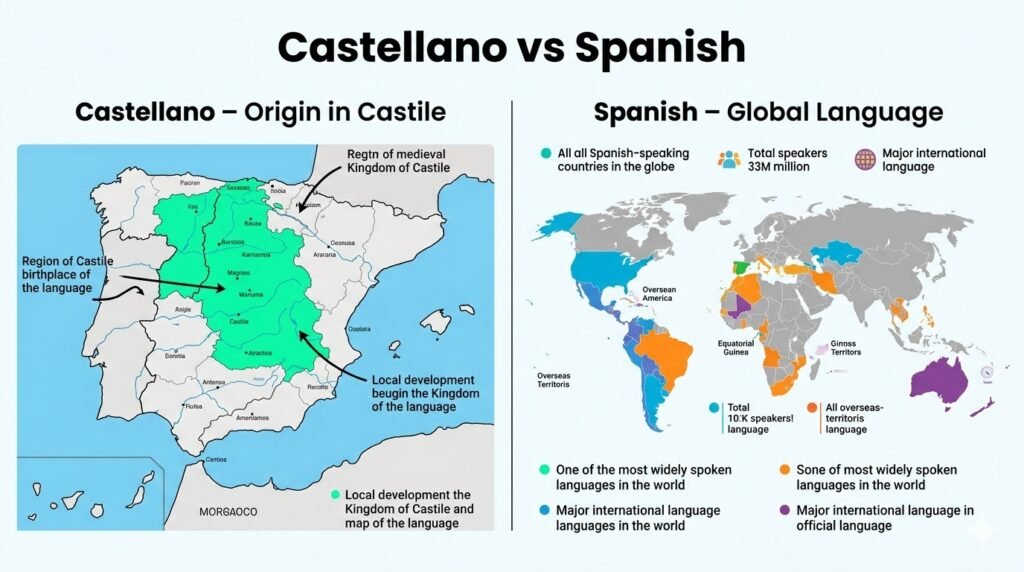
Quick Ans: The difference between Castellano vs Spanish mainly comes down to terminology and regional usage. Castellano refers specifically to the Spanish language that originated in the Castile region of Spain. Spanish, on the other hand, is the broader global term used for the language spoken across Spain and much of Latin America.
Many language learners become confused when they hear the terms Castellano vs Spanish. At first glance, both seem to describe the same language. In many situations, they actually do.
However, the terminology changes depending on geography, history, and cultural perspective. People in Spain may use the word Castellano to describe the standard Spanish language. Meanwhile, many international learners and English speakers simply use the word Spanish.
The confusion grows when someone studies the language in Latin America. In some countries, the language is officially called Castellano rather than Spanish. Despite the different names, the core language remains largely the same.
Understanding Castellano vs Spanish helps students, travelers, and educators communicate more clearly. It also provides insight into linguistic history and regional identity.
This guide explains the difference step by step. You will learn definitions, history, advantages of each term, real world examples, common mistakes, and practical exercises.
Quick Answer: Castellano vs Spanish
The easiest way to understand Castellano vs Spanish is through terminology.
| Feature | Castellano | Spanish |
|---|---|---|
| Meaning | Language from Castile region | Global name of the language |
| Usage | Common in Spain and parts of Latin America | Used worldwide |
| Historical Origin | Kingdom of Castile | Derived from Castellano |
| Scope | More specific term | Broader term |
In simple terms, Castellano is the original form of Spanish, while Spanish is the international name of the language.
What Is Castellano?
Castellano refers to the Spanish language that developed in the medieval Kingdom of Castile. This region was located in central Spain.
During the Middle Ages, several languages existed across the Iberian Peninsula. Over time, the Castilian dialect gained influence as political power expanded.
Eventually, this dialect became the foundation of modern Spanish.
Historical Development
The development of Castellano followed several stages:
- Latin spread across the Iberian Peninsula during the Roman Empire
- Regional dialects formed after the fall of Rome
- The Castilian dialect gained importance during the Reconquista
- Spanish rulers promoted Castellano as a national language
Because of this history, Castellano is often seen as the linguistic root of modern Spanish.
Where the Term Is Used
The word Castellano appears commonly in:
- Spain
- Argentina
- Uruguay
- Paraguay
- Chile
In these places, the term emphasizes the historical origin of the language.
What Is Spanish?
Spanish refers to the global language spoken by hundreds of millions of people around the world. The language evolved from Castellano but expanded far beyond Spain.
Today, Spanish is one of the most widely spoken languages globally.
Global Spread of Spanish
The language spread mainly during the Age of Exploration and colonization. Spanish explorers and settlers carried the language to the Americas, Africa, and Asia.
As a result, Spanish became the official language in many countries, including:
- Mexico
- Colombia
- Peru
- Spain
- Venezuela
- Ecuador
Each region developed its own accents and vocabulary, but the core language remains similar.
Modern Usage
In international contexts, the word Spanish is the most common name for the language. Schools, universities, and language courses almost always use this term.
For example, language programs usually advertise “Learn Spanish” rather than “Learn Castellano.”
Key Differences Between Castellano vs Spanish
Terminology
The most noticeable difference between Castellano vs Spanish involves naming.
Castellano refers specifically to the Castilian form of the language. Spanish serves as the broader international label.
Geographic Perspective
People in Spain sometimes say Castellano to distinguish it from other regional languages such as Catalan or Galician. In contrast, many global speakers use Spanish to describe the entire language.
Cultural Identity
Using the word Castellano can emphasize historical roots and regional identity. Meanwhile, the term Spanish highlights the global community of speakers.
Linguistic Scope
Castellano may refer to the standard form of Spanish from Spain. Spanish includes all regional varieties spoken worldwide.
Advantages and Disadvantages
Advantages of Using Castellano
- Highlights historical origin
- Distinguishes Spanish from other Iberian languages
- Common in certain Latin American countries
Disadvantages of Using Castellano
- Less familiar internationally
- May confuse language learners
- Not always recognized outside Spanish speaking regions
Advantages of Using Spanish
- Widely recognized worldwide
- Used in education and international communication
- Easier for language learners to understand
Disadvantages of Using Spanish
- Less specific about regional origin
- May overlook historical distinctions
Both terms remain correct depending on context.
Real World Examples
In Spain
A person in Madrid might say:
“I speak Castellano.”
This phrase distinguishes the language from Catalan, Basque, or Galician.
In Latin America
Many countries use both terms interchangeably. However, Argentina often prefers Castellano in official contexts.
In International Education
Language schools typically say:
“Spanish language course.”
Using the global term helps students from different countries understand the subject immediately.
These examples illustrate how Castellano vs Spanish depends on context and audience.
Regional and Global Usage
Spain
In Spain, the word Castellano frequently appears in education and government discussions. It identifies the national language while recognizing regional languages.
Latin America
Some Latin American countries officially refer to the language as Castellano in legal documents.
Global Communication
International organizations, universities, and language apps almost always use the term Spanish.
Therefore, global audiences are more familiar with Spanish than Castellano.
Related Concepts and Comparisons
Spanish vs Latin American Spanish
The Spanish spoken in Spain differs slightly from the varieties used in Latin America. Differences may include pronunciation, vocabulary, and expressions.
Castilian Spanish vs Regional Spanish
Castilian Spanish often refers to the standard variety used in Spain. Other regions have their own dialects.
Castellano vs Spanish vs Dialects
| Feature | Castellano | Spanish | Dialects |
|---|---|---|---|
| Definition | Original Castilian language | Global language name | Regional variations |
| Scope | Specific | Broad | Local speech patterns |
| Examples | Castilian Spanish | World Spanish | Mexican Spanish, Argentinian Spanish |
Understanding these relationships clarifies the broader linguistic landscape.
Common Mistakes About Castellano vs Spanish
Assuming They Are Different Languages
Some learners believe Castellano and Spanish are separate languages. In reality, they refer to the same linguistic system.
Thinking One Is More Correct
Both terms are correct. The choice depends on context and regional preference.
Ignoring Regional Identity
In Spain, language naming may reflect cultural identity. Understanding this helps avoid misunderstandings.
Overgeneralizing Dialects
Spanish contains many regional dialects. However, the core grammar and vocabulary remain similar.
Recognizing these nuances improves communication.
Beginner to Advanced Learning Tips
Beginner Level
Focus on basic vocabulary and grammar. Do not worry about the Castellano vs Spanish debate early in learning.
Intermediate Level
Learn regional vocabulary differences. Listening to speakers from different countries can help.
Advanced Level
Study linguistic history and dialect variation. Understanding language evolution provides deeper insight.
These steps help learners develop strong Spanish language skills.
Step By Step Learning Scenario
Imagine someone beginning a language course.
First, they enroll in a Spanish class online. The course introduces basic grammar and pronunciation.
Later, the student travels to Spain. Local speakers refer to the language as Castellano.
Eventually, the learner understands that both names describe the same language with historical context.
This scenario shows how Castellano vs Spanish becomes clearer with experience.
Exercises With Answers
Exercise 1
Which term refers to the historical language of the Castile region?
Answer: Castellano.
Exercise 2
Which name is used globally for the language?
Answer: Spanish.
Exercise 3
True or False: Castellano and Spanish are completely different languages.
Answer: False.
Exercise 4
Which term is more common in international education?
Answer: Spanish.
Exercise 5
In Spain, which word may be used to distinguish the national language from regional languages?
Answer: Castellano.
When Should You Use Castellano vs Spanish?
Use Castellano when:
- Speaking in Spain about the national language
- Distinguishing it from regional languages
- Referring to historical linguistic roots
Use Spanish when:
- Communicating internationally
- Teaching language courses
- Describing the global language
Choosing the right term depends on audience and context.
FAQs About Castellano vs Spanish
What is the difference between Castellano vs Spanish?
Castellano refers to the language originating in the Castile region of Spain, while Spanish is the global name for the same language.
Are Castellano and Spanish different languages?
No. In the Castellano vs Spanish comparison, both terms refer to the same language with different naming traditions.
Why do some people say Castellano instead of Spanish?
The term Castellano emphasizes historical origins and distinguishes the language from other regional languages in Spain.
Which term is more common worldwide?
Spanish is more common internationally, especially in education and global communication.
Do Latin American countries say Castellano?
Some countries, such as Argentina, officially use the term Castellano.
Is Castilian Spanish different from Latin American Spanish?
Yes. Pronunciation and vocabulary may vary, but the grammar remains largely the same.
Should language learners say Spanish or Castellano?
Most learners should use Spanish because it is widely understood worldwide.
Is Castellano the original form of Spanish?
Yes. Castellano developed in the Kingdom of Castile and later became the basis for modern Spanish.
Why does Spain use the term Castellano?
The term distinguishes the national language from other regional languages spoken in the country.
Are Spanish dialects very different from each other?
Some vocabulary and accents differ, but speakers from different regions can usually understand each other.
Conclusion
Understanding Castellano vs Spanish requires looking at history, culture, and geography. Both terms describe the same language, yet each highlights a different perspective.
Castellano refers to the historical language that developed in the Castile region of Spain. This term often appears in Spain and some Latin American countries when emphasizing linguistic roots or distinguishing the language from regional languages.
Spanish serves as the global name for the language spoken by hundreds of millions of people worldwide. It is the term most commonly used in education, international communication, and language learning.
Choosing between Castellano vs Spanish depends on context. In most global situations, Spanish is the safest and clearest option. However, understanding the term Castellano provides deeper insight into linguistic history and regional identity.
For language learners and travelers, recognizing both terms ensures clearer communication and a richer understanding of Spanish speaking cultures.
Discover More:-
- Stretcher vs Gurney: Key Differences, Uses, and Medical Comparison Guide
- Tumble vs Ruggable: Key Differences, Comfort, Price, and Washable Rug Guide

Robert Mitchell is a U.S.-based writer at Gramtivo.Com who focuses on grammar, writing improvement, and language-related content. He holds a degree in English and Linguistics from a U.S. university. His work aims to help readers enhance their writing skills with clear and practical guidance.