
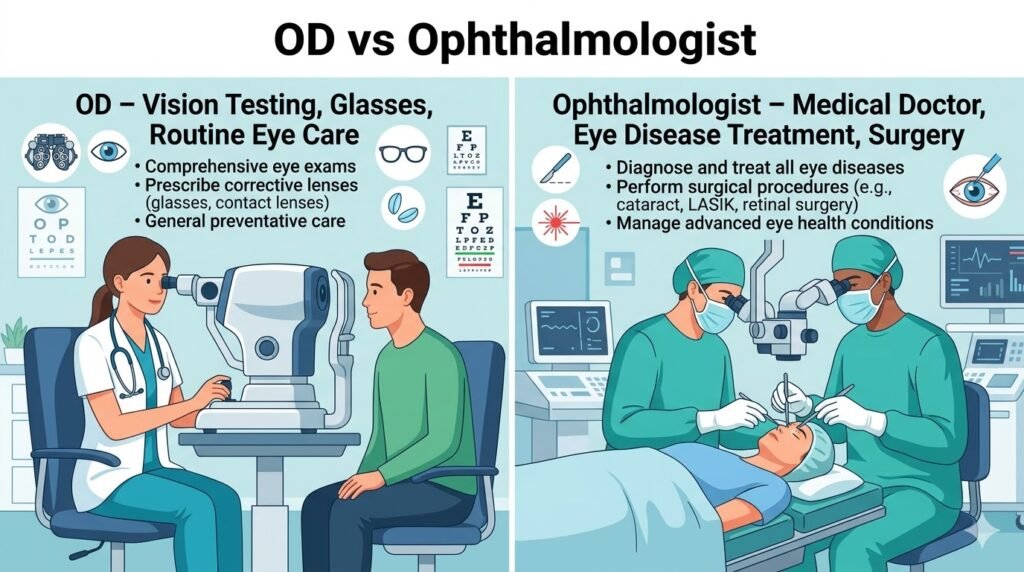
Quick Ans: The main difference between OD vs ophthalmologist is their level of medical training and the services they provide. An OD, or optometrist, performs eye exams and prescribes glasses or contact lenses. An ophthalmologist is a medical doctor who can diagnose diseases, prescribe medication, and perform eye surgery.
Many people feel confused when comparing OD vs ophthalmologist. Both professionals care for eye health. Both examine vision problems.
However, their training and responsibilities differ significantly.
An optometrist focuses on vision testing and routine eye care. An ophthalmologist receives full medical training and can treat complex eye diseases. Because of this difference, each professional plays a unique role in eye care.
For example, someone needing a new glasses prescription will usually visit an OD first. On the other hand, a patient with glaucoma or cataracts may need treatment from an ophthalmologist.
Understanding OD vs ophthalmologist helps patients choose the right professional for their needs. It also prevents unnecessary appointments and delays in treatment.
This guide explains the differences clearly. You will learn definitions, advantages, disadvantages, real world examples, common mistakes, and helpful practice exercises.
Quick Answer: OD vs Ophthalmologist
Understanding OD vs ophthalmologist becomes easier when comparing training and services.
| Feature | OD (Optometrist) | Ophthalmologist |
|---|---|---|
| Education | Doctor of Optometry degree | Medical doctor (MD or DO) |
| Medical School | No | Yes |
| Surgery | Cannot perform surgery | Can perform eye surgery |
| Eye Exams | Yes | Yes |
| Treat Eye Diseases | Some conditions | Full medical treatment |
| Prescribe Glasses | Yes | Yes |
In simple terms, an OD provides primary vision care, while an ophthalmologist provides medical and surgical eye care.
What Is an OD (Optometrist)?
An OD, or optometrist, is a healthcare professional who specializes in vision care and eye health. The title OD stands for Doctor of Optometry.
Optometrists perform routine eye exams and help people maintain healthy vision.
Education and Training
Optometrists complete several stages of education.
Typical training includes:
- Undergraduate college degree
- Four year Doctor of Optometry program
- Clinical training in vision care
Unlike ophthalmologists, optometrists do not attend medical school.
Services Provided by Optometrists
Optometrists provide many common eye care services.
These include:
- Vision testing
- Eye exams
- Prescribing glasses
- Prescribing contact lenses
- Detecting vision problems
- Monitoring eye health
Many optometrists also detect early signs of eye disease and refer patients to specialists when necessary.
Where Optometrists Work
Optometrists work in several healthcare settings:
- Eye clinics
- Optical stores
- Private practices
- Medical centers
Because of their accessibility, they often serve as the first step in eye care.
What Is an Ophthalmologist?
An ophthalmologist is a medical doctor who specializes in eye diseases, vision care, and eye surgery. Unlike optometrists, ophthalmologists complete full medical training.
Education and Training
Ophthalmologists complete extensive medical education.
Their training typically includes:
- Undergraduate college degree
- Medical school (MD or DO)
- Internship training
- Ophthalmology residency program
Many ophthalmologists also complete specialized fellowships.
Medical Services Provided
Ophthalmologists provide advanced medical treatment for eye conditions.
Their services include:
- Diagnosing eye diseases
- Prescribing medications
- Performing eye surgery
- Treating injuries
- Managing chronic eye conditions
They also perform routine eye exams and vision testing.
Common Eye Surgeries
Some procedures ophthalmologists perform include:
- Cataract surgery
- LASIK vision correction
- Retinal surgery
- Glaucoma surgery
These procedures require specialized medical training.
Key Differences Between OD vs Ophthalmologist
Level of Medical Training
The biggest difference between OD vs ophthalmologist involves education.
Optometrists earn a Doctor of Optometry degree. Ophthalmologists attend medical school and become licensed physicians.
Ability to Perform Surgery
Optometrists cannot perform eye surgery. Ophthalmologists regularly perform surgical procedures.
Medical Treatment
Optometrists diagnose vision issues and some eye conditions. Ophthalmologists treat complex diseases with medication or surgery.
Scope of Practice
Optometrists focus on primary vision care. Ophthalmologists provide advanced medical and surgical eye care.
These distinctions help patients determine which professional they should visit.
Advantages and Disadvantages
Advantages of Visiting an OD
Optometrists offer several benefits:
- Easier appointment availability
- Lower cost for basic exams
- Convenient locations in optical stores
- Focus on vision correction
Disadvantages of Visiting an OD
Some limitations exist:
- Cannot perform surgery
- Limited treatment for complex diseases
- May refer patients to specialists
Advantages of Visiting an Ophthalmologist
Ophthalmologists provide advanced medical services:
- Full medical diagnosis
- Surgical treatment
- Management of serious eye diseases
- Advanced testing equipment
Disadvantages of Visiting an Ophthalmologist
A few challenges may occur:
- Higher medical costs
- Longer appointment wait times
- Often located in specialized clinics
Therefore, the choice between OD vs ophthalmologist depends on the type of eye care needed.
Real World Examples
Routine Vision Check
Someone who needs new glasses usually visits an optometrist. The OD checks vision and updates the prescription.
Eye Disease Treatment
A patient diagnosed with glaucoma requires medical treatment. An ophthalmologist manages the condition with medication or surgery.
Eye Injury
Injuries involving the eye often require immediate medical attention. An ophthalmologist can provide emergency care and surgery if needed.
These examples demonstrate how OD vs ophthalmologist roles complement each other.
Regional and Global Usage
United States
In the United States, optometrists provide primary eye care. Ophthalmologists handle advanced medical treatment.
Canada and Europe
Similar systems exist in Canada and Europe. Optometrists perform routine eye exams, while ophthalmologists treat complex conditions.
Developing Healthcare Systems
In some regions, ophthalmologists handle most eye care due to limited healthcare professionals.
Healthcare structure therefore influences the OD vs ophthalmologist relationship worldwide.
Related Concepts and Comparisons
OD vs Optician
An optician helps fit glasses and lenses. Opticians do not perform eye exams.
Optometrist vs Ophthalmologist vs Optician
| Role | Optometrist (OD) | Ophthalmologist | Optician |
|---|---|---|---|
| Eye Exams | Yes | Yes | No |
| Prescribe Glasses | Yes | Yes | No |
| Medical Doctor | No | Yes | No |
| Surgery | No | Yes | No |
| Fit Glasses | Sometimes | Rarely | Yes |
Understanding these roles helps patients navigate the eye care system more easily.
Common Mistakes About OD vs Ophthalmologist
Assuming Both Are Medical Doctors
Optometrists are healthcare professionals but not medical doctors. Ophthalmologists complete medical school training.
Visiting the Wrong Specialist
Routine vision exams usually require an optometrist. Complex eye diseases require an ophthalmologist.
Ignoring Referral Advice
Optometrists often detect serious problems early. Ignoring referrals to ophthalmologists may delay treatment.
Confusing Opticians With Doctors
Opticians provide glasses and lens fitting services. They do not diagnose or treat eye conditions.
Avoiding these mistakes improves eye care decisions.
Beginner to Advanced Eye Care Tips
Beginner Level
Schedule regular eye exams every one or two years. Early detection prevents many vision problems.
Intermediate Level
Use protective eyewear during sports or hazardous activities.
Advanced Level
Monitor chronic conditions like diabetes or hypertension. These diseases can affect eye health significantly.
Consistent care helps maintain healthy vision.
Step By Step Patient Scenario
Imagine someone notices blurred vision.
If the patient visits an optometrist:
- The OD performs a vision exam
- The doctor checks eye health
- Glasses may be prescribed
If the problem involves disease:
- The OD refers the patient
- The ophthalmologist performs medical testing
- Treatment or surgery may follow
This process shows how OD vs ophthalmologist roles work together.
Exercises With Answers
Exercise 1
Which professional can perform eye surgery?
Answer: Ophthalmologist.
Exercise 2
Which professional commonly prescribes glasses?
Answer: Optometrist.
Exercise 3
Which professional attends medical school?
Answer: Ophthalmologist.
Exercise 4
Which professional performs routine eye exams?
Answer: Both optometrists and ophthalmologists.
Exercise 5
True or False: Opticians diagnose eye diseases.
Answer: False.
When Should You Choose OD vs Ophthalmologist?
Choose an optometrist (OD) if you:
- Need a vision exam
- Want new glasses or contact lenses
- Require routine eye health checks
Choose an ophthalmologist if you:
- Have an eye disease
- Need surgery
- Experience serious vision problems
- Have eye injuries
Selecting the correct professional ensures faster diagnosis and treatment.
FAQs About OD vs Ophthalmologist
What is the main difference between OD vs ophthalmologist?
An OD provides routine eye care and vision correction. An ophthalmologist is a medical doctor who treats eye diseases and performs surgery.
Is an OD a medical doctor?
No. An OD holds a Doctor of Optometry degree but does not attend medical school.
Can an optometrist diagnose eye diseases?
Yes. Optometrists can detect many eye conditions and refer patients to ophthalmologists when advanced care is needed.
Do ophthalmologists prescribe glasses?
Yes. Ophthalmologists can perform eye exams and prescribe glasses or contact lenses.
Which is better for a routine eye exam?
An optometrist usually handles routine vision exams efficiently and affordably.
Can an optometrist perform eye surgery?
No. Only ophthalmologists have the training and licensing to perform eye surgery.
Should I see an ophthalmologist for blurry vision?
Start with an optometrist. If a disease is suspected, a referral to an ophthalmologist may follow.
Do ophthalmologists treat glaucoma and cataracts?
Yes. Ophthalmologists diagnose and treat conditions such as glaucoma, cataracts, and retinal diseases.
What is an optician?
An optician fits and sells eyeglasses or contact lenses but does not perform eye exams.
Can children visit optometrists?
Yes. Optometrists commonly provide vision exams for children and adults.
Conclusion
Understanding OD vs ophthalmologist helps patients choose the right eye care professional. Both roles support eye health, but their training and responsibilities differ.
Optometrists provide primary vision care. Their work includes eye exams, vision correction, and early detection of eye problems. Because they are widely available, they often serve as the first point of contact for eye care.
Ophthalmologists are medical doctors who diagnose complex eye diseases and perform surgery. Their training allows them to treat serious conditions such as cataracts, glaucoma, and retinal disorders.
Most people begin with an optometrist for routine care. When specialized treatment becomes necessary, ophthalmologists provide advanced medical support.
Choosing the correct professional saves time and ensures proper treatment. With regular eye exams and timely medical care, individuals can protect their vision and maintain long term eye health.
Discover More:-
- Stretcher vs Gurney: Key Differences, Uses, and Medical Comparison Guide
- Offerpad vs Opendoor: Key Differences, Fees, and Home Selling Guide

Lisa Thompson is a USA-based content writer and language specialist focused on grammar, writing improvement and digital publishing.
She holds a degree in English Language and Communication and has professional experience in educational and web content creation.
As the author of Gramtivo.Com, she aims to help readers improve their writing skills through clear and practical guidance.


Pingback: Exception vs Acception: Meaning, Differences, and Correct Usage Guide