
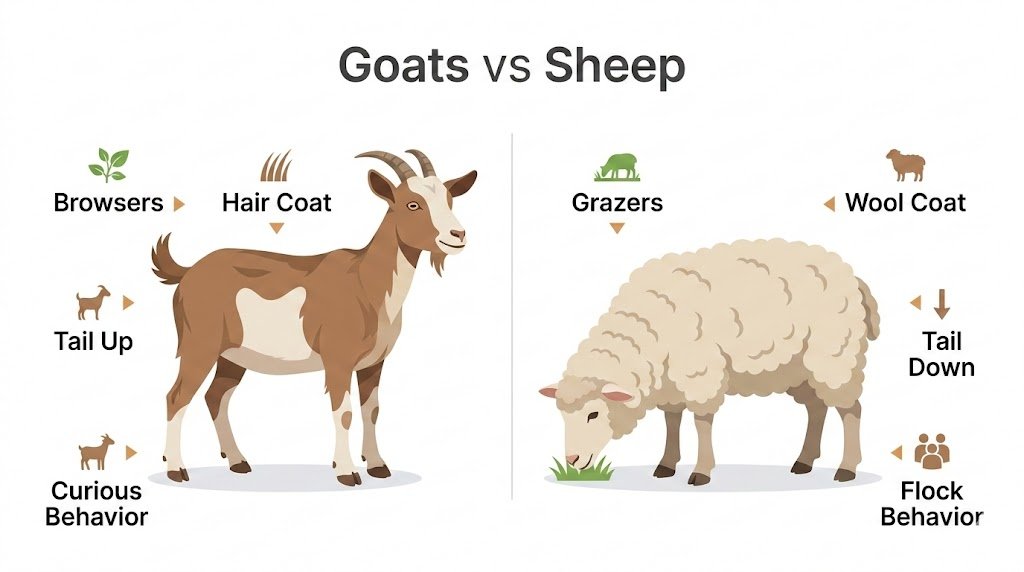
Quick Ans: The main difference between goats vs sheep lies in their behavior, physical traits, and feeding habits. Goats are curious browsers that eat leaves, shrubs, and plants above ground, while sheep are grazing animals that prefer grass. Although both animals belong to the same livestock family and are often raised on farms, they differ in appearance, temperament, and farming purposes.
Many people confuse goats vs sheep because the two animals look similar. Both have hooves. Both live on farms.
However, they are not the same animal.
At first glance, a beginner may struggle to tell them apart. Their size, color, and body shape can appear alike, especially from a distance. Because of this, people often assume goats and sheep are simply different names for the same animal.
In reality, several important differences exist. Their horns grow differently. Their tails move differently. Even their personalities are not the same.
Understanding goats vs sheep helps farmers choose the right livestock. It also helps students, animal lovers, and beginners recognize them easily.
In this guide, you will learn the key differences, advantages, uses, and common mistakes people make when identifying goats and sheep. By the end, you will clearly understand how these animals compare in the real world.
Quick Answer: Goats vs Sheep
The easiest way to understand goats vs sheep is to compare their physical traits and behavior.
| Feature | Goat | Sheep |
|---|---|---|
| Tail Position | Tail usually points upward | Tail usually points downward |
| Feeding Style | Browsers (eat shrubs and leaves) | Grazers (eat grass) |
| Hair / Coat | Hair | Wool |
| Behavior | Curious and independent | Calm and flock oriented |
| Horn Shape | Narrow and straighter | Thick and curved |
| Farming Use | Milk, meat, weed control | Wool, meat |
In short, goats are active browsers, while sheep are calm grazers.
What Are Goats?
Goats are hardy farm animals known for their curiosity and intelligence. They belong to the species Capra aegagrus hircus and are one of the oldest domesticated animals in the world.
Farmers raise goats for several purposes, including milk, meat, and land management.
Unlike many animals, goats prefer to explore their surroundings. They climb rocks, fences, and hills with ease. Because of this behavior, they are often described as adventurous livestock.
Common characteristics of goats include:
- Upright tails
- Narrow faces
- Beards in many males
- Hair instead of wool
- Active personality
What Do Goats Eat?
Goats are browsers. This means they prefer plants above ground rather than grass.
Typical goat diet includes:
- Leaves
- Shrubs
- Tree bark
- Vines
- Weeds
Because of their diet, farmers often use goats to control weeds and invasive plants.
Common Goat Breeds
Several popular breeds exist worldwide:
- Boer goats for meat
- Saanen goats for milk
- Nubian goats for dairy production
- Alpine goats for high milk yield
Each breed serves different farming goals.
What Are Sheep?
Sheep are calm and social animals that belong to the species Ovis aries. Humans have raised sheep for thousands of years, mainly for wool, meat, and milk.
Unlike goats, sheep are strong flock animals. They prefer to stay together in groups and rely on the herd for safety.
Typical sheep characteristics include:
- Thick wool coat
- Downward pointing tail
- Rounded body shape
- Gentle personality
What Do Sheep Eat?
Sheep are grazers. They prefer short grasses and plants close to the ground.
Their typical diet includes:
- Grass
- Clover
- Pasture plants
Because they graze continuously, sheep help maintain pasture land.
Common Sheep Breeds
Some well known sheep breeds include:
- Merino sheep for fine wool
- Suffolk sheep for meat
- Dorset sheep for lamb production
- Rambouillet sheep for wool and meat
Different regions favor different breeds depending on climate and farming needs.
Key Differences Between Goats vs Sheep
Tail Position
One of the easiest ways to identify goats vs sheep is tail direction.
Goats usually carry their tails upward. Sheep, on the other hand, hold their tails downward.
Coat Type
Goats grow hair. Sheep grow wool.
Wool is thicker and often used for textiles. Goat hair is lighter, though some breeds produce specialty fibers like cashmere.
Feeding Behavior
Another major difference between goats vs sheep is diet.
- Goats browse shrubs and leaves.
- Sheep graze on grass.
Because of this difference, farmers sometimes raise both animals together to manage land effectively.
Behavior and Personality
Goats are curious and independent. They explore and climb.
Sheep are more cautious and prefer to stay with their flock.
Advantages and Disadvantages
Goat Advantages
- Adapt well to rough terrain
- Eat weeds and shrubs
- Produce high quality milk
- Require less grass pasture
Goat Disadvantages
- Escape artists and climbers
- Can damage trees and plants
- Require strong fencing
Sheep Advantages
- Produce wool for clothing
- Calm and easy to manage
- Efficient grass grazers
- Good meat production
Sheep Disadvantages
- Sensitive to wet conditions
- Require regular wool shearing
- Less curious but more dependent on herd
Therefore, choosing between goats vs sheep depends on farm goals and environment.
Real World Examples
Small Farm
A small farmer may choose goats because they eat weeds and brush. As a result, they help clean overgrown land.
Wool Production
If the goal is textile production, sheep are a better choice. Their wool can be turned into clothing, blankets, and yarn.
Dairy Farming
Goat milk is popular worldwide. It is often used for cheese, yogurt, and specialty dairy products.
Land Management
In many regions, goats are used for natural weed control. Meanwhile, sheep maintain grass pastures by grazing evenly.
These real world uses highlight the practical differences between goats vs sheep.
Regional and Global Usage
Asia
In many Asian countries, goats are raised for meat and milk. Goat farming adapts well to mountainous terrain.
Europe
Sheep farming has a long history in Europe. Countries like the United Kingdom and Spain are known for wool production.
Africa
Both goats and sheep are important livestock animals. Goats are especially valued for their ability to survive in dry climates.
Australia and New Zealand
These countries are famous for large sheep populations and global wool exports.
Because climate and farming traditions vary, the balance of goats vs sheep also changes worldwide.
Related Concepts and Comparisons
Goat vs Sheep vs Lamb
A lamb is not a separate species. Instead, it refers to a young sheep.
Goat vs Sheep vs Ram
A ram is a male sheep. Male goats are called bucks.
Goat vs Sheep vs Cow
Cows are larger grazing animals used mainly for beef and dairy. In contrast, goats and sheep are smaller livestock animals often raised on smaller farms.
Understanding these related terms helps clarify the broader comparison of goats vs sheep.
Common Mistakes About Goats vs Sheep
Confusing Wool With Hair
People often assume all animals with thick coats produce wool. In reality, goats usually grow hair, not wool.
Ignoring Tail Direction
Tail position is one of the simplest ways to identify goats vs sheep, yet many beginners overlook it.
Assuming They Eat the Same Food
Although both eat plants, goats prefer browsing while sheep prefer grazing.
Thinking They Behave the Same
Goats are curious explorers. Sheep are flock animals that stay together.
Recognizing these differences helps avoid misidentification.
Beginner to Advanced Farming Tips
Beginner Level
Start with a small number of animals. Learn their feeding habits and shelter needs.
Intermediate Level
Mix goats and sheep on larger land. Because they eat different plants, they manage vegetation more effectively.
Advanced Level
Select specific breeds for targeted farming goals, such as dairy goats or wool sheep.
Proper planning ensures successful livestock management.
Step By Step Identification Scenario
Imagine you see an animal in a pasture.
First, look at the tail.
If the tail points upward, it is likely a goat. If the tail hangs down, it is likely a sheep.
Next, examine the coat.
Hair suggests a goat. Thick wool suggests a sheep.
Finally, observe behavior.
Climbing and curiosity often indicate a goat. Staying with a flock suggests a sheep.
These simple steps make identifying goats vs sheep much easier.
Exercises With Answers
Exercise 1
Which animal usually carries its tail upward?
Answer: Goat.
Exercise 2
Which animal produces wool?
Answer: Sheep.
Exercise 3
Which animal is more likely to climb rocks and fences?
Answer: Goat.
Exercise 4
Which animal primarily grazes on grass?
Answer: Sheep.
Exercise 5
True or False: Goats and sheep have the same feeding habits.
Answer: False.
When Should You Choose Goats vs Sheep?
Choose goats if you:
- Need weed control
- Want dairy milk
- Have rough terrain land
Choose sheep if you:
- Want wool production
- Manage grass pastures
- Prefer calm herd animals
Your choice should match your farm goals and environment.
FAQs About Goats vs Sheep
What is the biggest difference between goats vs sheep?
The biggest difference is feeding behavior and coat type. Goats browse shrubs and have hair, while sheep graze grass and produce wool.
Are goats and sheep the same animal?
No. Although they are related livestock animals, goats and sheep belong to different species.
Which animal is easier to manage, goats or sheep?
Sheep are generally easier to manage because they stay with the flock and climb less than goats.
Do goats produce wool like sheep?
Most goats produce hair, not wool. However, some breeds produce special fibers like cashmere.
Which is better for milk production?
Goats are commonly raised for milk, especially for cheese and yogurt products.
Why do sheep stay in groups more than goats?
Sheep rely on flock behavior for safety, while goats are naturally more independent.
Can goats and sheep live together?
Yes. Many farms raise both animals because their diets complement each other.
Which animal is more intelligent?
Goats are often considered more curious and problem solving compared to sheep.
Which animal is better for small farms?
Both can work well, but goats are often preferred for brush control and dairy.
Do goats and sheep require the same fencing?
No. Goats need stronger fencing because they climb and escape more easily.
Conclusion
Understanding goats vs sheep is important for farmers, students, and animal enthusiasts. Although these animals share similarities, their differences are clear when you look closely.
Goats are curious browsers that eat shrubs, climb easily, and produce milk or meat. Sheep are calm grazers that stay in flocks and provide valuable wool and meat.
Their coat types, feeding habits, and personalities make them suitable for different farming purposes. Goats are excellent for weed control and rugged landscapes. Sheep are ideal for pasture management and textile production.
When deciding between goats vs sheep, think about your land, goals, and resources. Choosing the right livestock ensures healthier animals and more productive farming.
With this knowledge, you can now confidently recognize and understand the differences between these two important farm animals.
Discover More:-
- On vs Zyn: Key Differences, Strengths, Flavors, and Buying Guide
- Stretcher vs Gurney: Key Differences, Uses, and Medical Comparison Guide

Robert Mitchell is a U.S.-based writer at Gramtivo.Com who focuses on grammar, writing improvement, and language-related content. He holds a degree in English and Linguistics from a U.S. university. His work aims to help readers enhance their writing skills with clear and practical guidance.

Pingback: Infraction vs Misdemeanor: Key Differences, Penalties, and Legal Guide
Pingback: Shingles vs Hives: Differences, Symptoms, Causes, and Treatment Guide