
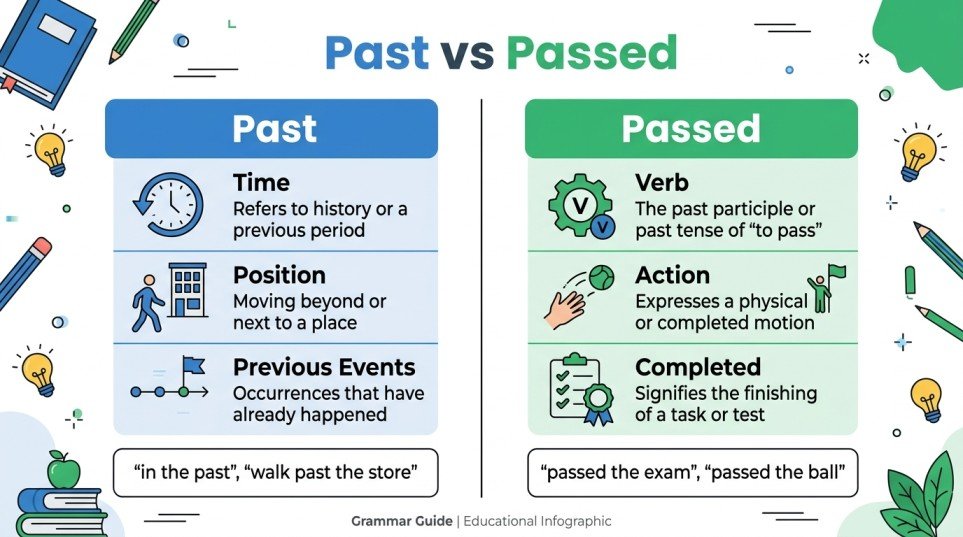
Quick Ans: The difference between past or passed is simple but important. Past is usually a noun, adjective, adverb, or preposition that refers to time or movement beyond something, while passed is the past tense of the verb pass. Understanding when to use each word helps improve writing accuracy and avoid common grammar mistakes.
Many English learners and native speakers struggle with past or passed. The words sound exactly the same when spoken. Because of that, they are often confused in writing.
Although they look similar, they serve different grammatical purposes. One word usually describes time, position, or something that has already happened. The other word describes an action that occurred in the past.
For example, “I walked past the store” is correct. Meanwhile, “I passed the store” is also correct, but it means something slightly different. Choosing the wrong word can make a sentence confusing or grammatically incorrect.
Therefore, learning the difference between past or passed is essential for clear communication. Whether you are writing emails, essays, blog posts, or business documents, using the correct word improves professionalism and readability.
This guide explains everything from beginner to advanced level. You will learn definitions, rules, examples, common mistakes, exercises, and practical tips that make choosing between past or passed easy.
Quick Answer: Past or Passed
The easiest way to remember past or passed is to identify whether you need a verb.
| Word | Part of Speech | Meaning |
|---|---|---|
| Past | Noun, adjective, adverb, or preposition | Refers to time, position, or something earlier |
| Passed | Verb (past tense of pass) | Means moved by, succeeded, transferred, or completed |
Simple Rule
Use passed when an action took place.
Use past when referring to time, location, or position.
Examples:
- We passed the school on our way home.
- We walked past the school.
What Does Past Mean?
The word past has several grammatical functions. Unlike passed, it is not usually a verb.
It commonly refers to:
- Time that has already happened
- A position beyond something
- Previous experiences
- Former events
Past as a Noun
As a noun, past means a time before the present.
Examples:
- Learn from the past.
- Her past shaped her future.
- The company has overcome mistakes from its past.
Past as an Adjective
As an adjective, past describes something previous.
Examples:
- The past year was challenging.
- During past meetings, the issue was discussed.
- Past experiences can teach valuable lessons.
Past as a Preposition
As a preposition, past means beyond a particular point.
Examples:
- The car drove past the house.
- Walk past the bank and turn left.
- We moved past the entrance quickly.
Past as an Adverb
As an adverb, past describes movement beyond something.
Examples:
- The runner sped past.
- The train rushed past.
- Several cyclists rode past.
What Does Passed Mean?
The word passed is the past tense and past participle of the verb pass.
It always describes an action that happened.
Common meanings include:
- Moving by something
- Completing something
- Succeeding in a test
- Handing something to another person
- Approving something
Passed as Movement
Examples:
- We passed the restaurant yesterday.
- The truck passed our car.
- She passed the finish line first.
Passed as Success
Examples:
- He passed the exam.
- They passed the driving test.
- She passed the certification program.
Passed as Transfer
Examples:
- He passed the ball to his teammate.
- She passed the document across the table.
- The teacher passed the papers back.
Passed as Approval
Examples:
- The committee passed the proposal.
- Lawmakers passed the bill.
- The board passed the new policy.
Key Differences Between Past or Passed
Grammar Function
The biggest difference between past or passed involves grammar.
Past usually functions as a noun, adjective, adverb, or preposition.
Passed functions as a verb.
Time Reference
Past often refers to earlier times.
Examples:
- In the past
- Past experiences
- Past events
Passed can refer to actions that happened previously.
Examples:
- Passed the exam
- Passed the building
- Passed the message
Sentence Role
Past often describes a condition or position.
Passed shows something that happened.
Compare these examples:
| Incorrect | Correct |
|---|---|
| We past the school. | We passed the school. |
| Walk passed the building. | Walk past the building. |
| She past the test. | She passed the test. |
Advantages and Disadvantages of Learning the Rule
Advantages
Understanding past or passed provides several benefits:
- Improves grammar accuracy
- Makes writing more professional
- Reduces common mistakes
- Improves communication clarity
Disadvantages
Some challenges still exist:
- Both words sound identical
- Spell check may not catch errors
- Beginners often confuse their functions
However, consistent practice quickly solves these problems.
Real World Examples
In Business Writing
Correct:
- The proposal passed review.
Incorrect:
- The proposal past review.
In Academic Writing
Correct:
- Students passed the final exam.
Correct:
- Researchers studied data from the past decade.
In Everyday Conversation
Correct:
- We walked past the park.
- We passed the park during our trip.
Although both sentences are correct, they use different grammar structures.
Regional and Global Usage
American English
American English follows the same rules for past or passed.
Examples:
- The law passed Congress.
- We drove past the building.
British English
British English also uses the words in the same way.
Examples:
- She passed her exams.
- We walked past the station.
International English
English learners worldwide frequently confuse these terms because they sound alike. Therefore, grammar instruction often focuses on this pair.
Related Concepts and Comparisons
Past vs Passed vs Passed Away
Many learners also encounter the phrase passed away.
Examples:
- He passed the test. ✓
- We walked past the church. ✓
- Her grandfather passed away last year. ✓
In this expression, passed away is a polite way to say someone died.
Past vs Previous
Both can refer to earlier time periods.
Examples:
- Past experiences
- Previous experiences
However, past often feels broader and more general.
Pass vs Passed
| Word | Meaning |
|---|---|
| Pass | Present tense verb |
| Passed | Past tense verb |
Examples:
- I pass the store every day.
- Yesterday, I passed the store.
Understanding these related concepts helps clarify the past or passed distinction.
Common Mistakes About Past or Passed
Using Past as a Verb
Incorrect:
- She past the exam.
Correct:
- She passed the exam.
Using Passed for Position
Incorrect:
- Walk passed the library.
Correct:
- Walk past the library.
Forgetting the Action Test
If an action occurred, you usually need passed.
Examples:
- He passed the ball.
- She passed the test.
- The car passed us.
Ignoring Sentence Context
Context determines the correct choice.
Compare:
- The past matters.
- Time passed quickly.
Both sentences are correct because the words serve different purposes.
Beginner to Advanced Learning Tips
Beginner Level
Remember one simple rule:
If you need a verb, choose passed.
Intermediate Level
Look for action in the sentence.
Examples:
- Action occurred = passed
- No action occurred = often past
Advanced Level
Analyze grammatical function.
Ask yourself:
- Is the word acting as a noun?
- Is it acting as an adjective?
- Is it functioning as a preposition?
- Does it describe an action?
This approach makes the correct choice much easier.
Step By Step Usage Scenario
Imagine you are writing a sentence.
You want to describe moving beyond a store.
Option 1:
- We passed the store.
This uses a verb.
Option 2:
- We walked past the store.
This uses a preposition.
Both are correct because each follows proper grammar rules.
Now consider an exam.
Correct:
- She passed the exam.
Incorrect:
- She past the exam.
Since passing an exam is an action, the verb form is required.
Exercises With Answers
Exercise 1
Choose the correct word:
We ______ the museum yesterday.
Answer: Passed.
Exercise 2
Choose the correct word:
Walk ______ the bank and turn right.
Answer: Past.
Exercise 3
Choose the correct word:
She ______ the final test.
Answer: Passed.
Exercise 4
Choose the correct word:
The ______ year was successful.
Answer: Past.
Exercise 5
True or False:
Passed is always a verb.
Answer: True.
When Should You Use Past or Passed?
Use past when:
- Referring to earlier time
- Describing a previous event
- Indicating movement beyond a point
- Acting as a noun, adjective, adverb, or preposition
Use passed when:
- Describing an action
- Referring to movement that occurred
- Talking about completing a test
- Mentioning approval or transfer
Checking whether a verb is needed usually reveals the correct answer.
FAQs About Past or Passed
What is the difference between past or passed?
Past usually refers to time, position, or something earlier, while passed is the past tense of the verb pass.
Is passed a verb?
Yes. Passed is always a verb form that describes an action.
Can past be used as a verb?
No. Past is generally a noun, adjective, adverb, or preposition.
How do I remember past or passed?
Look for action. If something happened, passed is usually correct.
Which is correct: walked past or walked passed?
Walked past is correct because past functions as a preposition.
Which is correct: passed the exam or past the exam?
Passed the exam is correct because passing an exam is an action.
Why do people confuse past or passed?
The words are homophones, meaning they sound the same but have different meanings and grammar functions.
Can I say time passed quickly?
Yes. Passed is correct because it describes what time did.
Is in the passed correct?
No. The correct phrase is “in the past.”
What does passed away mean?
Passed away is a polite expression meaning someone has died.
Conclusion
Understanding past or passed is essential for accurate English writing. Although the words sound identical, they perform very different jobs in a sentence.
Past usually refers to time, position, or something that happened earlier. It commonly functions as a noun, adjective, adverb, or preposition. Passed, by contrast, is the past tense of the verb pass and always describes an action.
The simplest rule is easy to remember. If the sentence needs a verb, use passed. If it refers to time, location, or position, use past.
Regular practice makes the distinction easier. Reading examples, completing exercises, and checking sentence structure can quickly improve your confidence.
By mastering the difference between past or passed, you can write more clearly, avoid common grammar mistakes, and communicate with greater professionalism in academic, business, and everyday situations.
Discover More:-
- Start or Sit: Complete Fantasy Football Decision Making Guide
- Complement or Compliment: Difference, Meaning, Examples, and Usage Guide

Lisa Thompson is a USA-based content writer and language specialist focused on grammar, writing improvement and digital publishing.
She holds a degree in English Language and Communication and has professional experience in educational and web content creation.
As the author of Gramtivo.Com, she aims to help readers improve their writing skills through clear and practical guidance.