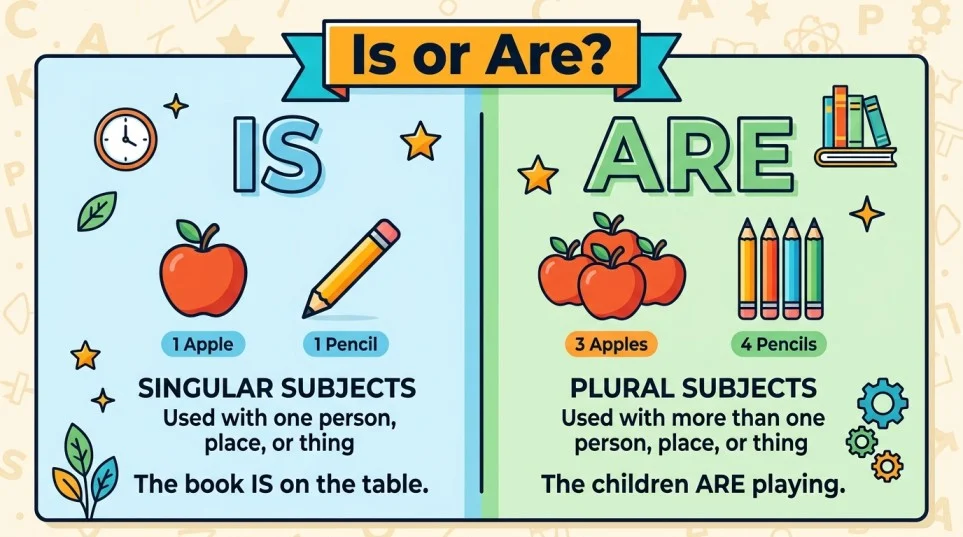
Quick Ans: The difference between is or are comes down to subject agreement. Use is with singular nouns and pronouns, while are is used with plural nouns and pronouns. Choosing the correct verb helps make sentences grammatically correct and easier to understand.
Many English learners struggle with is or are because both words mean a form of the verb to be. At first, the difference seems simple. However, mistakes happen frequently in everyday writing and speaking.
For example, should you say, “The book is on the table” or “The book are on the table”? What about sentences with groups, lists, or uncountable nouns? These situations often create confusion.
Understanding is or are is important because subject verb agreement is one of the basic rules of English grammar. When the wrong verb is used, sentences can sound unnatural or incorrect.
Fortunately, the rule is easier than many people think. Once you understand how singular and plural subjects work, choosing between is and are becomes much simpler.
This guide explains everything from beginner to advanced level. You will learn definitions, grammar rules, examples, common mistakes, exercises, related concepts, and practical tips for mastering is or are in everyday English.
Quick Answer: Is or Are
The simplest rule is this:
- Use is with singular subjects.
- Use are with plural subjects.
Examples
| Subject | Correct Verb | Example |
|---|---|---|
| The cat | Is | The cat is sleeping. |
| The dog | Is | The dog is friendly. |
| The cats | Are | The cats are sleeping. |
| The dogs | Are | The dogs are friendly. |
In short:
- One person, place, thing, or idea = is
- More than one person, place, thing, or idea = are
What Is “Is”?
Is is the singular present tense form of the verb to be.
It is used when the subject is singular. A singular subject refers to one person, one place, one thing, or one idea.
Examples of Is
- The car is new.
- My friend is happy.
- The house is large.
- The baby is sleeping.
In each sentence, the subject refers to only one thing. Therefore, is is the correct choice.
Common Singular Pronouns That Use Is
The following pronouns usually take is:
- He
- She
- It
- This
- That
Examples:
- He is my brother.
- She is a teacher.
- It is raining.
- This is delicious.
- That is interesting.
What Is “Are”?
Are is the plural present tense form of the verb to be.
Writers and speakers use it when the subject is plural. A plural subject means more than one person, place, thing, or idea.
Examples of Are
- The students are studying.
- The books are on the shelf.
- The dogs are barking.
- The flowers are beautiful.
Since the subjects refer to multiple items, are is required.
Common Pronouns That Use Are
These pronouns generally take are:
- We
- You
- They
- These
- Those
Examples:
- We are ready.
- You are welcome.
- They are excited.
- These are fresh.
- Those are expensive.
Key Differences Between Is or Are
Subject Number
The biggest difference between is or are involves the number of the subject.
- Singular subject = Is
- Plural subject = Are
Grammar Function
Both verbs are forms of to be. However, each must match the subject correctly.
Everyday Usage
Correct subject verb agreement improves clarity. Incorrect usage can make writing appear unprofessional.
Comparison Table
| Feature | Is | Are |
|---|---|---|
| Subject Type | Singular | Plural |
| Common Pronouns | He, She, It | We, You, They |
| Example | The cat is hungry. | The cats are hungry. |
| Usage Frequency | Singular statements | Plural statements |
Understanding Subject Verb Agreement
Subject verb agreement means the verb must match the subject.
This rule forms the foundation of choosing between is or are.
Singular Subject Examples
- The chair is broken.
- My phone is charging.
- The teacher is speaking.
Plural Subject Examples
- The chairs are broken.
- My phones are charging.
- The teachers are speaking.
As a result, identifying the subject first helps you choose the correct verb.
Special Cases for Is or Are
Using “There Is” and “There Are”
Many learners struggle with these expressions.
Use there is when referring to one item.
Examples:
- There is a bird outside.
- There is a problem.
Use there are when referring to multiple items.
Examples:
- There are many birds outside.
- There are several problems.
Collective Nouns
Collective nouns represent groups.
Examples include:
- Team
- Family
- Committee
- Class
When the group acts as a single unit, use is.
Examples:
- The team is winning.
- The family is traveling.
When emphasizing individuals within the group, some varieties of English may use are.
Examples:
- The team are arguing among themselves.
- The family are discussing different plans.
Advantages of Using Is or Are Correctly
Better Communication
Correct grammar helps readers understand your meaning immediately.
Improved Writing Quality
Professional writing depends on proper subject verb agreement.
Stronger Academic Performance
Students who master is or are make fewer grammar mistakes in assignments and exams.
Greater Confidence
Knowing the correct rule improves speaking and writing confidence.
Disadvantages of Incorrect Usage
Confusing Sentences
Incorrect verb agreement can make sentences harder to understand.
Reduced Professionalism
Grammar mistakes may create a poor impression in business communication.
Lower Academic Scores
Many language tests evaluate subject verb agreement.
Therefore, mastering is or are provides long term benefits.
Real World Examples
In School Writing
Correct:
- The student is prepared.
Incorrect:
- The student are prepared.
In Business Emails
Correct:
- The report is attached.
Correct:
- The reports are attached.
In Everyday Conversations
Correct:
- My friend is coming.
- My friends are coming.
These examples show how often is or are appears in daily communication.
Regional and Global Usage
American English
American English generally treats collective nouns as singular.
Examples:
- The team is winning.
- The government is working.
British English
British English sometimes treats collective nouns as plural.
Examples:
- The team are winning.
- The government are discussing the issue.
Although these differences exist, the basic is or are rule remains the same.
Related Concepts and Comparisons
Is vs Are vs Am
All three words are forms of to be.
| Verb | Subject |
|---|---|
| Am | I |
| Is | He, She, It |
| Are | We, You, They |
Examples:
- I am happy.
- She is happy.
- They are happy.
Was vs Were
These are past tense forms of to be.
Examples:
- He was tired.
- They were tired.
Learning these related forms helps strengthen grammar skills.
Common Mistakes With Is or Are
Using Are With Singular Subjects
Incorrect:
- The book are on the table.
Correct:
- The book is on the table.
Using Is With Plural Subjects
Incorrect:
- The books is on the table.
Correct:
- The books are on the table.
Forgetting Compound Subjects
Incorrect:
- Tom and Sarah is here.
Correct:
- Tom and Sarah are here.
Misidentifying the Subject
Incorrect:
- The list of items are long.
Correct:
- The list of items is long.
The main subject is list, not items.
Beginner to Advanced Tips
Beginner Level
Identify whether the subject is singular or plural before choosing a verb.
Intermediate Level
Practice with collective nouns and compound subjects.
Advanced Level
Learn exceptions and differences between American and British English.
Consistent practice helps develop automatic accuracy.
Step By Step Method for Choosing Is or Are
Follow this simple process:
Step 1
Identify the subject.
Example:
- The dogs are barking.
Subject: Dogs
Step 2
Determine whether the subject is singular or plural.
Dogs = plural
Step 3
Choose the correct verb.
Plural = are
Step 4
Read the sentence aloud.
If it sounds natural, the choice is probably correct.
Exercises With Answers
Exercise 1
Choose the correct word:
The cat ___ sleeping.
Answer: is
Exercise 2
Choose the correct word:
The students ___ studying.
Answer: are
Exercise 3
Choose the correct word:
There ___ a problem.
Answer: is
Exercise 4
Choose the correct word:
There ___ many problems.
Answer: are
Exercise 5
Choose the correct word:
My friends ___ here.
Answer: are
Exercise 6
Choose the correct word:
The teacher ___ explaining the lesson.
Answer: is
When Should You Use Is or Are?
Use is when:
- The subject is singular
- Referring to one person
- Referring to one object
- Referring to one idea
Use are when:
- The subject is plural
- Referring to multiple people
- Referring to multiple objects
- Referring to multiple ideas
Always identify the subject first before selecting the verb.
FAQs About Is or Are
What is the difference between is or are?
The difference is subject number. Use is for singular subjects and are for plural subjects.
When should I use is?
Use is when talking about one person, place, thing, or idea.
When should I use are?
Use are when referring to more than one person, place, thing, or idea.
Is “you is” correct?
No. The correct form is you are.
Why do we say “you are” instead of “you is”?
English grammar treats you with the verb are, regardless of whether it refers to one person or several people.
Is “there is” singular or plural?
There is is used with singular nouns.
Is “there are” plural?
Yes. Use there are when referring to multiple items.
Can collective nouns use both is and are?
Yes. Usage depends on whether the group is viewed as one unit or as individuals.
What is the easiest way to choose between is or are?
Identify the subject first. Then determine whether it is singular or plural.
Do grammar checkers always catch is or are mistakes?
Not always. Understanding the rule yourself remains the most reliable method.
Conclusion
Understanding is or are is one of the most important steps in mastering English grammar. Although the rule seems simple, mistakes happen frequently when writers fail to identify the subject correctly.
The core principle is straightforward. Use is with singular subjects and are with plural subjects. Once you learn to recognize the subject and determine its number, choosing the correct verb becomes much easier.
Practice plays a major role in building confidence. Reading, writing, and completing grammar exercises help reinforce the rule over time. Paying attention to special situations such as collective nouns and there is or there are constructions can also improve accuracy.
Whether you are a student, professional, or English learner, mastering is or are strengthens communication skills and improves writing quality. With regular practice, correct subject verb agreement will become a natural part of your everyday English.
Discover More:-
- Greatful or Grateful: Which Spelling Is Correct and Why?
- Ax or Axe: Which Spelling Is Correct? Complete Usage Guide

Jennifer Collins is a professional grammar expert and language educator at gramtivo.com, specializing in English grammar, writing skills, and language improvement. She holds a Master’s degree in English Language and Literature from a recognized university in the United States. With years of teaching and content development experience, she is dedicated to helping learners improve their communication skills with clear and practical guidance.