
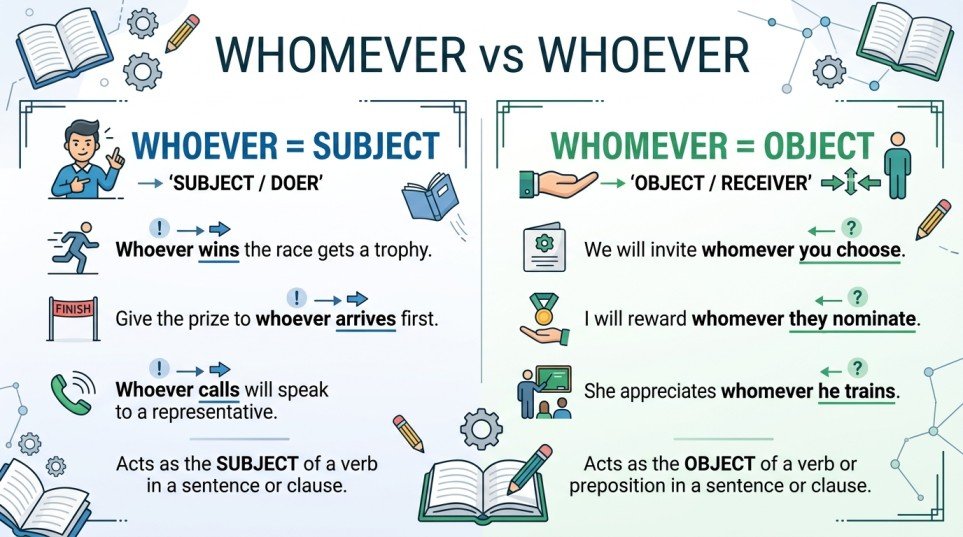
Quick Ans: The difference between whomever or whoever comes down to grammar and sentence structure. Use whoever when the word acts as the subject of a clause, and use whomever when it acts as an object. Although many people avoid whomever in everyday writing, understanding the distinction helps improve grammar accuracy and professional communication.
Many English learners and even native speakers struggle with whomever or whoever. The two words look similar. Their meanings are closely related. As a result, people often use one when the other is correct.
The confusion usually starts because both words refer to an unknown person. In addition, modern English uses who and whoever far more often than whom and whomever. Consequently, many writers are unsure whether whomever is still necessary.
Grammar rules can seem complicated at first. However, learning the difference between whomever or whoever becomes much easier when you understand how each word functions in a sentence. The key is identifying whether the word acts as a subject or an object.
This guide explains everything in simple language. You will learn definitions, grammar rules, examples, common mistakes, real world usage, exercises, and practical tips. By the end, you will know exactly when to use whomever and when to use whoever.
Quick Answer: Whomever or Whoever
The easiest way to understand whomever or whoever is to determine the word’s role in the clause.
| Word | Function | Example |
|---|---|---|
| Whoever | Subject | Whoever arrives first gets the prize. |
| Whomever | Object | Give the prize to whomever you choose. |
A simple shortcut can help:
- Replace the word with he or they → use whoever.
- Replace the word with him or them → use whomever.
For example:
- Whoever wants pizza can join us. (He wants pizza.)
- Invite whomever you like. (You like him.)
What Does Whoever Mean?
Whoever is a pronoun used when referring to any person who performs an action. In grammar terms, it functions as a subject.
Basic Definition
Whoever means:
- Any person who
- The person who
- Anyone who
Examples of Whoever
Consider these examples:
- Whoever finishes first wins.
- Whoever calls me back will get the information.
- Hire whoever has the best qualifications.
- Whoever made this cake did a great job.
In each sentence, whoever performs the action.
How Whoever Works
Think about the sentence:
“Whoever studies hard will succeed.”
Here, whoever performs the action of studying. Therefore, whoever is correct because it functions as the subject.
What Does Whomever Mean?
Whomever is the object form of whoever. It refers to the person receiving an action rather than performing it.
Basic Definition
Whomever means:
- Any person whom
- The person whom
- Anyone whom
Examples of Whomever
Look at these examples:
- Choose whomever you trust.
- Invite whomever you want.
- Give the award to whomever the committee selects.
- Support whomever you believe deserves help.
In each case, whomever receives the action.
How Whomever Works
Consider this sentence:
“Choose whomever you prefer.”
The verb prefer acts on the person being chosen. Since the word functions as an object, whomever is correct.
Key Differences Between Whomever or Whoever
Subject vs Object
The biggest difference between whomever or whoever involves grammatical function.
- Whoever acts as a subject.
- Whomever acts as an object.
Sentence Role
Whoever performs an action.
Whomever receives an action.
Replacement Test
A helpful trick involves substitution.
If “he” sounds correct, use whoever.
If “him” sounds correct, use whomever.
Comparison Table
| Feature | Whoever | Whomever |
|---|---|---|
| Grammar Role | Subject | Object |
| Common Usage | Very common | Less common |
| Formal Writing | Frequent | Sometimes used |
| Everyday Speech | Common | Rare |
Advantages and Disadvantages
Advantages of Using Whoever Correctly
Using whoever properly offers several benefits:
- Improves grammar accuracy
- Makes writing clearer
- Sounds natural in conversation
- Works well in formal writing
Disadvantages of Misusing Whoever
Incorrect usage may:
- Create grammatical errors
- Confuse readers
- Reduce professionalism
Advantages of Using Whomever Correctly
Proper use of whomever:
- Demonstrates strong grammar knowledge
- Improves formal writing
- Increases precision
Disadvantages of Using Whomever Excessively
Overusing whomever can:
- Sound overly formal
- Make sentences awkward
- Confuse casual readers
Therefore, many modern writers simplify sentences instead of forcing whomever into everyday communication.
Real World Examples
Workplace Communication
Professional emails often contain phrases such as:
- Contact whoever is available.
- Assign the task to whomever the manager selects.
Both sentences follow correct grammar rules.
Academic Writing
Formal writing tends to preserve distinctions between whomever or whoever.
For example:
- Whoever submits the paper first receives feedback.
- Credit should be given to whomever conducted the research.
Everyday Conversations
Most people naturally use whoever more often.
Examples include:
- Whoever wants coffee can have some.
- Whoever gets there first should call me.
In casual speech, many speakers avoid whomever entirely.
Regional and Global Usage
American English
American English increasingly favors whoever over whomever. Many style guides allow simpler constructions.
British English
British English still recognizes both forms. However, casual conversation often follows the same trend toward simpler language.
Modern Global English
Across the world, English learners usually encounter whoever more frequently than whomever.
As a result, whomever appears mainly in formal or academic contexts.
Related Concepts and Comparisons
Who vs Whom
The relationship is similar:
| Subject Form | Object Form |
|---|---|
| Who | Whom |
| Whoever | Whomever |
Whoever vs Anyone Who
Many sentences can be rewritten.
Instead of:
- Whoever arrives first wins.
You can say:
- Anyone who arrives first wins.
Whomever vs Anyone You Choose
Similarly:
- Invite whomever you want.
Can become:
- Invite anyone you want.
These alternatives often sound more natural.
Common Mistakes About Whomever or Whoever
Using Whomever Because It Sounds More Formal
Many writers assume whomever is always more correct.
Example:
❌ Whomever finishes first wins.
✅ Whoever finishes first wins.
The word acts as the subject, so whoever is required.
Ignoring the Clause
The correct choice depends on the entire clause.
Example:
❌ Give the prize to whoever you choose.
✅ Give the prize to whomever you choose.
The person receives the action of choosing.
Applying the Rule Too Quickly
Some people look only at the main sentence.
Instead, examine the clause where the word appears.
Avoiding Both Words Entirely
While simplification is useful, understanding the grammar still improves writing skills.
Beginner to Advanced Grammar Tips
Beginner Level
Remember one simple rule:
- Subject = whoever
- Object = whomever
Intermediate Level
Use the he/him test.
Examples:
- He will arrive. → Whoever will arrive.
- You trust him. → Whomever you trust.
Advanced Level
Analyze the entire clause rather than the surrounding sentence.
For example:
“Give the award to whoever wins.”
Although the phrase follows a preposition, whoever is correct because it serves as the subject of wins.
Understanding clause structure helps solve difficult cases.
Step By Step Usage Scenario
Imagine you are writing a sentence.
Sentence:
“Invite _____ you prefer.”
Step 1: Identify the action.
The action is prefer.
Step 2: Determine who receives the action.
The unknown person receives the action.
Step 3: Apply the rule.
Because the word functions as an object, use whomever.
Correct sentence:
“Invite whomever you prefer.”
Now consider:
“_____ arrives first may choose a seat.”
The person performs the action of arriving.
Therefore, use whoever.
Correct sentence:
“Whoever arrives first may choose a seat.”
Exercises With Answers
Exercise 1
Choose the correct word:
_____ wants dessert may have some.
Answer: Whoever.
Exercise 2
Choose the correct word:
Hire _____ you think is best.
Answer: Whomever.
Exercise 3
Choose the correct word:
_____ finishes the race first wins.
Answer: Whoever.
Exercise 4
Choose the correct word:
Send the package to _____ requested it.
Answer: Whoever.
Exercise 5
True or False: Whomever is always more formal and therefore always correct.
Answer: False.
When Should You Choose Whomever or Whoever?
Use whoever when:
- The word acts as a subject.
- The person performs the action.
- “He” or “they” fits the sentence.
Use whomever when:
- The word acts as an object.
- The person receives the action.
- “Him” or “them” fits the sentence.
Following this approach eliminates most grammar mistakes.
FAQs About Whomever or Whoever
What is the difference between whomever or whoever?
Whoever functions as a subject, while whomever functions as an object.
Is whomever still used in modern English?
Yes. However, it appears less frequently than whoever, especially in casual communication.
How can I remember when to use whoever?
Use whoever when the person performs the action in the clause.
How can I remember when to use whomever?
Use whomever when the person receives the action or acts as an object.
What is the he or him test for whomever or whoever?
Replace the word with he or him. If he works, use whoever. If him works, use whomever.
Can I use whoever in place of whomever?
In casual conversation many people do, but formal grammar still recognizes the distinction.
Why does whomever sound awkward sometimes?
Modern English increasingly favors simpler structures, so whomever can sound overly formal.
Is whoever more common than whomever?
Yes. Whoever appears far more often in everyday speech and writing.
Do professional writers still use whomever?
Yes. Formal, academic, and legal writing sometimes uses whomever when grammar requires it.
What is the easiest way to choose between whomever or whoever?
Identify whether the word acts as a subject or an object within its clause.
Conclusion
Understanding whomever or whoever becomes much easier once you focus on grammatical function. Whoever acts as the subject of a clause and performs an action. Whomever acts as an object and receives an action.
Although modern English often favors simpler wording, the distinction still matters in professional, academic, and formal writing. Learning the rule helps improve clarity, accuracy, and confidence.
The easiest strategy is the he/him test. If he fits naturally, choose whoever. If him sounds correct, select whomever. This simple method solves most grammar questions quickly.
Practice with real examples whenever possible. Over time, identifying the correct form becomes automatic. By mastering whomever or whoever, you can write more professionally and communicate with greater precision.
Discover More:-
- Start or Sit: Complete Fantasy Football Decision Making Guide
- Forty or Fourty: Which Spelling Is Correct and Why?

Lisa Thompson is a USA-based content writer and language specialist focused on grammar, writing improvement and digital publishing.
She holds a degree in English Language and Communication and has professional experience in educational and web content creation.
As the author of Gramtivo.Com, she aims to help readers improve their writing skills through clear and practical guidance.