
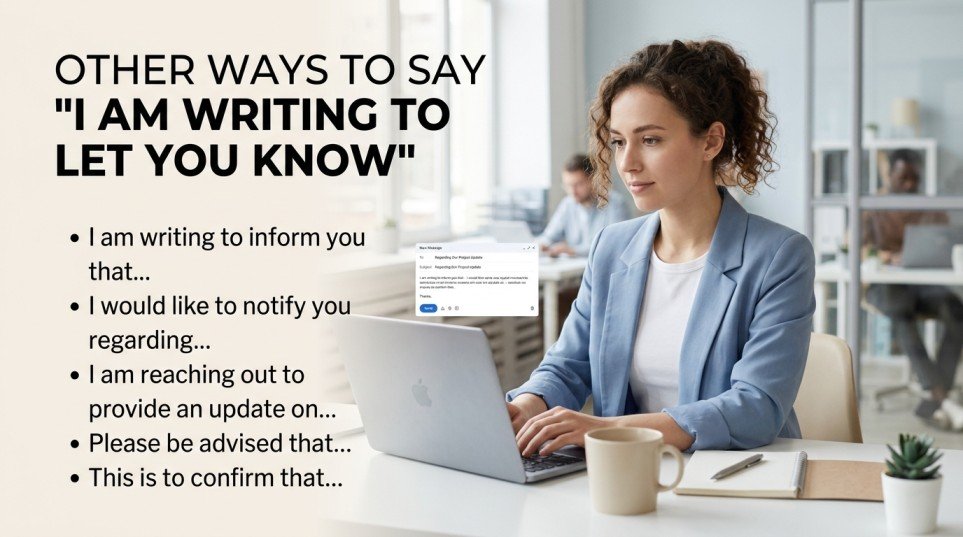
Quick Answer: Instead of saying I am writing to let you know, you can say: I wanted to inform you, just a quick update, I’d like to notify you, I’m reaching out to share, I wanted to make you aware.
The phrase “I am writing to let you know” is commonly used in emails and professional communication to introduce information or updates. It is polite, clear, and widely understood.
However, repeating the same phrase in every email can make your writing sound repetitive or outdated. Native speakers often use more natural and modern alternatives depending on the tone and purpose of the message.
Learning alternatives to “I am writing to let you know” improves your email writing skills and helps you sound more professional, fluent, and confident. It also helps you adjust tone in formal communication and use more effective professional reaction phrases in English.
Quick Categories Section
Formal alternatives to “I am writing to let you know”
- I would like to inform you
- I am reaching out to inform you
- Please be advised that
- I wish to notify you
Pro Tip: Use these in formal emails, official notices, or business communication.
Casual alternatives
- Just wanted to let you know
- Quick update
- Thought I’d mention
- Just a heads-up
Pro Tip: Great for friendly emails and relaxed workplace conversations.
Professional alternatives
- I wanted to make you aware
- I’m reaching out to share
- I’d like to update you
- I’m contacting you regarding
Pro Tip: Keep your wording concise and direct in business writing.
Informal expressions
- Just so you know
- FYI
- Wanted to tell you
- Giving you a quick update
Pro Tip: Avoid overly informal expressions in formal workplace emails.
“Professional English becomes stronger when your email phrases sound natural and varied.”
Common Mistakes
- Overusing the same opening line
Example: Starting every email with “I am writing to let you know.” - Sounding too formal in casual situations
Example: Using “Please be advised” in a friendly team chat. - Using informal phrases in official emails
Example: Writing “FYI” in a legal or corporate notice. - Writing long and unclear introductions
Example: Adding unnecessary wording before the main point. - Ignoring tone and audience
Example: Using casual expressions with senior management.
What Does “I Am Writing to Let You Know” Mean?
It means the writer wants to inform someone about important information, updates, or news.
Grammatically, it is a present continuous phrase commonly used in formal writing and emails.
Example Sentence:
I am writing to let you know that the meeting has been rescheduled.
When to Use “I Am Writing to Let You Know”
- In professional emails
- When sharing updates or announcements
- To introduce important information
- In formal written communication
Spoken vs Written: Mostly written
Formal vs Informal: Neutral to formal
Is It Professional or Polite to Say “I Am Writing to Let You Know”?
Polite? ✔️ Yes
Professional? ✔️ Yes
Business Example:
“I am writing to let you know that your application has been approved.”
Pros and Cons of Using “I Am Writing to Let You Know”
Pros
- Clear and professional
- Easy to understand
- Widely accepted in business English
- Suitable for formal writing
Cons
- Sounds repetitive
- Slightly outdated in modern emails
- Can feel too wordy
- Lacks personality
“Clear communication is professional, but concise communication is even better.”
Other Ways to Say “I Am Writing to Let You Know” (With Examples)
These alternatives will help you sound more fluent, confident, and natural in professional and casual communication.
Use them according to tone, audience, and context.
1. Phrase: I would like to inform you
Meaning: Politely sharing information.
Explanation: Formal and professional alternative.
Example Sentence: I would like to inform you that your request has been approved.
Best Use: formal email
Worst Use: casual chat
Tone: formal, professional
Context Variability: professional / written
2. Phrase: Just wanted to let you know
Meaning: Informing someone casually.
Explanation: Friendly and conversational.
Example Sentence: Just wanted to let you know the package arrived.
Best Use: friendly email
Worst Use: official notice
Tone: casual, warm
Context Variability: casual / spoken
3. Phrase: I’m reaching out to share
Meaning: Contacting someone to provide information.
Explanation: Modern professional wording.
Example Sentence: I’m reaching out to share an important update.
Best Use: workplace
Worst Use: slang context
Tone: professional, approachable
Context Variability: professional / written
4. Phrase: Please be advised that
Meaning: Official notice or information.
Explanation: Very formal business phrase.
Example Sentence: Please be advised that the office will close early tomorrow.
Best Use: official communication
Worst Use: casual email
Tone: formal, authoritative
Context Variability: professional
5. Phrase: I wanted to make you aware
Meaning: Informing someone about something important.
Explanation: Polite and professional.
Example Sentence: I wanted to make you aware of the recent changes.
Best Use: workplace
Worst Use: slang
Tone: professional, polite
Context Variability: professional / written
“The best email openings sound clear, direct, and natural.”
6. Phrase: I’d like to update you
Meaning: Sharing new information.
Explanation: Common in professional communication.
Example Sentence: I’d like to update you on the project timeline.
Best Use: business update
Worst Use: casual texting
Tone: professional, direct
Context Variability: professional
7. Phrase: Just a quick update
Meaning: Briefly sharing information.
Explanation: Short and modern expression.
Example Sentence: Just a quick update—the meeting has moved to Friday.
Best Use: team communication
Worst Use: legal notice
Tone: casual, professional
Context Variability: professional / casual
8. Phrase: I’m contacting you regarding
Meaning: Reaching out about a topic.
Explanation: Formal business phrase.
Example Sentence: I’m contacting you regarding your recent inquiry.
Best Use: formal email
Worst Use: friendly chat
Tone: formal, professional
Context Variability: professional
9. Phrase: I’d like to notify you
Meaning: Officially informing someone.
Explanation: Formal and direct.
Example Sentence: I’d like to notify you of the upcoming policy changes.
Best Use: official update
Worst Use: casual talk
Tone: formal, serious
Context Variability: professional
10. Phrase: Thought I’d mention
Meaning: Casually bringing up information.
Explanation: Informal and conversational.
Example Sentence: Thought I’d mention that the event starts earlier now.
Best Use: friendly communication
Worst Use: formal writing
Tone: relaxed, casual
Context Variability: casual
11. Phrase: Just so you know
Meaning: Sharing information informally.
Explanation: Very common in spoken English.
Example Sentence: Just so you know, I’ll be out tomorrow.
Best Use: casual updates
Worst Use: formal business emails
Tone: informal, friendly
Context Variability: spoken / casual
12. Phrase: I’m writing to inform you
Meaning: Formally providing information.
Explanation: Traditional professional wording.
Example Sentence: I’m writing to inform you of the schedule change.
Best Use: business email
Worst Use: texting
Tone: formal, professional
Context Variability: professional
13. Phrase: I wanted to notify you
Meaning: Officially informing someone.
Explanation: Slightly formal alternative.
Example Sentence: I wanted to notify you about the maintenance update.
Best Use: workplace
Worst Use: casual chat
Tone: professional, polite
Context Variability: professional
14. Phrase: I’d like to let you know
Meaning: Sharing information politely.
Explanation: Softer and more natural wording.
Example Sentence: I’d like to let you know that your order has shipped.
Best Use: customer communication
Worst Use: slang
Tone: polite, neutral
Context Variability: professional / casual
15. Phrase: I’m happy to inform you
Meaning: Sharing positive news.
Explanation: Adds enthusiasm and positivity.
Example Sentence: I’m happy to inform you that you’ve been selected.
Best Use: good news
Worst Use: negative updates
Tone: positive, professional
Context Variability: professional
“Natural email phrases make your writing sound modern and confident.”
16. Phrase: This is to inform you
Meaning: Officially providing information.
Explanation: Common in formal notices.
Example Sentence: This is to inform you that the office will remain closed Monday.
Best Use: formal notice
Worst Use: casual email
Tone: formal, direct
Context Variability: professional
17. Phrase: I wanted to update you
Meaning: Sharing recent information.
Explanation: Friendly professional phrase.
Example Sentence: I wanted to update you on the project status.
Best Use: workplace
Worst Use: legal documents
Tone: professional, conversational
Context Variability: professional
18. Phrase: I’m emailing to let you know
Meaning: Informing through email.
Explanation: Simple and direct.
Example Sentence: I’m emailing to let you know the files are ready.
Best Use: workplace emails
Worst Use: formal notices
Tone: neutral, professional
Context Variability: written
19. Phrase: Kindly note that
Meaning: Asking someone to pay attention to information.
Explanation: Formal and polite.
Example Sentence: Kindly note that payment is due Friday.
Best Use: formal communication
Worst Use: casual chat
Tone: formal, polite
Context Variability: professional
20. Phrase: For your information
Meaning: Providing information for awareness.
Explanation: Often shortened to FYI.
Example Sentence: For your information, the report has been submitted.
Best Use: updates
Worst Use: emotional conversations
Tone: neutral, informative
Context Variability: professional
21. Phrase: I wanted to share
Meaning: Providing information warmly.
Explanation: Friendly and natural wording.
Example Sentence: I wanted to share some exciting news with you.
Best Use: positive updates
Worst Use: strict notices
Tone: warm, professional
Context Variability: casual / professional
22. Phrase: I’m reaching out regarding
Meaning: Contacting about a subject.
Explanation: Common business phrase.
Example Sentence: I’m reaching out regarding the upcoming deadline.
Best Use: professional communication
Worst Use: casual text
Tone: professional, neutral
Context Variability: professional
23. Phrase: I’d like to bring to your attention
Meaning: Highlighting important information.
Explanation: Formal and respectful.
Example Sentence: I’d like to bring to your attention the recent policy updates.
Best Use: important notices
Worst Use: casual chats
Tone: formal, professional
Context Variability: professional
24. Phrase: Just giving you a heads-up
Meaning: Informal warning or update.
Explanation: Conversational phrase.
Example Sentence: Just giving you a heads-up about tomorrow’s delay.
Best Use: friendly workplace
Worst Use: legal writing
Tone: casual, helpful
Context Variability: casual
25. Phrase: I wanted to reach out
Meaning: Initiating communication.
Explanation: Modern professional phrase.
Example Sentence: I wanted to reach out regarding your application.
Best Use: networking
Worst Use: informal texting
Tone: professional, approachable
Context Variability: professional
26. Phrase: I’m pleased to let you know
Meaning: Sharing positive news.
Explanation: Formal and positive.
Example Sentence: I’m pleased to let you know your proposal was accepted.
Best Use: good news
Worst Use: complaints
Tone: positive, formal
Context Variability: professional
27. Phrase: I’d like to share an update
Meaning: Informing someone about progress.
Explanation: Common in modern business English.
Example Sentence: I’d like to share an update on the project.
Best Use: team communication
Worst Use: casual texting
Tone: professional, clear
Context Variability: professional
28. Phrase: I wanted to touch base
Meaning: Briefly reconnecting or updating.
Explanation: Common workplace expression.
Example Sentence: I wanted to touch base about the meeting schedule.
Best Use: workplace
Worst Use: formal notices
Tone: professional, conversational
Context Variability: professional
29. Phrase: I’m writing regarding
Meaning: Contacting about a specific topic.
Explanation: Concise and professional.
Example Sentence: I’m writing regarding your recent request.
Best Use: business email
Worst Use: casual chat
Tone: formal, direct
Context Variability: professional
30. Phrase: I’d like to make you aware
Meaning: Informing someone carefully.
Explanation: Professional and polite.
Example Sentence: I’d like to make you aware of the recent updates.
Best Use: workplace communication
Worst Use: slang context
Tone: professional, respectful
Context Variability: professional / written
“Professional fluency comes from using clear and varied communication.”
Mini Quiz / Self-Check
1. Which phrase is best for a formal notice?
A. Just a heads-up
B. Please be advised that
C. Thought I’d mention
Answer: B
2. Which phrase is most casual?
A. Kindly note that
B. Just so you know
C. I’d like to notify you
Answer: B
3. Which phrase works best in professional emails?
A. I’m reaching out to share
B. FYI
C. Wanted to tell you
Answer: A
Comparison Table: Top Alternatives
| Phrase | Tone | Best Use |
|---|---|---|
| I would like to inform you | Formal | Official emails |
| Just wanted to let you know | Casual | Friendly updates |
| I’m reaching out to share | Professional | Workplace |
| Please be advised that | Formal | Notices |
| I wanted to make you aware | Professional | Business updates |
| Just a quick update | Casual-professional | Team chats |
| I’d like to update you | Professional | Work communication |
| Kindly note that | Formal | Important notices |
| I wanted to share | Warm | Positive updates |
| I’m writing regarding | Professional | Formal emails |
FAQs
1. What are the best alternatives to “I am writing to let you know”?
Top alternatives include I would like to inform you, just a quick update, and I’m reaching out to share.
2. Is “I am writing to let you know” professional?
Yes, it is polite and professional, especially in formal emails.
3. What is a more modern version of this phrase?
Many professionals now use I wanted to make you aware or just a quick update.
4. Can I use casual phrases in business emails?
Only in relaxed workplace environments; formal emails should stay professional.
5. Why should I learn alternatives to “I am writing to let you know”?
It improves fluency, professionalism, and variety in written English.
Conclusion
Learning different other ways to say “I am writing to let you know” helps your emails sound more natural, modern, and professional. It also improves tone flexibility in workplace communication.
Practice these alternatives regularly and choose phrases based on audience and context. Over time, your professional English will become clearer, more polished, and more confident.
CTA: Try replacing your usual email opening with a more natural alternative today.
Discover More:-
- Other Ways to Say Sorry to Keep You Waiting (30+ Examples)
- Other Ways to Say Have a Great Rest of Your Week (30+ Examples)

Lisa Thompson is a USA-based content writer and language specialist focused on grammar, writing improvement and digital publishing.
She holds a degree in English Language and Communication and has professional experience in educational and web content creation.
As the author of Gramtivo.Com, she aims to help readers improve their writing skills through clear and practical guidance.