
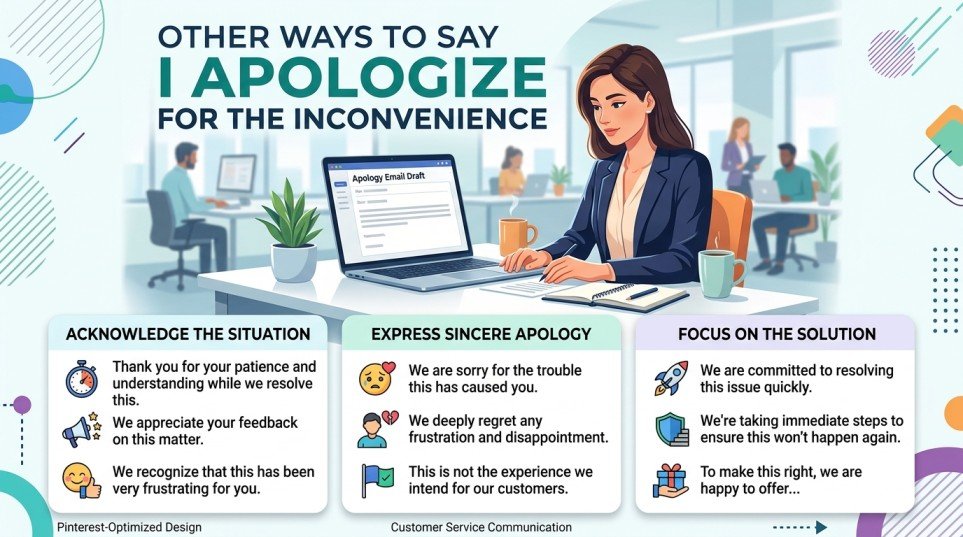
Quick Answer: Instead of saying I apologize for the inconvenience, you can say: sorry for the trouble, please accept my apologies, I regret any inconvenience caused, thank you for your patience, my sincere apologies.
The phrase “I apologize for the inconvenience” is commonly used when acknowledging a problem, delay, mistake, or disruption that may have affected someone else. It is polite, professional, and widely accepted in customer service and business communication.
Although effective, using the same apology repeatedly can make your writing sound robotic or overly formal. Native speakers often choose different expressions depending on the situation and the relationship with the recipient.
Learning alternatives to “I apologize for the inconvenience” helps you sound more natural, empathetic, and professional. It also improves your ability to adapt tone in emails, workplace conversations, and customer communications while helping you express excitement in English and other emotions more effectively through varied language.
Quick Categories Section
Formal alternatives to “I apologize for the inconvenience”
- Please accept my apologies
- I regret any inconvenience caused
- My sincere apologies
- Kindly accept our apologies
Pro Tip: These phrases work well in official correspondence and formal business communication.
Casual alternatives
- Sorry about that
- My bad
- Sorry for the trouble
- I didn’t mean to cause any issues
Pro Tip: Use these when speaking with friends, colleagues, or people you know well.
Professional alternatives
- Thank you for your patience
- We appreciate your understanding
- We regret the inconvenience
- We apologize for any disruption
Pro Tip: Professional communication often focuses on solutions as much as apologies.
Informal expressions
- Oops, sorry about that
- That’s on me
- My mistake
- Sorry for the hassle
Pro Tip: Avoid informal expressions in business emails or customer-facing communication.
“A thoughtful apology strengthens relationships and builds trust.”
Common Mistakes
- Overusing the exact same apology Example: Repeating “I apologize for the inconvenience” in every email.
- Sounding overly robotic Example: Using formal wording in casual conversations.
- Apologizing without offering a solution Example: “Sorry for the inconvenience” without explaining next steps.
- Using informal phrases in professional settings Example: “My bad” in a client email.
- Being too vague Example: Apologizing without identifying the issue.
What Does “I Apologize for the Inconvenience” Mean?
It means you are expressing regret for a problem, delay, or disruption that may have negatively affected someone.
Grammatically, it is a formal apology statement often used in written communication.
Example Sentence:
I apologize for the inconvenience caused by the unexpected delay.
When to Use “I Apologize for the Inconvenience”
- Customer service situations
- Business emails
- Service interruptions
- Delayed responses
- Missed deadlines
- Scheduling changes
Spoken vs Written: More common in writing
Formal vs Informal: Generally formal
Is It Professional or Polite to Say “I Apologize for the Inconvenience”?
Polite? ✔️ Yes
Professional? ✔️ Yes
Business Example:
“We apologize for the inconvenience and appreciate your patience while we resolve the issue.”
Pros and Cons of Using “I Apologize for the Inconvenience”
Pros
- Professional tone
- Widely accepted
- Shows accountability
- Suitable for business communication
Cons
- Can sound repetitive
- May feel impersonal
- Sometimes overly formal
- Commonly overused in emails
“The best apologies acknowledge the issue and offer reassurance.”
Other Ways to Say “I Apologize for the Inconvenience” (With Examples)
These alternatives will help you sound more fluent, professional, and empathetic in different situations.
Use them according to tone, audience, and context.
1. Phrase: Sorry for the trouble
Meaning: Apologizing for causing difficulty.
Explanation: A friendly and natural alternative.
Example Sentence: Sorry for the trouble; we’ll have this fixed shortly.
Best Use: customer support
Worst Use: legal document
Tone: friendly, apologetic
Context Variability: casual / professional / spoken
2. Phrase: Please accept my apologies
Meaning: A formal expression of regret.
Explanation: Common in business communication.
Example Sentence: Please accept my apologies for the delay in responding.
Best Use: formal email
Worst Use: casual chat
Tone: formal, respectful
Context Variability: professional / written
3. Phrase: My sincere apologies
Meaning: Deep and genuine regret.
Explanation: Stronger than a standard apology.
Example Sentence: My sincere apologies for the confusion.
Best Use: serious issue
Worst Use: minor mistake
Tone: sincere, formal
Context Variability: professional / written
4. Phrase: I regret any inconvenience caused
Meaning: Expressing regret for negative impact.
Explanation: Very common in professional settings.
Example Sentence: I regret any inconvenience caused by this change.
Best Use: official notice
Worst Use: casual talk
Tone: formal, professional
Context Variability: professional / written
5. Phrase: Thank you for your patience
Meaning: Appreciating understanding during a problem.
Explanation: Positive alternative that focuses on the recipient.
Example Sentence: Thank you for your patience while we resolve this matter.
Best Use: customer service
Worst Use: personal apology
Tone: professional, positive
Context Variability: professional / written
“Sometimes appreciation sounds stronger than an apology.”
6. Phrase: We appreciate your understanding
Meaning: Thanking someone for being reasonable.
Explanation: Often used instead of repeated apologies.
Example Sentence: We appreciate your understanding during this delay.
Best Use: business communication
Worst Use: personal conflict
Tone: professional, appreciative
Context Variability: professional
7. Phrase: Sorry about that
Meaning: Informal apology.
Explanation: Common in everyday speech.
Example Sentence: Sorry about that, I overlooked your message.
Best Use: casual conversation
Worst Use: formal complaint
Tone: casual, friendly
Context Variability: spoken / casual
8. Phrase: We apologize for any disruption
Meaning: Apologizing for interruption.
Explanation: Suitable for service-related issues.
Example Sentence: We apologize for any disruption to your service.
Best Use: announcements
Worst Use: casual talk
Tone: professional, formal
Context Variability: professional
9. Phrase: Sorry for the hassle
Meaning: Apologizing for inconvenience.
Explanation: Friendly and conversational.
Example Sentence: Sorry for the hassle caused by the mix-up.
Best Use: everyday use
Worst Use: legal communication
Tone: casual, apologetic
Context Variability: casual / spoken
10. Phrase: My apologies
Meaning: A concise apology.
Explanation: Short but professional.
Example Sentence: My apologies for the misunderstanding.
Best Use: workplace
Worst Use: highly emotional situations
Tone: professional, polite
Context Variability: professional / spoken
“Professional reaction phrases often focus on solutions rather than blame.”
11. Phrase: I’m sorry for any inconvenience caused
Meaning: Direct apology.
Explanation: Slightly softer than the original phrase.
Example Sentence: I’m sorry for any inconvenience caused by the delay.
Best Use: customer communication
Worst Use: casual jokes
Tone: polite, professional
Context Variability: professional
12. Phrase: I take full responsibility
Meaning: Accepting accountability.
Explanation: Shows ownership of the issue.
Example Sentence: I take full responsibility for the error.
Best Use: workplace issues
Worst Use: minor incidents
Tone: accountable, sincere
Context Variability: professional
13. Phrase: We regret the inconvenience
Meaning: Formal regret.
Explanation: Common in public notices.
Example Sentence: We regret the inconvenience and thank you for your patience.
Best Use: announcements
Worst Use: personal conversations
Tone: formal, corporate
Context Variability: professional
14. Phrase: I’m sorry for the delay
Meaning: Apology for lateness.
Explanation: More specific than a general apology.
Example Sentence: I’m sorry for the delay in getting back to you.
Best Use: email communication
Worst Use: unrelated issues
Tone: professional, polite
Context Variability: professional
15. Phrase: I sincerely regret this situation
Meaning: Genuine regret.
Explanation: Appropriate for significant problems.
Example Sentence: I sincerely regret this situation and its impact.
Best Use: serious matters
Worst Use: small mistakes
Tone: sincere, formal
Context Variability: professional
16. Phrase: Sorry for the inconvenience
Meaning: Direct acknowledgment of disruption.
Explanation: Shorter version of the original phrase.
Example Sentence: Sorry for the inconvenience caused.
Best Use: customer service
Worst Use: legal matters
Tone: polite, direct
Context Variability: professional / spoken
17. Phrase: Kindly accept our apologies
Meaning: Formal apology.
Explanation: Respectful business language.
Example Sentence: Kindly accept our apologies for the interruption.
Best Use: official communication
Worst Use: casual conversations
Tone: formal, respectful
Context Variability: professional
18. Phrase: I regret this oversight
Meaning: Apology for a mistake.
Explanation: Focuses on an error or omission.
Example Sentence: I regret this oversight and will correct it immediately.
Best Use: workplace
Worst Use: personal issues
Tone: accountable, formal
Context Variability: professional
19. Phrase: We are sorry for the inconvenience
Meaning: Company apology.
Explanation: Common corporate phrase.
Example Sentence: We are sorry for the inconvenience and appreciate your patience.
Best Use: customer notices
Worst Use: casual chat
Tone: professional, polite
Context Variability: professional
20. Phrase: I apologize for the delay
Meaning: Apology for lateness.
Explanation: Specific and professional.
Example Sentence: I apologize for the delay in processing your request.
Best Use: business emails
Worst Use: unrelated issues
Tone: professional, respectful
Context Variability: professional
“A clear apology demonstrates professionalism and accountability.”
21. Phrase: I’m sorry this happened
Meaning: Regret for an unfortunate situation.
Explanation: Personal and empathetic.
Example Sentence: I’m sorry this happened to you.
Best Use: customer complaints
Worst Use: formal announcements
Tone: empathetic, sincere
Context Variability: spoken / professional
22. Phrase: I understand your frustration
Meaning: Acknowledging emotions.
Explanation: Shows empathy before offering a solution.
Example Sentence: I understand your frustration and appreciate your patience.
Best Use: customer support
Worst Use: unrelated issues
Tone: empathetic, professional
Context Variability: professional
23. Phrase: We understand the inconvenience
Meaning: Recognizing the impact.
Explanation: Shows awareness of the issue.
Example Sentence: We understand the inconvenience this may have caused.
Best Use: service updates
Worst Use: casual settings
Tone: professional, understanding
Context Variability: professional
24. Phrase: I regret the inconvenience
Meaning: Formal regret.
Explanation: Professional and concise.
Example Sentence: I regret the inconvenience caused by this error.
Best Use: workplace communication
Worst Use: informal chats
Tone: formal, professional
Context Variability: professional
25. Phrase: I appreciate your patience
Meaning: Thanking someone for waiting.
Explanation: Positive alternative to apologizing.
Example Sentence: I appreciate your patience during this process.
Best Use: customer service
Worst Use: personal disputes
Tone: appreciative, professional
Context Variability: professional
26. Phrase: We value your understanding
Meaning: Appreciating cooperation.
Explanation: Common in business messages.
Example Sentence: We value your understanding as we address this issue.
Best Use: official notices
Worst Use: casual talk
Tone: professional, appreciative
Context Variability: professional
27. Phrase: I’m truly sorry
Meaning: Deep apology.
Explanation: More emotional and personal.
Example Sentence: I’m truly sorry for the inconvenience.
Best Use: serious situations
Worst Use: routine notices
Tone: sincere, heartfelt
Context Variability: spoken / professional
28. Phrase: Please forgive the inconvenience
Meaning: Requesting understanding.
Explanation: Formal but warm.
Example Sentence: Please forgive the inconvenience caused.
Best Use: formal letters
Worst Use: casual messages
Tone: respectful, apologetic
Context Variability: professional
29. Phrase: We sincerely apologize
Meaning: Strong corporate apology.
Explanation: Suitable for major issues.
Example Sentence: We sincerely apologize for the disruption.
Best Use: public statements
Worst Use: casual conversations
Tone: formal, sincere
Context Variability: professional
30. Phrase: I apologize for any inconvenience this may have caused
Meaning: Complete professional apology.
Explanation: A polished alternative often used in business writing.
Example Sentence: I apologize for any inconvenience this may have caused and appreciate your understanding.
Best Use: formal correspondence
Worst Use: casual conversation
Tone: professional, courteous
Context Variability: professional / written
“The most effective apology combines sincerity, accountability, and action.”
Mini Quiz / Self-Check
1. Which phrase is best for a formal client email?
A. My bad
B. Please accept my apologies
C. Sorry about that
Answer: B
2. Which phrase focuses on appreciation rather than apology?
A. Thank you for your patience
B. My mistake
C. Sorry for the hassle
Answer: A
3. Which phrase is too informal for most business situations?
A. My bad
B. I regret any inconvenience caused
C. We appreciate your understanding
Answer: A
Comparison Table: Top Alternatives
| Phrase | Tone | Best Use |
|---|---|---|
| Please accept my apologies | Formal | Business emails |
| My sincere apologies | Formal | Serious issues |
| Thank you for your patience | Professional | Customer service |
| We appreciate your understanding | Professional | Workplace communication |
| Sorry for the trouble | Friendly | General apologies |
| My apologies | Professional | Everyday work emails |
| We regret the inconvenience | Formal | Official notices |
| I understand your frustration | Empathetic | Customer support |
| I appreciate your patience | Professional | Delays and updates |
| We sincerely apologize | Formal | Public statements |
FAQs
1. What are the best alternatives to “I apologize for the inconvenience”?
Some of the best options include please accept my apologies, thank you for your patience, and my sincere apologies.
2. Is “I apologize for the inconvenience” professional?
Yes. It is one of the most common and professional apology phrases used in business communication.
3. What is a more empathetic alternative?
Try I understand your frustration or I’m sorry this happened.
4. What should I say in a customer service email?
Use thank you for your patience or we appreciate your understanding alongside an explanation or solution.
5. Why should I learn other ways to say “I apologize for the inconvenience”?
Using varied professional reaction phrases improves communication, avoids repetition, and helps you sound more natural.
Conclusion
Learning other ways to say “I apologize for the inconvenience” helps you communicate with greater professionalism, empathy, and confidence. Different situations require different levels of formality, and having multiple alternatives allows you to choose the most appropriate response.
Practice these phrases in emails, workplace communication, and customer interactions. Over time, you’ll develop stronger communication skills and a more natural command of professional English.
CTA: Which alternative do you use most often? Try incorporating a new one into your next email or conversation.
Discover More:-
- Other Ways to Say I Look Forward to the Meeting (30+ Examples)
- Other Ways to Say I Love You (30+ Examples)

Robert Mitchell is a U.S.-based writer at Gramtivo.Com who focuses on grammar, writing improvement, and language-related content. He holds a degree in English and Linguistics from a U.S. university. His work aims to help readers enhance their writing skills with clear and practical guidance.