
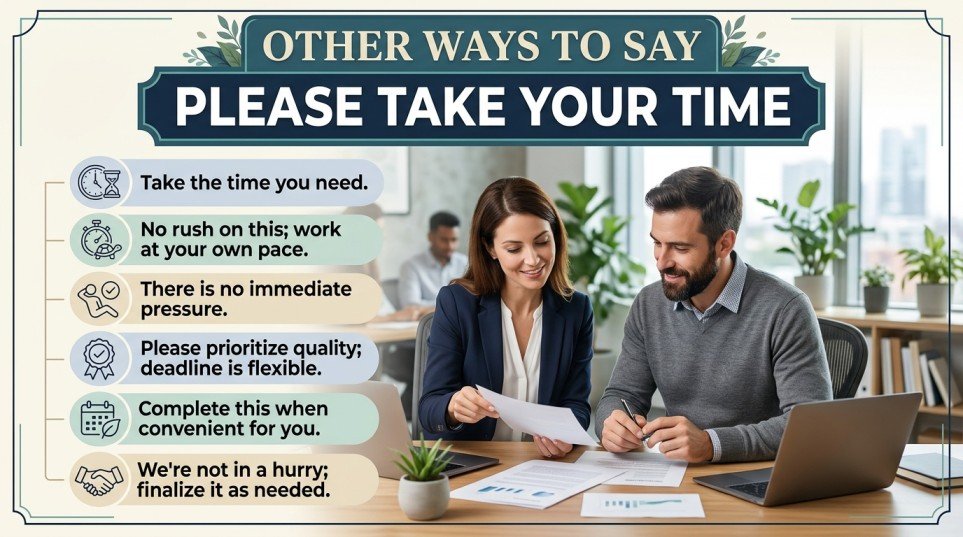
Quick Answer: You can say please take your time in many different ways depending on tone and situation. Popular alternatives include: no rush, take all the time you need, whenever you’re ready, there’s no hurry, don’t feel rushed.
The phrase “please take your time” is commonly used to tell someone they do not need to hurry. It creates a calm, patient, and understanding tone in conversations.
Although the phrase is polite and widely accepted, repeating it too often can make your English sound repetitive. Native speakers often use different expressions depending on whether the situation is casual, professional, or formal.
Learning alternatives to “please take your time” helps improve fluency and communication skills. It also helps you sound more natural in conversations and gives you more flexibility to express excitement in English, reassurance, or professionalism.
Quick Categories Section
Formal alternatives to “please take your time”
- There is no urgency
- Please proceed at your convenience
- Feel free to take the necessary time
- No immediate response is required
Pro Tip: These phrases work well in professional emails and formal conversations.
Casual alternatives
- No rush
- Take your time
- Whenever you’re ready
- Don’t hurry
Pro Tip: Use these with friends, family, or relaxed conversations.
Professional alternatives
- Take all the time you need
- There’s no pressure
- Please don’t feel rushed
- Respond when convenient
Pro Tip: Professional reaction phrases should sound supportive but concise.
Informal expressions
- Chill, no rush
- Go at your own pace
- Take it easy
- No need to hurry
Pro Tip: Avoid overly informal phrases in workplace communication.
“Patient and supportive language makes your English sound more thoughtful.”
Common Mistakes
- Using overly casual expressions at work
Example: “Chill, no rush” in a business email sounds unprofessional. - Sounding too vague
Example: “Whenever” may confuse listeners about deadlines. - Repeating the same phrase too often
Example: Constantly saying “take your time” sounds repetitive. - Using formal phrases in casual conversations
Example: “Proceed at your convenience” with close friends sounds unnatural. - Ignoring tone and urgency
Example: Saying “no hurry” during urgent situations sends mixed signals.
What Does “Please Take Your Time” Mean?
It means someone should not feel pressured to hurry and can proceed comfortably.
Grammatically, it is an imperative phrase used politely to reduce pressure.
Example Sentence:
Please take your time reviewing the document.
When to Use “Please Take Your Time”
- When someone is making a decision
- During customer service interactions
- In supportive conversations
- In both spoken and written English
Spoken vs Written: Common in both
Formal vs Informal: Neutral and polite
Is It Professional or Polite to Say “Please Take Your Time”?
Polite? ✔️ Yes
Professional? ✔️ Yes
Business Example:
“Please take your time reviewing the proposal before responding.”
Pros and Cons of Using “Please Take Your Time”
Pros
- Polite and respectful
- Reduces pressure
- Professional and friendly
- Easy to understand
Cons
- Can sound repetitive
- Slightly generic
- May lack warmth in some contexts
- Less expressive than alternatives
“The right tone can make conversations feel calmer and more professional.”
Other Ways to Say “Please Take Your Time” (With Examples)
These alternatives will help you sound more fluent, confident, and natural in different situations.
Use them according to tone, audience, and context.
1. Phrase: No rush
Meaning: There is no need to hurry.
Explanation: Very common and casual reassurance.
Example Sentence: No rush, reply whenever you can.
Best Use: casual talk
Worst Use: legal writing
Tone: relaxed, friendly
Context Variability: casual / spoken
2. Phrase: Take all the time you need
Meaning: Plenty of time is available.
Explanation: Warm and supportive phrase.
Example Sentence: Take all the time you need to decide.
Best Use: reassurance
Worst Use: urgent deadlines
Tone: caring, calm
Context Variability: professional / spoken
3. Phrase: Whenever you’re ready
Meaning: Proceed when comfortable.
Explanation: Encourages comfort and flexibility.
Example Sentence: Whenever you’re ready, we can begin.
Best Use: meetings
Worst Use: emergency situations
Tone: patient, polite
Context Variability: casual / professional
4. Phrase: There’s no hurry
Meaning: Speed is unnecessary.
Explanation: Direct reassurance.
Example Sentence: There’s no hurry, take your time.
Best Use: general use
Worst Use: urgent tasks
Tone: calm, reassuring
Context Variability: casual / spoken
5. Phrase: Don’t feel rushed
Meaning: No pressure to move quickly.
Explanation: Helpful in sensitive situations.
Example Sentence: Don’t feel rushed while making your decision.
Best Use: emotional support
Worst Use: fast-paced tasks
Tone: supportive, gentle
Context Variability: professional / spoken
“Natural English becomes easier when you learn multiple ways to express the same idea.”
6. Phrase: Go at your own pace
Meaning: Move comfortably at your preferred speed.
Explanation: Encourages personal comfort.
Example Sentence: Go at your own pace during training.
Best Use: learning context
Worst Use: strict deadlines
Tone: encouraging, relaxed
Context Variability: casual / professional
7. Phrase: Please proceed at your convenience
Meaning: Continue whenever suitable.
Explanation: Formal and professional alternative.
Example Sentence: Please proceed at your convenience.
Best Use: business email
Worst Use: casual chat
Tone: formal, respectful
Context Variability: professional / written
8. Phrase: There’s no pressure
Meaning: No expectations for speed.
Explanation: Removes stress from the situation.
Example Sentence: There’s no pressure to decide today.
Best Use: reassurance
Worst Use: urgent matters
Tone: calm, supportive
Context Variability: professional / casual
9. Phrase: Don’t hurry
Meaning: Take things slowly.
Explanation: Simple and direct.
Example Sentence: Don’t hurry, we still have time.
Best Use: everyday use
Worst Use: formal email
Tone: casual, caring
Context Variability: spoken
10. Phrase: Feel free to take your time
Meaning: You are welcome to move slowly.
Explanation: Polite and warm expression.
Example Sentence: Feel free to take your time reviewing it.
Best Use: customer service
Worst Use: urgent deadlines
Tone: polite, supportive
Context Variability: professional
11. Phrase: No immediate response is required
Meaning: An instant reply isn’t necessary.
Explanation: Formal and professional phrase.
Example Sentence: No immediate response is required.
Best Use: workplace
Worst Use: casual talk
Tone: formal, professional
Context Variability: written
12. Phrase: Take it easy
Meaning: Relax and don’t rush.
Explanation: Informal and friendly expression.
Example Sentence: Take it easy, there’s plenty of time.
Best Use: friends
Worst Use: business email
Tone: relaxed, informal
Context Variability: casual
13. Phrase: No need to hurry
Meaning: There’s enough time available.
Explanation: Gentle reassurance.
Example Sentence: No need to hurry with the report.
Best Use: supportive tone
Worst Use: emergencies
Tone: calm, friendly
Context Variability: professional / casual
14. Phrase: Respond when convenient
Meaning: Reply at a suitable time.
Explanation: Professional and concise.
Example Sentence: Respond when convenient for you.
Best Use: workplace
Worst Use: emotional situations
Tone: professional, respectful
Context Variability: professional / written
15. Phrase: Take your time deciding
Meaning: Make the decision carefully.
Explanation: Encourages thoughtful consideration.
Example Sentence: Take your time deciding what works best.
Best Use: decision-making
Worst Use: urgent deadlines
Tone: patient, supportive
Context Variability: spoken / professional
“Supportive phrases create smoother and more respectful communication.”
16. Phrase: Don’t feel any pressure
Meaning: There is no stress or urgency.
Explanation: Reassuring and empathetic.
Example Sentence: Don’t feel any pressure to answer today.
Best Use: emotional support
Worst Use: strict timelines
Tone: gentle, understanding
Context Variability: professional / spoken
17. Phrase: We’re in no hurry
Meaning: There is plenty of time available.
Explanation: Casual and comforting phrase.
Example Sentence: We’re in no hurry, so relax.
Best Use: casual talk
Worst Use: formal writing
Tone: calm, friendly
Context Variability: casual
18. Phrase: Relax and take your time
Meaning: Stay calm and move slowly.
Explanation: Warm and reassuring.
Example Sentence: Relax and take your time with the form.
Best Use: reassurance
Worst Use: formal emails
Tone: warm, caring
Context Variability: spoken
19. Phrase: There’s plenty of time
Meaning: Enough time is available.
Explanation: Reduces urgency.
Example Sentence: There’s plenty of time before the deadline.
Best Use: general use
Worst Use: emergencies
Tone: reassuring, calm
Context Variability: casual / professional
20. Phrase: Feel free to go slowly
Meaning: Proceed at a comfortable pace.
Explanation: Gentle encouragement.
Example Sentence: Feel free to go slowly during practice.
Best Use: teaching
Worst Use: urgent tasks
Tone: patient, encouraging
Context Variability: spoken
21. Phrase: Take as long as you need
Meaning: No time restriction exists.
Explanation: Strong reassurance.
Example Sentence: Take as long as you need to recover.
Best Use: emotional support
Worst Use: deadlines
Tone: caring, empathetic
Context Variability: spoken / professional
22. Phrase: Don’t stress about time
Meaning: Time should not cause worry.
Explanation: Casual reassurance.
Example Sentence: Don’t stress about time, we’re okay.
Best Use: friends
Worst Use: formal communication
Tone: casual, supportive
Context Variability: casual
23. Phrase: You can take your time
Meaning: There’s no pressure to rush.
Explanation: Direct and natural phrase.
Example Sentence: You can take your time with the application.
Best Use: general use
Worst Use: urgent situations
Tone: neutral, polite
Context Variability: casual / professional
24. Phrase: Move at a comfortable pace
Meaning: Continue at a suitable speed.
Explanation: Encouraging and supportive.
Example Sentence: Move at a comfortable pace during training.
Best Use: coaching
Worst Use: emergency tasks
Tone: supportive, calm
Context Variability: professional
25. Phrase: There’s absolutely no rush
Meaning: Speed is completely unnecessary.
Explanation: Strong reassurance.
Example Sentence: There’s absolutely no rush to finish today.
Best Use: reassurance
Worst Use: urgent meetings
Tone: warm, relaxed
Context Variability: casual / professional
26. Phrase: Handle it when you can
Meaning: Complete it at a suitable time.
Explanation: Casual flexibility.
Example Sentence: Handle it when you can this week.
Best Use: casual work chat
Worst Use: formal documents
Tone: relaxed, practical
Context Variability: casual
27. Phrase: Please don’t rush yourself
Meaning: Avoid unnecessary pressure.
Explanation: Thoughtful and supportive.
Example Sentence: Please don’t rush yourself with recovery.
Best Use: emotional support
Worst Use: strict deadlines
Tone: caring, gentle
Context Variability: spoken / professional
28. Phrase: Take whatever time you need
Meaning: No strict time limit exists.
Explanation: Strongly reassuring phrase.
Example Sentence: Take whatever time you need to think about it.
Best Use: sensitive situations
Worst Use: emergencies
Tone: empathetic, patient
Context Variability: professional / spoken
29. Phrase: We can wait
Meaning: Others are willing to be patient.
Explanation: Short and reassuring.
Example Sentence: We can wait, no problem.
Best Use: teamwork
Worst Use: urgent matters
Tone: calm, understanding
Context Variability: spoken
30. Phrase: There’s no need to rush
Meaning: Hurrying is unnecessary.
Explanation: Natural and widely used expression.
Example Sentence: There’s no need to rush with the presentation.
Best Use: workplace
Worst Use: emergencies
Tone: reassuring, polite
Context Variability: casual / professional
“Fluent English comes from knowing how to adjust your tone naturally.”
Mini Quiz / Self-Check
1. Which phrase is best for a professional email?
A. Chill, no rush
B. Please proceed at your convenience
C. Take it easy
Answer: B
2. Which phrase sounds most casual?
A. No immediate response is required
B. Don’t hurry
C. Chill, no rush
Answer: C
3. Which expression is best for emotional support?
A. Take whatever time you need
B. Respond when convenient
C. No immediate response is required
Answer: A
Comparison Table: Top Alternatives
| Phrase | Tone | Best Use |
|---|---|---|
| No rush | Casual | Friends |
| Take all the time you need | Supportive | Reassurance |
| Whenever you’re ready | Neutral | Meetings |
| There’s no hurry | Calm | Everyday use |
| Don’t feel rushed | Gentle | Sensitive situations |
| Proceed at your convenience | Formal | Business emails |
| There’s no pressure | Supportive | Workplace |
| Respond when convenient | Professional | Emails |
| Take whatever time you need | Empathetic | Emotional support |
| There’s no need to rush | Neutral | General use |
FAQs
1. What are the best alternatives to “please take your time”?
Popular choices include no rush, take all the time you need, and there’s no hurry.
2. Is “please take your time” professional?
Yes, it is polite and professional in most workplace situations.
3. What should I say instead in a business email?
Use phrases like respond when convenient or please proceed at your convenience.
4. Are informal expressions in English appropriate at work?
Only in relaxed workplaces; otherwise, choose professional reaction phrases.
5. Why learn other ways to say “please take your time”?
It improves fluency, tone awareness, and communication confidence.
Conclusion
Learning other ways to say “please take your time” helps you communicate more naturally and professionally. It also allows you to sound more supportive, patient, and fluent in different contexts.
Practice these expressions regularly and pay attention to tone. The more alternatives you know, the more confident and adaptable your English will become.
CTA: Try using a new alternative in your next conversation or email.
Discover More:-
- Other Ways to Say Have a Great Rest of Your Week (30+ Examples)
- Other Ways to Say Sorry to Keep You Waiting (30+ Examples)

Robert Mitchell is a U.S.-based writer at Gramtivo.Com who focuses on grammar, writing improvement, and language-related content. He holds a degree in English and Linguistics from a U.S. university. His work aims to help readers enhance their writing skills with clear and practical guidance.