
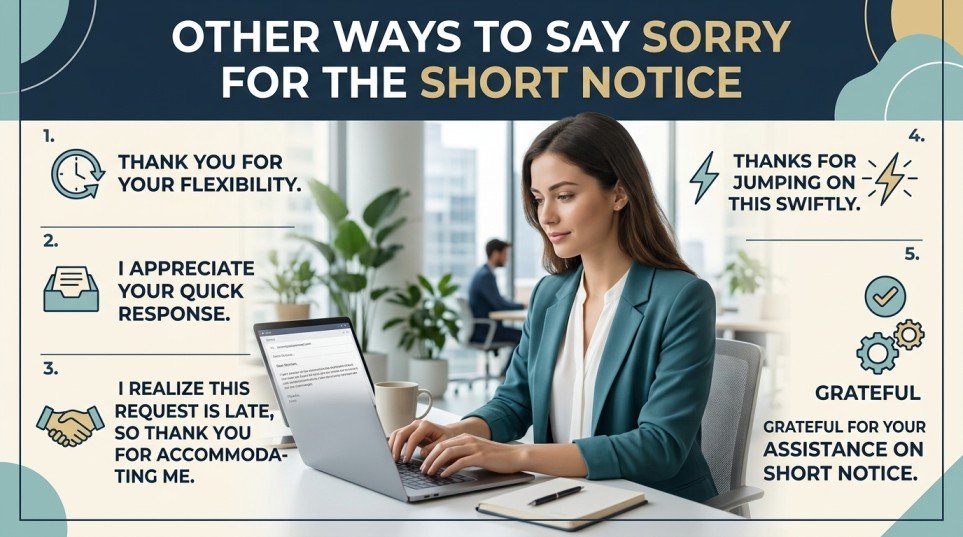
Quick Answer: Instead of saying sorry for the short notice, you can say: thank you for your flexibility, I apologize for the late update, sorry for the last-minute notice, I appreciate your understanding, thanks for accommodating this request.
The phrase “sorry for the short notice” is commonly used when informing someone about something at the last minute. It expresses politeness and acknowledges inconvenience.
Although the phrase is widely accepted, using the same wording repeatedly can sound repetitive or overly apologetic. Native speakers often choose different expressions depending on the situation and level of professionalism.
Learning alternatives to “sorry for the short notice” helps you sound more fluent and natural. It also improves workplace communication and helps you choose the right tone in both formal and informal situations. These phrases can also help you express excitement in English more naturally when sharing unexpected plans or updates.
Quick Categories Section
Formal alternatives to “sorry for the short notice”
- I apologize for the late notice
- Please accept my apologies for the delay
- I regret the short notice
- Thank you for your understanding
Pro Tip: Use these in formal emails, client communication, and workplace messages.
Casual alternatives
- Sorry for the last-minute heads-up
- My bad for the short notice
- Sorry this is so last minute
- Hope this isn’t too sudden
Pro Tip: Keep casual expressions friendly and conversational.
Professional alternatives
- Thank you for your flexibility
- I appreciate your accommodation
- Thank you for adjusting on short notice
- Apologies for the late update
Pro Tip: In professional communication, gratitude often sounds better than excessive apologizing.
Informal expressions
- Sorry for the late heads-up
- Didn’t mean to spring this on you
- Hope you can still make it
- This came up unexpectedly
Pro Tip: Avoid informal expressions in formal workplace emails.
“Professional English sounds stronger when it balances politeness with confidence.”
Common Mistakes
- Over-apologizing in professional emails
Example: Repeating “sorry” several times in one message. - Using overly casual phrases at work
Example: “My bad” in a client email sounds unprofessional. - Ignoring tone
Example: Using humor in serious scheduling situations. - Being too vague
Example: Saying “sorry for the short notice” without context. - Using long explanations
Example: Writing unnecessary details instead of being direct.
What Does “Sorry for the Short Notice” Mean?
It means apologizing for informing someone about something with very little advance warning.
Grammatically, it’s an apology phrase commonly used in spoken and written English.
Example Sentence:
Sorry for the short notice, but the meeting has been moved to tomorrow morning.
When to Use “Sorry for the Short Notice”
- When changing plans unexpectedly
- In last-minute invitations
- During scheduling changes
- In workplace communication
- In both spoken and written English
Spoken vs Written: Common in both
Formal vs Informal: Neutral but adaptable
Is It Professional or Polite to Say “Sorry for the Short Notice”?
Polite? ✔️ Yes
Professional? ✔️ Yes
Business Example:
“Sorry for the short notice, but we need to reschedule the meeting for Friday.”
Pros and Cons of Using “Sorry for the Short Notice”
Pros
- Polite and respectful
- Common in professional English
- Easy to understand
- Shows awareness of inconvenience
Cons
- Can sound repetitive
- Sometimes overly apologetic
- Lacks variety
- May weaken confident communication if overused
“Clear and confident wording improves both fluency and professionalism.”
Other Ways to Say “Sorry for the Short Notice” (With Examples)
These alternatives will help you sound more fluent, confident, and natural in different situations.
Use them according to tone, context, and audience.
1. Phrase: I apologize for the late notice
Meaning: A formal apology for informing someone late.
Explanation: Common in professional communication.
Example Sentence: I apologize for the late notice regarding tomorrow’s meeting.
Best Use: business email
Worst Use: casual chat
Tone: formal, professional
Context Variability: professional / written
2. Phrase: Thank you for your flexibility
Meaning: Appreciation for someone’s ability to adapt.
Explanation: Sounds more positive than apologetic.
Example Sentence: Thank you for your flexibility with this schedule change.
Best Use: workplace
Worst Use: personal conflict
Tone: professional, appreciative
Context Variability: professional / spoken
3. Phrase: Sorry this is so last minute
Meaning: Apologizing for late timing.
Explanation: Casual and conversational.
Example Sentence: Sorry this is so last minute, but can we meet today?
Best Use: friendly talk
Worst Use: formal report
Tone: casual, polite
Context Variability: casual / spoken
4. Phrase: I appreciate your understanding
Meaning: Gratitude for patience and cooperation.
Explanation: Professional and respectful.
Example Sentence: I appreciate your understanding regarding this sudden change.
Best Use: workplace
Worst Use: slang context
Tone: polite, professional
Context Variability: professional / written
5. Phrase: Apologies for the late update
Meaning: Sorry for sharing information late.
Explanation: Common in business communication.
Example Sentence: Apologies for the late update on the project timeline.
Best Use: office communication
Worst Use: casual hangout
Tone: professional, direct
Context Variability: professional
“Gratitude-focused phrases often sound more professional than repeated apologies.”
6. Phrase: Sorry for the last-minute notice
Meaning: Apologizing for informing someone late.
Explanation: Slight variation of the original phrase.
Example Sentence: Sorry for the last-minute notice about the event.
Best Use: general use
Worst Use: legal writing
Tone: neutral, polite
Context Variability: casual / professional
7. Phrase: Thank you for accommodating this request
Meaning: Appreciation for someone’s cooperation.
Explanation: Professional and polished.
Example Sentence: Thank you for accommodating this request on short notice.
Best Use: workplace
Worst Use: casual speech
Tone: formal, appreciative
Context Variability: professional
8. Phrase: I regret the short notice
Meaning: Formal expression of apology.
Explanation: Sounds more refined and professional.
Example Sentence: I regret the short notice for this change.
Best Use: formal communication
Worst Use: casual conversation
Tone: formal, respectful
Context Variability: professional / written
9. Phrase: Hope this isn’t too sudden
Meaning: A softer way to acknowledge timing.
Explanation: Friendly and conversational.
Example Sentence: Hope this isn’t too sudden, but can we reschedule?
Best Use: casual requests
Worst Use: legal matters
Tone: warm, casual
Context Variability: casual
10. Phrase: Thanks for adjusting on short notice
Meaning: Appreciation for flexibility.
Explanation: Positive and workplace-friendly.
Example Sentence: Thanks for adjusting on short notice.
Best Use: teamwork
Worst Use: formal complaint
Tone: professional, warm
Context Variability: professional / spoken
11. Phrase: Please excuse the late notice
Meaning: Asking forgiveness for delayed information.
Explanation: Polite and formal.
Example Sentence: Please excuse the late notice regarding the venue change.
Best Use: formal email
Worst Use: slang talk
Tone: formal, respectful
Context Variability: professional
12. Phrase: Didn’t mean to spring this on you
Meaning: Informal apology for sudden information.
Explanation: Casual and conversational.
Example Sentence: Didn’t mean to spring this on you so late.
Best Use: friends
Worst Use: business email
Tone: informal, friendly
Context Variability: casual
13. Phrase: Sorry for the late heads-up
Meaning: Apologizing for delayed warning.
Explanation: Informal but common.
Example Sentence: Sorry for the late heads-up about tonight’s plans.
Best Use: casual talk
Worst Use: formal writing
Tone: relaxed, informal
Context Variability: spoken
14. Phrase: This came up unexpectedly
Meaning: Explaining sudden circumstances.
Explanation: Less apologetic and more explanatory.
Example Sentence: This came up unexpectedly, so I had to contact you late.
Best Use: workplace
Worst Use: joking context
Tone: neutral, explanatory
Context Variability: professional / spoken
15. Phrase: Thank you for being so understanding
Meaning: Appreciation for patience.
Explanation: Warm and professional.
Example Sentence: Thank you for being so understanding about the timing.
Best Use: workplace
Worst Use: sarcasm
Tone: appreciative, warm
Context Variability: professional
“Natural English becomes more effective when you vary your expressions.”
16. Phrase: Sorry for the delayed notice
Meaning: Apologizing for informing late.
Explanation: Direct and simple.
Example Sentence: Sorry for the delayed notice about the meeting.
Best Use: general communication
Worst Use: highly formal writing
Tone: neutral, polite
Context Variability: professional / casual
17. Phrase: I know this is short notice
Meaning: Acknowledging inconvenience.
Explanation: Shows awareness politely.
Example Sentence: I know this is short notice, but I need your help.
Best Use: requests
Worst Use: strict legal context
Tone: considerate, neutral
Context Variability: professional / spoken
18. Phrase: I appreciate your patience
Meaning: Gratitude for understanding delays.
Explanation: Professional and calm.
Example Sentence: I appreciate your patience with this last-minute change.
Best Use: office communication
Worst Use: casual jokes
Tone: professional, respectful
Context Variability: professional
19. Phrase: Sorry to bring this up so late
Meaning: Apologizing for delayed discussion.
Explanation: Conversational and polite.
Example Sentence: Sorry to bring this up so late in the day.
Best Use: casual workplace
Worst Use: formal letters
Tone: casual, respectful
Context Variability: spoken / professional
20. Phrase: Thank you for your cooperation
Meaning: Appreciation for support.
Explanation: Formal and workplace-friendly.
Example Sentence: Thank you for your cooperation despite the short notice.
Best Use: business communication
Worst Use: casual chat
Tone: formal, professional
Context Variability: professional
21. Phrase: Sorry for the sudden change
Meaning: Apologizing for unexpected adjustments.
Explanation: Common in scheduling situations.
Example Sentence: Sorry for the sudden change in plans.
Best Use: scheduling
Worst Use: legal writing
Tone: neutral, polite
Context Variability: casual / professional
22. Phrase: I hope this still works for you
Meaning: Checking availability politely.
Explanation: Softens last-minute requests.
Example Sentence: I hope this still works for you despite the timing.
Best Use: meetings
Worst Use: strict instructions
Tone: considerate, warm
Context Variability: professional / spoken
23. Phrase: Thanks for your quick response
Meaning: Appreciation for acting fast.
Explanation: Positive workplace phrase.
Example Sentence: Thanks for your quick response on such short notice.
Best Use: teamwork
Worst Use: complaints
Tone: appreciative, professional
Context Variability: workplace
24. Phrase: Sorry for reaching out so late
Meaning: Apology for late communication.
Explanation: Common in email and messaging.
Example Sentence: Sorry for reaching out so late tonight.
Best Use: messages
Worst Use: formal documents
Tone: polite, conversational
Context Variability: spoken / written
25. Phrase: Thanks for making time
Meaning: Appreciation for availability.
Explanation: Positive and respectful.
Example Sentence: Thanks for making time on such short notice.
Best Use: meetings
Worst Use: informal parties
Tone: appreciative, professional
Context Variability: workplace
26. Phrase: My apologies for the timing
Meaning: Formal apology for inconvenient timing.
Explanation: Professional and concise.
Example Sentence: My apologies for the timing of this request.
Best Use: formal communication
Worst Use: casual slang
Tone: formal, respectful
Context Variability: professional
27. Phrase: Sorry for the rushed notice
Meaning: Apologizing for urgency.
Explanation: Casual but understandable.
Example Sentence: Sorry for the rushed notice about tomorrow.
Best Use: casual plans
Worst Use: corporate writing
Tone: casual, apologetic
Context Variability: casual
28. Phrase: Thank you for your patience and flexibility
Meaning: Appreciation for adaptability.
Explanation: Highly professional wording.
Example Sentence: Thank you for your patience and flexibility during this change.
Best Use: workplace
Worst Use: joking tone
Tone: professional, appreciative
Context Variability: professional
29. Phrase: Hope you can still make it
Meaning: Friendly acknowledgment of late notice.
Explanation: Casual and conversational.
Example Sentence: Hope you can still make it despite the late invite.
Best Use: social invitations
Worst Use: formal meetings
Tone: casual, warm
Context Variability: casual
30. Phrase: Thanks for understanding the short timeline
Meaning: Appreciation for accepting limited time.
Explanation: Professional and direct.
Example Sentence: Thanks for understanding the short timeline on this project.
Best Use: workplace
Worst Use: informal jokes
Tone: professional, appreciative
Context Variability: professional / written
“Professional communication becomes stronger when your tone is polite but confident.”
Mini Quiz / Self-Check
1. Best phrase for a business email?
A. My bad for the short notice
B. Thank you for your flexibility
C. Didn’t mean to spring this on you
Answer: B
2. Which phrase is most informal?
A. I regret the short notice
B. Sorry for the late heads-up
C. Thank you for your cooperation
Answer: B
3. Which phrase sounds most professional?
A. Hope this isn’t too sudden
B. I appreciate your understanding
C. My bad for the delay
Answer: B
Comparison Table: Top Alternatives
| Phrase | Tone | Best Use |
|---|---|---|
| I apologize for the late notice | Formal | Emails |
| Thank you for your flexibility | Professional | Workplace |
| Sorry this is so last minute | Casual | Friends |
| I appreciate your understanding | Professional | Office |
| Apologies for the late update | Professional | Business |
| Please excuse the late notice | Formal | Client communication |
| Thanks for adjusting on short notice | Warm | Teamwork |
| Sorry for the sudden change | Neutral | Scheduling |
| My apologies for the timing | Formal | Workplace |
| Hope this still works for you | Friendly | Meetings |
FAQs
1. What are the best alternatives to “sorry for the short notice”?
Top options include thank you for your flexibility, I appreciate your understanding, and apologies for the late update.
2. Is “sorry for the short notice” professional?
Yes, it is both polite and professional in workplace communication.
3. What should I say instead in formal emails?
Use phrases like I apologize for the late notice or thank you for your cooperation.
4. Why should I avoid over-apologizing?
Too many apologies can weaken confident communication in professional settings.
5. Can gratitude sound better than apologizing?
Yes. Phrases like thank you for your flexibility often sound more positive and professional.
Conclusion
Learning different other ways to say “sorry for the short notice” helps you communicate more naturally and professionally. It also allows you to adapt your tone depending on the audience and situation.
Practice these phrases regularly so your English sounds more fluent, polished, and confident in both spoken and written communication.
CTA: Which alternative will you use in your next email or message?
Alt Text: Other ways to say sorry for the short notice with professional email communication scene
Discover More:-
- Other Ways to Say Have a Great Rest of Your Week (30+ Examples)
- Other Ways to Say Sorry to Keep You Waiting (30+ Examples)

Jennifer Collins is a professional grammar expert and language educator at gramtivo.com, specializing in English grammar, writing skills, and language improvement. She holds a Master’s degree in English Language and Literature from a recognized university in the United States. With years of teaching and content development experience, she is dedicated to helping learners improve their communication skills with clear and practical guidance.