Quick Answer: Instead of saying I was wondering, you can use: I’d like to know, could you tell me, I wanted to ask, may I ask, I’m curious about.
The phrase “I was wondering” is commonly used to make questions sound softer, more polite, and less direct. Native English speakers often use it in professional emails, everyday conversations, and polite requests.
Although the phrase is useful, repeating it too often can make your English sound repetitive. Different situations require different levels of formality and tone.
Learning alternatives to “I was wondering” helps you sound more fluent, natural, and confident. It also improves your ability to adjust tone in professional communication and helps you express excitement in English or curiosity more effectively.
Quick Categories Section
Formal alternatives to “I was wondering”
- I would like to inquire
- May I ask
- I’d appreciate knowing
- I wanted to ask
Pro Tip: Use these in professional emails, interviews, or formal requests.
Casual alternatives
- I’m curious
- Do you know
- Can you tell me
- I wanted to know
Pro Tip: Great for everyday conversations with friends or coworkers.
Professional alternatives
- I’d like to ask
- Could you clarify
- I’d appreciate some information
- I wanted to check
Pro Tip: Keep your tone concise and polite in workplace communication.
Informal expressions
- Got any idea
- Just curious
- What’s up with
- Do you happen to know
Pro Tip: Avoid these in formal writing or business communication.
“Polite language makes your English sound more natural and professional.”
Common Mistakes
- Using “I was wondering” too often
Example: Starting every email with the same phrase. - Making sentences unnecessarily long
Example: “I was wondering if maybe perhaps…” - Using informal expressions professionally
Example: “Got any idea?” in a formal email. - Sounding too indirect
Example: Over-softening simple questions. - Using the wrong tone
Example: Casual phrases in serious workplace communication.
What Does “I Was Wondering” Mean?
It means you are politely asking a question or expressing curiosity.
Grammatically, it uses the past continuous form to soften requests and make them sound more polite.
Example Sentence:
I was wondering if you could help me with this report.
When to Use “I Was Wondering”
- When making polite requests
- In professional emails
- When asking for information
- To sound less direct in conversation
Spoken vs Written: Very common in both
Formal vs Informal: Neutral and polite
Is It Professional or Polite to Say “I Was Wondering”?
Polite? ✔️ Yes
Professional? ✔️ Yes
Business Example:
“I was wondering if we could schedule a meeting next week.”
Pros and Cons of Using “I Was Wondering”
Pros
- Polite and respectful
- Common in professional English
- Softens requests
- Sounds natural
Cons
- Can become repetitive
- Sometimes too indirect
- Longer than direct questions
- Less effective in urgent situations
“Tone matters just as much as vocabulary in professional English.”
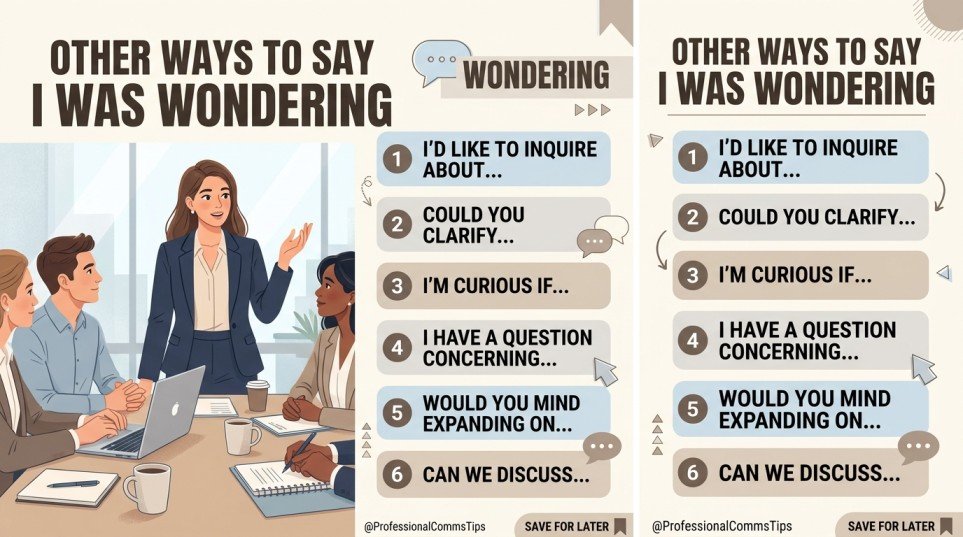
Other Ways to Say “I Was Wondering” (With Examples)
These alternatives will help you sound more fluent, confident, and natural in different situations.
Use them according to tone, audience, and context.
1. Phrase: I’d like to know
Meaning: Politely asking for information.
Explanation: Clear and professional alternative.
Example Sentence: I’d like to know when the project starts.
Best Use: workplace
Worst Use: slang context
Tone: polite, professional
Context Variability: professional / written
2. Phrase: Could you tell me
Meaning: Requesting information politely.
Explanation: Common in both speech and writing.
Example Sentence: Could you tell me where the meeting is?
Best Use: general use
Worst Use: casual slang
Tone: polite, neutral
Context Variability: professional / spoken
3. Phrase: I wanted to ask
Meaning: Introducing a question politely.
Explanation: Friendly and natural expression.
Example Sentence: I wanted to ask about your schedule.
Best Use: everyday use
Worst Use: urgent situations
Tone: friendly, polite
Context Variability: casual / professional
4. Phrase: May I ask
Meaning: Asking permission to ask something.
Explanation: Formal and respectful.
Example Sentence: May I ask why the deadline changed?
Best Use: formal context
Worst Use: casual chat
Tone: formal, respectful
Context Variability: professional
5. Phrase: I’m curious about
Meaning: Expressing interest or curiosity.
Explanation: Casual but thoughtful.
Example Sentence: I’m curious about your new project.
Best Use: conversations
Worst Use: legal writing
Tone: curious, friendly
Context Variability: casual / spoken
“Using varied question phrases instantly improves fluency.”
6. Phrase: I wanted to know
Meaning: Politely seeking information.
Explanation: Slightly softer than direct questions.
Example Sentence: I wanted to know if you were available tomorrow.
Best Use: general use
Worst Use: emergency situations
Tone: polite, neutral
Context Variability: professional / spoken
7. Phrase: Could I ask
Meaning: Requesting permission to ask.
Explanation: Soft and respectful tone.
Example Sentence: Could I ask a quick question?
Best Use: workplace
Worst Use: casual slang
Tone: polite, professional
Context Variability: professional
8. Phrase: Do you happen to know
Meaning: Asking casually for information.
Explanation: Friendly conversational tone.
Example Sentence: Do you happen to know the address?
Best Use: casual talk
Worst Use: formal writing
Tone: casual, polite
Context Variability: spoken
9. Phrase: I’d appreciate knowing
Meaning: Politely requesting information.
Explanation: Professional and formal.
Example Sentence: I’d appreciate knowing the final decision.
Best Use: business email
Worst Use: casual chat
Tone: formal, professional
Context Variability: professional / written
10. Phrase: I wanted to check
Meaning: Verifying information politely.
Explanation: Common in workplace communication.
Example Sentence: I wanted to check whether the files were sent.
Best Use: office communication
Worst Use: emotional conversations
Tone: professional, neutral
Context Variability: professional
11. Phrase: Can you let me know
Meaning: Asking for information or updates.
Explanation: Friendly and common phrase.
Example Sentence: Can you let me know when you arrive?
Best Use: general use
Worst Use: legal context
Tone: casual, polite
Context Variability: spoken / written
12. Phrase: I’d like to ask
Meaning: Introducing a question politely.
Explanation: Professional and direct.
Example Sentence: I’d like to ask about the next steps.
Best Use: meetings
Worst Use: slang talk
Tone: professional, respectful
Context Variability: professional
13. Phrase: Just curious
Meaning: Informally expressing curiosity.
Explanation: Relaxed conversational phrase.
Example Sentence: Just curious, how long did it take?
Best Use: casual talk
Worst Use: formal writing
Tone: informal, friendly
Context Variability: casual
14. Phrase: I’m interested in knowing
Meaning: Showing thoughtful interest.
Explanation: More formal than “I’m curious.”
Example Sentence: I’m interested in knowing your opinion.
Best Use: professional discussion
Worst Use: slang context
Tone: formal, thoughtful
Context Variability: professional
15. Phrase: Could you clarify
Meaning: Asking for clearer information.
Explanation: Common in workplace communication.
Example Sentence: Could you clarify the instructions?
Best Use: office setting
Worst Use: casual chat
Tone: professional, direct
Context Variability: professional
“The right question phrase can make you sound confident and respectful.”
16. Phrase: I’d love to know
Meaning: Expressing enthusiastic curiosity.
Explanation: Warm and conversational.
Example Sentence: I’d love to know what happened next.
Best Use: friendly conversations
Worst Use: formal writing
Tone: warm, enthusiastic
Context Variability: casual
17. Phrase: I’m trying to find out
Meaning: Looking for information.
Explanation: Practical and straightforward.
Example Sentence: I’m trying to find out the meeting time.
Best Use: information requests
Worst Use: emotional talk
Tone: neutral, practical
Context Variability: professional / spoken
18. Phrase: Would you mind telling me
Meaning: Very polite request for information.
Explanation: Softens direct questions.
Example Sentence: Would you mind telling me your availability?
Best Use: formal requests
Worst Use: urgent situations
Tone: polite, formal
Context Variability: professional
19. Phrase: I hoped to ask
Meaning: Gentle and polite introduction.
Explanation: Slightly formal wording.
Example Sentence: I hoped to ask about the project update.
Best Use: respectful requests
Worst Use: casual slang
Tone: formal, polite
Context Variability: professional
20. Phrase: Do you know
Meaning: Direct request for information.
Explanation: Simple and common.
Example Sentence: Do you know where she works?
Best Use: everyday speech
Worst Use: formal writing
Tone: neutral, casual
Context Variability: spoken
21. Phrase: I’d appreciate some information
Meaning: Polite request for details.
Explanation: Formal and professional.
Example Sentence: I’d appreciate some information about the program.
Best Use: business emails
Worst Use: casual conversation
Tone: formal, professional
Context Variability: written
22. Phrase: I was hoping you could tell me
Meaning: Soft and respectful request.
Explanation: Makes requests sound gentler.
Example Sentence: I was hoping you could tell me more about the role.
Best Use: interviews
Worst Use: urgent situations
Tone: polite, respectful
Context Variability: professional
23. Phrase: I have a question about
Meaning: Introducing a topic directly.
Explanation: Clear and practical phrase.
Example Sentence: I have a question about the assignment.
Best Use: workplace
Worst Use: emotional support
Tone: neutral, professional
Context Variability: professional / spoken
24. Phrase: Can I ask something
Meaning: Casual way to introduce a question.
Explanation: Friendly and conversational.
Example Sentence: Can I ask something quickly?
Best Use: casual talk
Worst Use: formal writing
Tone: casual, friendly
Context Variability: spoken
25. Phrase: I’m looking for information on
Meaning: Seeking details on a topic.
Explanation: Common in formal communication.
Example Sentence: I’m looking for information on your services.
Best Use: business inquiries
Worst Use: informal chat
Tone: professional, neutral
Context Variability: written
26. Phrase: Could you explain
Meaning: Asking for clarification.
Explanation: Direct but polite.
Example Sentence: Could you explain the process again?
Best Use: workplace
Worst Use: emotional context
Tone: professional, clear
Context Variability: professional
27. Phrase: I’d be interested to know
Meaning: Showing thoughtful curiosity.
Explanation: Polished and professional tone.
Example Sentence: I’d be interested to know your feedback.
Best Use: discussions
Worst Use: slang
Tone: formal, thoughtful
Context Variability: professional
28. Phrase: Any chance you know
Meaning: Casual request for information.
Explanation: Informal conversational style.
Example Sentence: Any chance you know his number?
Best Use: friends
Worst Use: professional email
Tone: informal, relaxed
Context Variability: casual
29. Phrase: I wanted to inquire
Meaning: Formal request for information.
Explanation: Professional alternative.
Example Sentence: I wanted to inquire about your pricing plans.
Best Use: business communication
Worst Use: casual speech
Tone: formal, professional
Context Variability: written
30. Phrase: Could you give me some details
Meaning: Asking for additional information.
Explanation: Friendly and practical.
Example Sentence: Could you give me some details about the event?
Best Use: general communication
Worst Use: slang context
Tone: polite, practical
Context Variability: professional / spoken
“Fluent English speakers vary their tone depending on the situation.”
Mini Quiz / Self-Check
1. Which phrase is best for a formal email?
A. Just curious
B. I wanted to inquire
C. Any chance you know
Answer: B
2. Which expression is most informal?
A. Could you clarify
B. I’d appreciate knowing
C. Just curious
Answer: C
3. Which phrase works well in workplace communication?
A. Got any idea
B. Could you explain
C. What’s up with
Answer: B
Comparison Table: Top Alternatives
| Phrase | Tone | Best Use |
|---|---|---|
| I’d like to know | Professional | Work |
| Could you tell me | Neutral | General |
| I wanted to ask | Friendly | Everyday |
| May I ask | Formal | Respectful communication |
| I’m curious about | Casual | Conversations |
| Could you clarify | Professional | Workplace |
| I wanted to inquire | Formal | Business emails |
| Just curious | Informal | Friends |
| I’d appreciate knowing | Professional | Written English |
| Do you happen to know | Casual | Spoken English |
FAQs
1. What are the best alternatives to “I was wondering”?
Popular options include I’d like to know, could you tell me, and I wanted to ask.
2. Is “I was wondering” professional?
Yes, it is commonly used in polite workplace communication.
3. What should I say instead in formal emails?
Use phrases like I wanted to inquire or I’d appreciate knowing.
4. Why do native speakers use “I was wondering”?
It softens questions and sounds more polite.
5. How can I sound more fluent in English requests?
Use a variety of professional reaction phrases and polite alternatives instead of repeating the same expression.
Conclusion
Learning different other ways to say “I was wondering” helps you sound more fluent, polite, and professional. It also improves your ability to adapt tone depending on the situation.
Practice these phrases regularly in conversations and emails. Over time, your English will sound more natural, confident, and polished.
CTA: Which alternative will you start using today?
Discover More:-
- Other Ways to Say I Would Love To (30+ Examples)
- Other Ways to Say Hope to See You Soon (30+ Examples)

Robert Mitchell is a U.S.-based writer at Gramtivo.Com who focuses on grammar, writing improvement, and language-related content. He holds a degree in English and Linguistics from a U.S. university. His work aims to help readers enhance their writing skills with clear and practical guidance.