
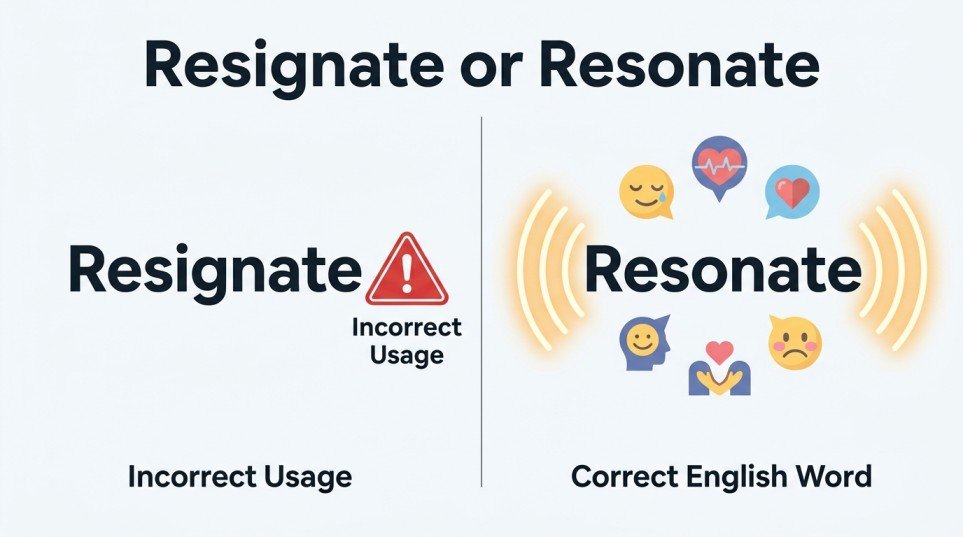
Quick Ans: The correct word is usually resonate, not resignate. “Resonate” means to connect emotionally, produce sound vibrations, or strongly relate to something. “Resignate” is not a standard English word and is often used by mistake when people actually mean “resonate.”
Many people search for resignate or resonate because the two words sound similar. During conversations, writing, or online posts, it is easy to confuse them. However, only one of these words is widely accepted in standard English.
The confusion often happens because pronunciation can sound close in fast speech. In addition, autocorrect tools sometimes fail to catch the mistake. As a result, writers may accidentally type “resignate” instead of “resonate.”
Understanding the difference matters in professional communication. Using the wrong word in emails, essays, articles, or presentations can create confusion and weaken credibility.
Fortunately, the distinction is simple once you understand the meaning and usage. The word “resonate” has several clear definitions and appears commonly in both formal and casual English. Meanwhile, “resignate” is generally considered incorrect in modern usage.
This guide explains everything about resignate or resonate in a clear and easy way. You will learn meanings, examples, common mistakes, grammar tips, exercises, and real world usage scenarios.
Quick Answer: Resignate or Resonate
If you are choosing between resignate or resonate, the correct word is almost always resonate.
| Word | Correct? | Meaning |
|---|---|---|
| Resonate | Yes | To connect deeply or produce vibrations |
| Resignate | No | Not a standard English word |
In short:
- Use resonate in speaking and writing.
- Avoid using resignate in standard English.
What Does Resonate Mean?
The word resonate has several meanings depending on context. Most commonly, it means something emotionally connects with someone.
Emotional Meaning
When an idea resonates, it feels meaningful or relatable.
Examples:
- Her story resonated with the audience.
- The message resonated deeply with readers.
- His speech resonated across the community.
In these examples, the idea created a strong emotional response.
Sound and Science Meaning
In physics and music, resonate refers to vibrations or sound waves.
Examples:
- The guitar strings resonate beautifully.
- Sound resonated through the hall.
Therefore, the word can describe both emotional and physical reactions.
Why Resonate Is Common
The word appears frequently in:
- Business communication
- Public speaking
- Marketing
- Literature
- Psychology
- Music
Because of its versatility, resonate is widely used in modern English.
What Does Resignate Mean?
The word resignate is generally not recognized as correct standard English.
Most dictionaries do not include it as an accepted word. In many cases, people accidentally create the word because they confuse it with:
- Resonate
- Resignation
- Resign
Why People Use “Resignate”
Several factors cause this mistake:
- Similar pronunciation
- Typing errors
- Mishearing conversations
- Incorrect assumptions about grammar
For example, someone may write:
- “Her message really resignated with me.”
The correct sentence should be:
- “Her message really resonated with me.”
Because of this confusion, many people search online for resignate or resonate.
Key Differences Between Resignate or Resonate
Spelling
The correct spelling is resonate.
Incorrect spelling:
- Resignate
Correct spelling:
- Resonate
Dictionary Recognition
Resonate appears in English dictionaries. Resignate usually does not.
Usage in Writing
Professional writing uses resonate in both formal and informal situations.
Examples include:
- Articles
- Books
- Business emails
- Academic papers
- Speeches
Meaning
Resonate has clear meanings related to emotional impact and vibration. Resignate lacks an accepted definition in standard English.
Advantages of Using the Correct Word
Better Professional Writing
Using resonate correctly improves clarity and professionalism.
Stronger Communication
Readers understand your message immediately when proper vocabulary is used.
Improved Credibility
Correct grammar and word choice help build trust in academic and workplace settings.
Better Search and SEO Performance
Content with proper spelling performs better online because search engines recognize standard vocabulary.
Therefore, learning the difference between resignate or resonate improves both writing quality and communication effectiveness.
Common Situations Where “Resonate” Is Used
Business Communication
Companies often use resonate in branding and marketing.
Examples:
- The campaign resonated with customers.
- Our message resonates with younger audiences.
Public Speaking
Speakers use the word to describe emotional impact.
Example:
- Her speech resonated with the crowd.
Literature and Storytelling
Authors describe emotional connection using resonate.
Example:
- The novel resonated with readers worldwide.
Social Media
People commonly write:
- “This quote really resonates with me.”
As you can see, resonate appears in many real world situations.
Regional and Global Usage
American English
In the United States, resonate is extremely common in business, education, and media.
British English
British English also uses resonate frequently with the same meanings.
International English
Around the world, English learners often confuse resignate or resonate because of pronunciation similarities.
Consequently, grammar guides frequently explain this difference.
Related Concepts and Comparisons
Resonate vs Relate
Resonate means to create a strong emotional impact. Relate means to understand through personal experience.
Example:
- I relate to her struggles.
- Her struggles resonate with me.
Resonate vs Echo
Echo refers to repeated sound. Resonate often suggests deeper emotional or symbolic impact.
Resonate vs Inspire
Inspire motivates action. Resonate creates emotional connection.
These comparisons help clarify the meaning of resonate even further.
Common Mistakes About Resignate or Resonate
Using “Resignate” in Formal Writing
Many people accidentally type resignate in essays or emails. However, professional writing should use resonate.
Confusing It With “Resignation”
The word resignation relates to quitting a job or accepting defeat. It does not connect to resonate.
Incorrect Verb Forms
Some writers incorrectly say:
- “The message was resignating.”
Correct version:
- “The message was resonating.”
Ignoring Spell Check Warnings
Spell check tools often highlight resignate as incorrect. Ignoring these warnings can lead to embarrassing mistakes.
Avoiding these errors improves writing quality significantly.
Beginner to Advanced Usage Tips
Beginner Level
Use resonate when describing emotional connection.
Example:
- The movie resonated with me.
Intermediate Level
Use resonate in professional communication.
Example:
- The marketing strategy resonated with customers.
Advanced Level
Use resonate metaphorically in analytical or creative writing.
Example:
- The theme resonates throughout modern literature.
Practicing these levels helps develop stronger vocabulary skills.
Step By Step Correction Scenario
Imagine you write this sentence:
- “Her speech resignated with the audience.”
Here is the correction process:
- Identify the suspicious word
- Check dictionary spelling
- Replace resignated with resonated
- Read sentence again
Correct sentence:
- “Her speech resonated with the audience.”
This simple process prevents common grammar mistakes.
Exercises With Answers
Exercise 1
Which word is correct in standard English?
Answer: Resonate.
Exercise 2
Fill in the blank:
- “The message really ______ with readers.”
Answer: Resonated.
Exercise 3
True or False: Resignate is commonly accepted in professional English.
Answer: False.
Exercise 4
Which word means to create emotional connection?
Answer: Resonate.
Exercise 5
Correct this sentence:
- “The story resignated with me.”
Answer:
- “The story resonated with me.”
When Should You Use Resonate?
Use resonate when describing:
- Emotional connection
- Powerful ideas
- Sound vibration
- Meaningful communication
- Audience reaction
Avoid using resignate in standard writing because it is considered incorrect.
FAQs About Resignate or Resonate
Is resignate a real word?
Resignate is generally not recognized as a standard English word. Most people actually mean resonate.
What does resonate mean?
Resonate means to create emotional connection or produce sound vibrations.
Why do people confuse resignate or resonate?
The confusion happens because the words sound similar during speech.
Which word should I use in professional writing?
You should use resonate in professional communication.
Is resignate in the dictionary?
Most major dictionaries do not recognize resignate as standard English.
How do you use resonate in a sentence?
Example: “Her speech resonated with the audience.”
Can resonate describe emotions?
Yes. The word often describes emotional impact and personal connection.
What is the past tense of resonate?
The past tense is resonated.
Why is resonate popular in marketing?
Businesses use it to describe messages that connect strongly with audiences.
Is resonate formal or informal?
Resonate works in both formal and informal English.
Conclusion
Understanding resignate or resonate is important for clear communication. Although the words sound similar, only resonate is widely accepted in standard English.
The word resonate describes emotional connection, meaningful impact, or physical vibration. It appears regularly in business communication, public speaking, literature, and everyday conversation.
Resignate, however, is usually considered a spelling or vocabulary mistake. Most writers accidentally use it when they actually mean resonate.
Using the correct word improves professionalism, credibility, and writing quality. It also prevents confusion in emails, essays, articles, and presentations.
Whenever you want to describe something that strongly connects with people, use resonate confidently. Avoid resignate in formal and professional writing.
By mastering the difference between resignate or resonate, you can communicate more clearly and effectively in every situation.
Discover More:-

Lisa Thompson is a USA-based content writer and language specialist focused on grammar, writing improvement and digital publishing.
She holds a degree in English Language and Communication and has professional experience in educational and web content creation.
As the author of Gramtivo.Com, she aims to help readers improve their writing skills through clear and practical guidance.