
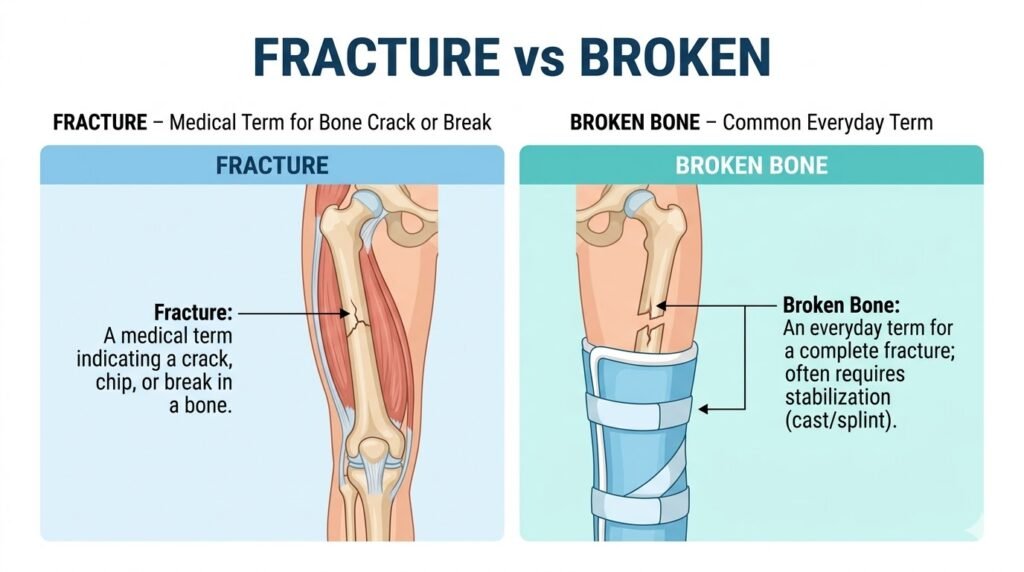
Quick Ans: The difference between fracture vs broken is mostly about medical terminology. Doctors use the word fracture to describe any crack or break in a bone. In everyday language, people often say broken bone, but medically both terms usually mean the same thing.
Many people wonder about fracture vs broken after an injury. A doctor may say you have a fracture, while a friend might say your bone is broken. The two words seem different, so confusion often follows.
In simple terms, both describe damage to a bone.
Medical professionals prefer the word fracture because it sounds more precise and professional. However, a broken bone and a fractured bone usually refer to the same condition.
Understanding this difference matters. Patients feel less worried when they know the terms. Clear knowledge also helps when reading medical reports, discussing injuries, or learning about bone health.
Bone injuries can happen during sports, accidents, falls, or physical stress. Some fractures are small cracks, while others split the bone completely.
This guide explains fracture vs broken in simple language. You will learn definitions, types, advantages of medical terminology, real world examples, common mistakes, and practical exercises.
Quick Answer: Fracture vs Broken
Understanding fracture vs broken becomes easier when you look at medical language versus everyday speech.
| Term | Meaning | Usage |
|---|---|---|
| Fracture | Medical term for any crack or break in bone | Used by doctors |
| Broken | Common word for a damaged bone | Used in everyday conversation |
In short, all broken bones are fractures, and most fractures are described as broken bones in normal speech.
What Is a Fracture?
A fracture is a medical term used to describe a crack, split, or complete break in a bone. Doctors use this word because it covers many different types of bone injuries.
Bones are strong, but extreme pressure or impact can damage them. When the bone structure fails, a fracture occurs.
Common Causes of Fractures
Several situations can cause fractures:
- Falls or accidents
- Sports injuries
- Car crashes
- Heavy impact
- Weak bones from disease
Because bones support the body, fractures require proper treatment and rest.
Types of Fractures
Doctors classify fractures into different categories.
Common types include:
- Hairline fracture
- Stress fracture
- Greenstick fracture
- Compound fracture
- Comminuted fracture
Each type describes how the bone cracks or separates.
How Doctors Diagnose a Fracture
Medical professionals use several steps:
- Physical examination
- Patient symptom review
- Imaging tests such as X rays
- Additional scans if necessary
Accurate diagnosis helps doctors choose the correct treatment.
What Is a Broken Bone?
A broken bone is a general term used outside medical settings. It describes any situation where a bone cracks or splits.
People often use the word broken because it sounds easier and more familiar.
Examples of Broken Bones
Common broken bone injuries include:
- Broken arm
- Broken wrist
- Broken ankle
- Broken rib
- Broken finger
Although the wording is simple, the injury still requires medical care.
Symptoms of a Broken Bone
Several symptoms often appear after injury:
- Pain at the injury site
- Swelling
- Bruising
- Difficulty moving the limb
- Visible deformity in severe cases
If these symptoms appear, medical attention is important.
Key Differences Between Fracture vs Broken
Medical Language
Doctors usually say fracture. Medical records, reports, and textbooks use this term.
Everyday Language
Most people say broken bone when talking casually.
Severity
Both terms describe bone damage. Neither term automatically means the injury is worse.
Communication
Medical professionals choose fracture because it sounds more precise. Patients often feel more comfortable hearing the word broken.
Advantages and Disadvantages of Each Term
Advantages of Using Fracture
- More accurate medical language
- Describes many injury types
- Used in professional reports
- Clear in healthcare communication
Disadvantages of Using Fracture
- May sound serious or confusing to patients
- Less familiar to people outside medicine
Advantages of Using Broken
- Easy to understand
- Common everyday word
- Clear for general conversations
Disadvantages of Using Broken
- Less precise in medical settings
- Does not describe specific fracture types
Therefore, the fracture vs broken difference is mainly about communication style.
Real World Examples
Hospital Visit
A patient falls while playing sports. The doctor checks the injury and says there is a fracture in the wrist. Later, the patient tells friends that the wrist is broken.
Both descriptions refer to the same injury.
Medical Report
Medical records typically state:
“Distal radius fracture.”
However, family members might describe the injury as a broken wrist.
Sports Injury
Athletes often suffer stress fractures from repeated pressure on bones. Fans may simply say the athlete broke a bone.
These examples show how the fracture vs broken terms are used differently.
Regional and Global Usage
Medical Communities
Doctors around the world use the term fracture in medical documentation.
Everyday Language
People in many countries prefer the word broken bone during casual conversations.
Media and News
News reports about injuries often use both terms depending on the context.
Therefore, the fracture vs broken difference remains mostly linguistic rather than medical.
Related Concepts and Comparisons
Fracture vs Sprain
A fracture involves a bone injury. A sprain damages ligaments that connect bones.
Fracture vs Dislocation
A fracture cracks the bone. A dislocation occurs when a joint moves out of position.
Fracture vs Bruise
A bruise affects soft tissue. A fracture affects the bone structure itself.
Comparison Table
| Condition | Affected Area | Cause |
|---|---|---|
| Fracture | Bone | Impact or stress |
| Sprain | Ligaments | Joint twisting |
| Dislocation | Joint | Forced movement |
| Bruise | Soft tissue | Minor trauma |
Understanding these conditions helps explain the broader fracture vs broken discussion.
Common Mistakes About Fracture vs Broken
Thinking a Fracture Is Worse
Many people assume fractures are more serious. In reality, fractures and broken bones mean the same injury.
Ignoring Small Fractures
Hairline fractures can seem minor, yet they still require treatment and rest.
Avoiding Medical Care
Some individuals ignore pain and assume it is only a bruise. However, untreated fractures can lead to complications.
Misunderstanding Medical Reports
Patients sometimes worry when doctors say fracture. Learning the meaning helps reduce unnecessary fear.
Beginner to Advanced Treatment Tips
Beginner Level
Initial care often involves:
- Resting the injured area
- Applying ice
- Immobilizing the limb
Intermediate Level
Doctors may recommend:
- Casting the bone
- Using splints
- Limiting movement
Advanced Treatment
Severe fractures sometimes require:
- Surgical repair
- Metal plates or screws
- Physical therapy for recovery
Treatment depends on fracture type and severity.
Step By Step Injury Scenario
Imagine someone falls while running.
First, pain appears in the arm. Next, swelling develops around the wrist. Movement becomes difficult.
At the hospital, doctors perform an X ray. The image shows a fracture in the bone.
The patient receives a cast for several weeks. Eventually, the bone heals and normal movement returns.
This scenario demonstrates how fracture vs broken terminology applies in real life.
Exercises With Answers
Exercise 1
Which term is used more often by doctors?
Answer: Fracture.
Exercise 2
Which term is more common in everyday speech?
Answer: Broken bone.
Exercise 3
True or False: A fracture and a broken bone are completely different injuries.
Answer: False.
Exercise 4
Which medical test commonly confirms a fracture?
Answer: X ray.
Exercise 5
Which injury affects ligaments instead of bones?
Answer: Sprain.
When Should You Seek Medical Help?
Immediate medical care is necessary if you experience:
- Severe pain
- Bone deformity
- Inability to move a limb
- Significant swelling
- Numbness or tingling
Doctors can confirm the injury and begin proper treatment.
FAQs About Fracture vs Broken
What is the difference between fracture vs broken?
The difference is mostly terminology. Fracture is the medical term, while broken bone is the everyday description.
Is a fracture worse than a broken bone?
No. In most cases, fracture and broken bone mean the same type of injury.
Why do doctors say fracture instead of broken?
Doctors prefer fracture because it sounds more precise and fits medical documentation.
Can a fracture heal without treatment?
Some minor fractures heal with rest, but medical evaluation is always recommended.
Are all broken bones considered fractures?
Yes. In the fracture vs broken comparison, every broken bone is medically classified as a fracture.
How long does a fracture take to heal?
Healing usually takes six to eight weeks, though recovery time varies.
What causes stress fractures?
Repeated pressure on bones during sports or physical activity often causes stress fractures.
Can children heal fractures faster than adults?
Yes. Children’s bones often heal faster because they are still growing.
Do fractures always require a cast?
Not always. Some minor fractures only require splints or rest.
Can a fracture occur without severe pain?
Yes. Hairline fractures sometimes cause mild pain that increases with activity.
Conclusion
Understanding fracture vs broken helps patients communicate clearly with healthcare providers. Although the two terms sound different, they usually describe the same bone injury.
Doctors prefer the word fracture because it covers many types of bone damage. Everyday conversations often use the word broken because it feels simpler and more familiar.
Bone injuries range from small hairline cracks to complete breaks. Proper diagnosis is essential because treatment depends on the type and location of the fracture.
Early medical attention helps prevent complications and supports faster healing. Rest, immobilization, and medical care often allow bones to recover fully.
Knowing the difference between fracture vs broken reduces confusion and improves understanding of medical information. With the right care and knowledge, most bone injuries heal successfully.
Discover More:-
- Trustee vs Beneficiary: Key Differences, Roles, Rights, and Legal Responsibilities
- Grizzly vs Gorilla: Size, Strength, Fight Analysis, and Key Differences

Robert Mitchell is a U.S.-based writer at Gramtivo.Com who focuses on grammar, writing improvement, and language-related content. He holds a degree in English and Linguistics from a U.S. university. His work aims to help readers enhance their writing skills with clear and practical guidance.


Pingback: Ipamorelin vs Tesamorelin: Key Differences, Benefits, and Peptide Comparison
Pingback: Septic vs Sewer: Key Differences, Costs, Maintenance, and Homeowner Guide
Pingback: Bernedoodle vs Goldendoodle: Differences, Personality, Size, and Care Guide