Quick Ans: The difference between blond or blonde comes from grammar and traditional usage. In English, blond is often used for males and as a general adjective, while blonde is traditionally used for females. Today, many style guides accept both forms, but understanding the distinction helps improve writing accuracy.
Many writers, students, and English learners wonder whether they should use blond or blonde. At first glance, the two words appear almost identical. In fact, they refer to the same hair color. However, the spelling changes depending on context.
The confusion exists because English borrowed both words from French. As a result, traditional grammar rules introduced separate masculine and feminine forms. Over time, English usage evolved, creating different preferences across countries and style guides.
You may see blond hair in one article and a blonde woman in another. Meanwhile, some publications use only one spelling regardless of gender. This variation often leaves people unsure which option is correct.
Understanding the difference between blond or blonde can improve your writing and help you avoid common grammar mistakes. Whether you are writing an essay, article, resume, story, or social media post, knowing when to use each spelling is valuable.
This guide explains the definitions, usage rules, examples, regional differences, common mistakes, and practical exercises. By the end, choosing between blond or blonde will feel simple.
Quick Answer: Blond or Blonde
The simplest way to understand blond or blonde is to look at traditional usage.
| Usage | Blond | Blonde |
|---|---|---|
| Male person | Yes | No |
| Female person | Sometimes | Yes |
| Hair color adjective | Yes | Yes |
| Modern gender neutral usage | Common | Less common |
| American English | Often preferred | Used mainly for females |
| British English | Both commonly used | Both commonly used |
In short:
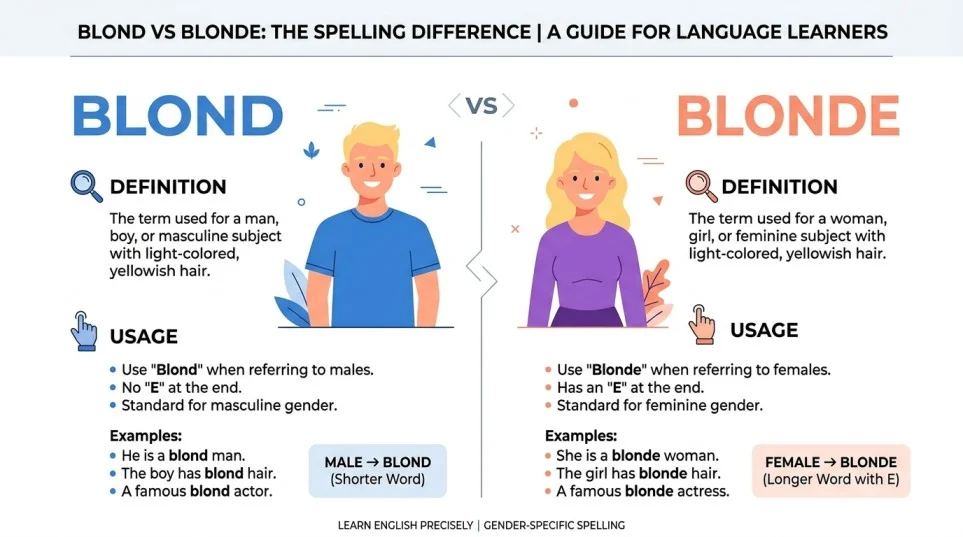
- Blond traditionally refers to males or acts as a general adjective.
- Blonde traditionally refers to females.
- Modern English often treats blond as gender neutral.
What Does Blond Mean?
The word blond describes a light yellow or golden hair color. Traditionally, it refers to males when used as a noun.
Examples:
- He is a blond man.
- The blond boy won the race.
- His blond hair shines in the sunlight.
In many modern publications, blond also serves as a general adjective for hair color regardless of gender.
Blond as an Adjective
When used as an adjective, blond describes hair color.
Examples:
- She has blond hair.
- The child has naturally blond curls.
- Many Scandinavian people have blond hair.
Because adjectives modify nouns, many style guides prefer blond hair rather than blonde hair.
Blond as a Noun
As a noun, blond traditionally refers to a male with blond hair.
Examples:
- The blond stood near the doorway.
- A tall blond entered the room.
Although correct, this usage is less common today.
What Does Blonde Mean?
The word blonde traditionally refers to a female with blond hair. It can function as both a noun and an adjective.
Examples:
- She is a blonde.
- The blonde actress starred in the movie.
- A blonde woman greeted us.
Because English borrowed the word from French, the feminine ending remained in traditional usage.
Blonde as a Noun
This is the most common use of blonde.
Examples:
- The blonde smiled.
- A blonde won the competition.
- The famous blonde appeared on stage.
Blonde as an Adjective
Some writers also use blonde as an adjective.
Examples:
- A blonde woman entered the room.
- The blonde actress received an award.
However, many modern style guides prefer blond as the adjective form regardless of gender.
Key Differences Between Blond or Blonde
Gender Usage
Traditionally:
- Blond = male
- Blonde = female
Modern usage often simplifies this distinction.
Adjective vs Noun
Many editors follow this approach:
- Blond hair
- Blonde woman
- Blonde actress
This style keeps the feminine noun form while using blond as the descriptive adjective.
Formal Writing
Formal publications frequently use blond as the standard adjective. Meanwhile, blonde remains common when referring specifically to a woman.
Everyday Usage
In casual conversation, many people use both spellings interchangeably. Nevertheless, understanding the traditional distinction improves writing precision.
Why Are There Two Spellings?
The answer comes from language history.
English borrowed the words from French. In French grammar, masculine and feminine nouns often have different endings.
French forms:
- Blond = masculine
- Blonde = feminine
When English adopted these words, many writers preserved the distinction.
Over time, however, English became less dependent on grammatical gender. Consequently, modern usage shifted toward simplification.
Today, some publications maintain the traditional rule while others prefer a single spelling.
Advantages and Disadvantages of Each Usage Style
Using Traditional Rules
Advantages:
- Grammatically precise
- Preferred by many editors
- Reflects historical usage
- Useful in formal writing
Disadvantages:
- Can confuse readers
- Requires remembering gender distinctions
- Not universally followed
Using Blond for Everything
Advantages:
- Simple and consistent
- Common in modern writing
- Easier for learners
- Works as a universal adjective
Disadvantages:
- May conflict with traditional style guides
- Some readers expect blonde for females
Therefore, the best choice often depends on audience and publication standards.
Real World Examples
In Journalism
Many newspapers write:
- She has blond hair.
- The blonde actress attended the event.
This approach combines modern adjective usage with traditional noun usage.
In Novels
Authors often use both forms depending on character descriptions.
Example:
- A blonde woman crossed the street.
- Her blond hair reflected the sunlight.
In Everyday Conversation
Most people focus on pronunciation rather than spelling. Since both words sound the same, confusion mainly occurs in writing.
Regional Usage Around the World
American English
American style guides often prefer:
- Blond hair
- Blonde woman
This approach is especially common in newspapers and magazines.
British English
British English tends to be more flexible. Writers frequently use either spelling depending on personal preference.
International English
Many English learners use blond as the standard adjective and blonde as the noun for females.
As a result, global usage continues to evolve.
Related Concepts and Comparisons
Blond vs Blonde Hair
Many editors prefer:
- Blond hair
Some writers use:
- Blonde hair
Both forms appear in published writing, although blond hair is more widely accepted in style guides.
Blond vs Brunette
A brunette is traditionally a woman with brown hair.
Examples:
- Blonde woman
- Brunette woman
These words share French origins.
Blond vs Golden Hair
Golden hair describes a hair color appearance. Blond refers to a specific hair color category.
For example:
- The child has blond hair.
- Her hair looked golden in the sunset.
Common Mistakes About Blond or Blonde
Using Blonde for Male Subjects
Incorrect:
- He is a blonde.
Correct:
- He is a blond.
Traditional grammar reserves blonde for females.
Assuming One Form Is Always Wrong
Both spellings are correct. The proper choice depends on context and style preferences.
Mixing Adjective and Noun Rules
Many writers struggle with this distinction.
Example:
- Blond hair
- Blonde woman
Understanding the difference helps maintain consistency.
Ignoring Style Guide Requirements
Different publications have different preferences. Always check editorial guidelines before publishing.
Beginner to Advanced Writing Tips
Beginner Level
Remember the basic rule:
- Blond = male or general adjective
- Blonde = female noun
Intermediate Level
Use blond for hair descriptions regardless of gender.
Examples:
- Blond hair
- Blond child
- Blond curls
Advanced Level
Follow the style guide of your publication. Some editors prefer strict traditional usage, while others use modern gender neutral forms.
Consistency matters more than personal preference.
Step By Step Usage Scenario
Imagine you are writing about a woman.
Option 1:
- She has blond hair.
- She is a blonde.
Imagine you are writing about a man.
Option 2:
- He has blond hair.
- He is a blond.
Using these patterns keeps your writing clear and professional.
Exercises With Answers
Exercise 1
Which spelling traditionally refers to a female person?
Answer: Blonde.
Exercise 2
Which spelling traditionally refers to a male person?
Answer: Blond.
Exercise 3
Fill in the blank:
She has _____ hair.
Answer: Blond.
Exercise 4
Fill in the blank:
The _____ actress won an award.
Answer: Blonde.
Exercise 5
True or False: Blond and blonde have different pronunciations.
Answer: False.
When Should You Use Blond or Blonde?
Use blond when:
- Referring to a male person
- Describing hair color
- Following many modern style guides
Use blonde when:
- Referring to a female person
- Following traditional grammar conventions
Always consider your audience, publication, and writing style.
FAQs About Blond or Blonde
What is the difference between blond or blonde?
Traditionally, blond refers to males and blonde refers to females. Modern English often uses blond as a general adjective.
Is blond or blonde correct?
Both are correct. The appropriate choice depends on grammar, style guide preferences, and context.
Do blond and blonde mean different hair colors?
No. Both words describe the same hair color.
Should I write blond hair or blonde hair?
Most style guides prefer blond hair, although blonde hair also appears in published writing.
Can a man be called a blonde?
Traditional grammar says no. A man is traditionally called a blond.
Why are there two spellings?
English borrowed the words from French, which uses masculine and feminine forms.
Which spelling is more common in American English?
American English often uses blond as the adjective and blonde as the noun for females.
Do British writers use both spellings?
Yes. British English tends to allow more flexibility.
Is blonde only a noun?
No. Blonde can also function as an adjective, although many style guides prefer blond as the adjective form.
Which spelling should English learners use?
Using blond for adjectives and blonde for female nouns is a safe and widely accepted approach.
Conclusion
Understanding blond or blonde is easier once you know the traditional rule. Blond originally referred to males, while blonde referred to females. Although English borrowed these distinctions from French, modern usage has become more flexible.
Many style guides now prefer blond as the standard adjective for hair color. At the same time, blonde remains common when referring to a woman with blond hair. Consequently, both spellings continue to appear in books, newspapers, websites, and everyday writing.
Writers should focus on consistency. If you follow a style guide, use its preferred form throughout your content. When no style guide exists, a practical approach is to use blond for hair descriptions and blonde for female nouns.
By understanding the history, grammar, and modern conventions behind blond or blonde, you can write more confidently and avoid common spelling mistakes.
Discover More:-
- iOS or Android: Full Comparison Guide for Features, Security, and Performance
- Ax or Axe: Which Spelling Is Correct? Complete Usage Guide

Lisa Thompson is a USA-based content writer and language specialist focused on grammar, writing improvement and digital publishing.
She holds a degree in English Language and Communication and has professional experience in educational and web content creation.
As the author of Gramtivo.Com, she aims to help readers improve their writing skills through clear and practical guidance.