
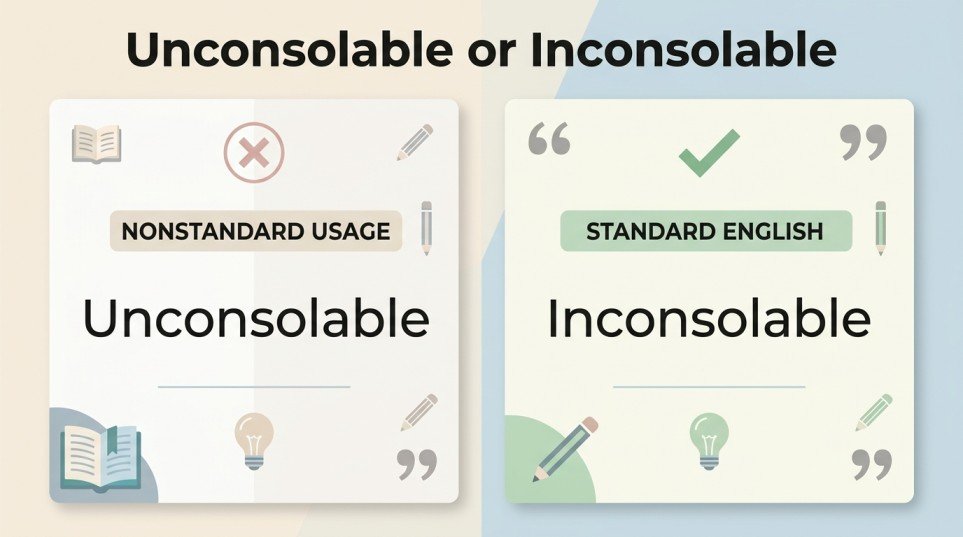
Quick Ans: The difference between unconsolable or inconsolable is mainly based on usage and acceptance in standard English. “Inconsolable” is the correct and widely accepted word that describes someone who cannot be comforted after sadness or loss. “Unconsolable” appears occasionally in informal speech, but it is considered nonstandard or incorrect in most dictionaries and professional writing.
Many English learners become confused about unconsolable or inconsolable because both words seem similar. Each one appears to describe deep sadness. Both contain the word “console,” which means to comfort someone.
However, only one form is considered standard English.
The word “inconsolable” is widely accepted in grammar, dictionaries, literature, and formal writing. On the other hand, “unconsolable” is rarely used and is generally viewed as incorrect or nonstandard.
This confusion often happens because many English adjectives begin with the prefix “un.” For example, people commonly say “unhappy,” “uncomfortable,” or “uncertain.” As a result, some writers naturally assume “unconsolable” must also be correct.
Understanding the difference between unconsolable or inconsolable helps improve grammar, vocabulary, and professional communication. It also prevents mistakes in essays, emails, articles, and conversations.
In this complete guide, you will learn definitions, examples, grammar rules, common mistakes, comparisons, exercises, and practical usage tips.
Quick Answer: Unconsolable or Inconsolable
To quickly understand unconsolable or inconsolable, focus on correctness and standard usage.
| Word | Correct in Standard English? | Common Usage |
|---|---|---|
| Inconsolable | Yes | Widely accepted |
| Unconsolable | Usually no | Rare and nonstandard |
In simple terms:
- Inconsolable is the correct word.
- Unconsolable is generally avoided in formal English.
What Does Inconsolable Mean?
The word inconsolable describes someone who cannot be comforted after emotional pain, grief, disappointment, or sadness.
It comes from:
- Prefix: “in”
- Root word: “console”
- Suffix: “able”
Together, the word means “not able to be comforted.”
Common Situations Where Inconsolable Is Used
People often use “inconsolable” in emotional situations such as:
- Losing a loved one
- Experiencing heartbreak
- Facing tragedy
- Receiving terrible news
Example Sentences
Here are several correct examples:
- The child was inconsolable after losing her pet.
- He became inconsolable when he heard the news.
- The family remained inconsolable during the funeral.
In each sentence, the word describes deep emotional distress.
What Does Unconsolable Mean?
The word unconsolable occasionally appears in casual speech or online writing. However, most dictionaries either exclude it or label it as nonstandard.
Some people create the word because many English adjectives use the “un” prefix. Nevertheless, English grammar does not always follow simple patterns.
Why People Use Unconsolable
Several reasons explain the confusion:
- “Un” is a common negative prefix
- The word sounds natural to many speakers
- Some writers assume both versions are interchangeable
Despite this, professional writers and editors strongly prefer “inconsolable.”
Should You Use Unconsolable?
In most cases, no.
Formal writing should use “inconsolable” instead. Academic papers, business communication, and professional articles rarely accept “unconsolable.”
Key Differences Between Unconsolable or Inconsolable
Standard Usage
The biggest difference involves correctness.
“Inconsolable” is recognized in standard English. “Unconsolable” is generally considered incorrect.
Dictionary Acceptance
Most dictionaries include “inconsolable.” Many either omit “unconsolable” or mark it as rare.
Professional Writing
Editors, teachers, and grammar experts recommend “inconsolable” for formal communication.
Frequency of Use
“Inconsolable” appears far more often in books, newspapers, and academic writing.
Why “In” Works Better Than “Un”
English uses several negative prefixes, including:
- Un
- In
- Im
- Ir
- Dis
However, not every root word works naturally with every prefix.
For example:
| Correct Word | Incorrect Form |
|---|---|
| Incomplete | Uncomplete |
| Invisible | Unvisible |
| Inaccurate | Unaccurate |
Similarly, English standardizes “inconsolable” instead of “unconsolable.”
Therefore, memorization and exposure to correct usage matter.
Advantages and Disadvantages of Each Word
Inconsolable Advantages
- Grammatically correct
- Accepted in dictionaries
- Suitable for professional writing
- Common in literature and media
Inconsolable Disadvantages
- Slightly formal sounding in casual conversation
Unconsolable Advantages
- Sounds understandable to many speakers
- Occasionally appears in informal speech
Unconsolable Disadvantages
- Considered nonstandard
- May appear incorrect in professional writing
- Often rejected by grammar checkers
As a result, “inconsolable” remains the safer and more professional choice.
Real World Examples
In Literature
Authors frequently use “inconsolable” to describe grief.
Example:
- The widow was inconsolable after the tragedy.
In News Articles
Journalists also prefer “inconsolable” in emotional reporting.
Example:
- Parents were inconsolable following the accident.
In Everyday Conversation
People sometimes say “unconsolable” casually. However, educated speakers usually choose “inconsolable.”
These examples show why understanding unconsolable or inconsolable matters in real communication.
Regional and Global Usage
American English
American English strongly favors “inconsolable.”
British English
British English also uses “inconsolable” as the standard form.
Informal Internet Usage
Online discussions sometimes contain “unconsolable.” Nevertheless, grammar experts still recommend avoiding it in professional contexts.
Consequently, the global standard remains “inconsolable.”
Related Concepts and Comparisons
Inconsolable vs Heartbroken
“Inconsolable” focuses on the inability to comfort someone. “Heartbroken” focuses more on emotional pain itself.
Inconsolable vs Devastated
“Devastated” describes severe emotional shock. “Inconsolable” specifically emphasizes failed attempts at comfort.
Inconsolable vs Miserable
“Miserable” describes unhappiness in general. “Inconsolable” expresses deeper grief.
Understanding these related terms improves emotional vocabulary and writing precision.
Common Mistakes About Unconsolable or Inconsolable
Assuming Both Words Are Correct
Many learners believe both forms are equally acceptable. However, only “inconsolable” is standard English.
Using Unconsolable in Formal Writing
Professional documents should avoid “unconsolable.”
Confusing Prefix Rules
English prefixes do not always follow predictable patterns. Therefore, memorizing accepted forms is important.
Overusing Emotional Vocabulary
Writers sometimes use “inconsolable” for small disappointments. The word should describe very strong emotional pain.
Avoiding these mistakes improves grammar accuracy and writing quality.
Beginner to Advanced Usage Tips
Beginner Level
Use “inconsolable” whenever describing someone who cannot be comforted.
Intermediate Level
Practice identifying emotional intensity in sentences.
Example:
- Sad = mild emotion
- Heartbroken = strong emotion
- Inconsolable = extreme grief
Advanced Level
Use “inconsolable” carefully in creative writing, journalism, or storytelling to create emotional impact.
Strong vocabulary improves clarity and emotional expression.
Step By Step Grammar Scenario
Imagine you are writing a sentence about grief.
Incorrect version:
- She was unconsolable after the funeral.
Correct version:
- She was inconsolable after the funeral.
The second sentence follows standard English rules and sounds more professional.
Exercises With Answers
Exercise 1
Which word is standard English in the unconsolable or inconsolable comparison?
Answer: Inconsolable.
Exercise 2
Which word do dictionaries commonly accept?
Answer: Inconsolable.
Exercise 3
Which sentence is correct?
A. He became unconsolable.
B. He became inconsolable.
Answer: B.
Exercise 4
True or False: “Unconsolable” is preferred in professional writing.
Answer: False.
Exercise 5
What does “inconsolable” mean?
Answer: Unable to be comforted.
When Should You Use Inconsolable?
Use “inconsolable” when:
- Writing formal English
- Describing deep grief
- Creating professional content
- Writing essays or articles
- Speaking in academic settings
Avoid “unconsolable” in most professional situations.
FAQs About Unconsolable or Inconsolable
Which is correct, unconsolable or inconsolable?
“Inconsolable” is the correct and standard English word.
Is unconsolable a real word?
Some people use it informally, but most dictionaries and grammar experts consider it nonstandard.
Why is inconsolable preferred over unconsolable?
English standardized the prefix “in” for this word, similar to words like “incomplete” and “invisible.”
Can I use unconsolable in casual conversation?
You can, but many people may view it as grammatically incorrect.
What does inconsolable mean?
It means unable to be comforted because of deep sadness or grief.
Is inconsolable formal English?
Yes. It is accepted in professional, academic, and literary writing.
Do grammar checkers accept unconsolable?
Many grammar tools flag it as incorrect or uncommon.
What is an example of inconsolable in a sentence?
“The child was inconsolable after losing his favorite toy.”
Is inconsolable stronger than sad?
Yes. “Inconsolable” describes much deeper emotional pain.
Do British and American English both use inconsolable?
Yes. Both varieties of English prefer “inconsolable.”
Conclusion
Understanding unconsolable or inconsolable is important for clear and professional English communication. Although both words may sound similar, only “inconsolable” is widely accepted in standard grammar and dictionaries.
The word describes someone who cannot be comforted because of intense sadness or grief. Writers, teachers, editors, and grammar experts consistently recommend this form in formal communication.
Meanwhile, “unconsolable” occasionally appears in casual speech or online writing. However, most professional settings avoid it because it sounds nonstandard or incorrect.
Using the correct vocabulary improves writing quality, credibility, and confidence. Therefore, choosing “inconsolable” is the safest option for essays, articles, emails, and conversations.
By understanding the differences between unconsolable or inconsolable, you can avoid common grammar mistakes and communicate more effectively.
Discover More:-

Lisa Thompson is a USA-based content writer and language specialist focused on grammar, writing improvement and digital publishing.
She holds a degree in English Language and Communication and has professional experience in educational and web content creation.
As the author of Gramtivo.Com, she aims to help readers improve their writing skills through clear and practical guidance.