
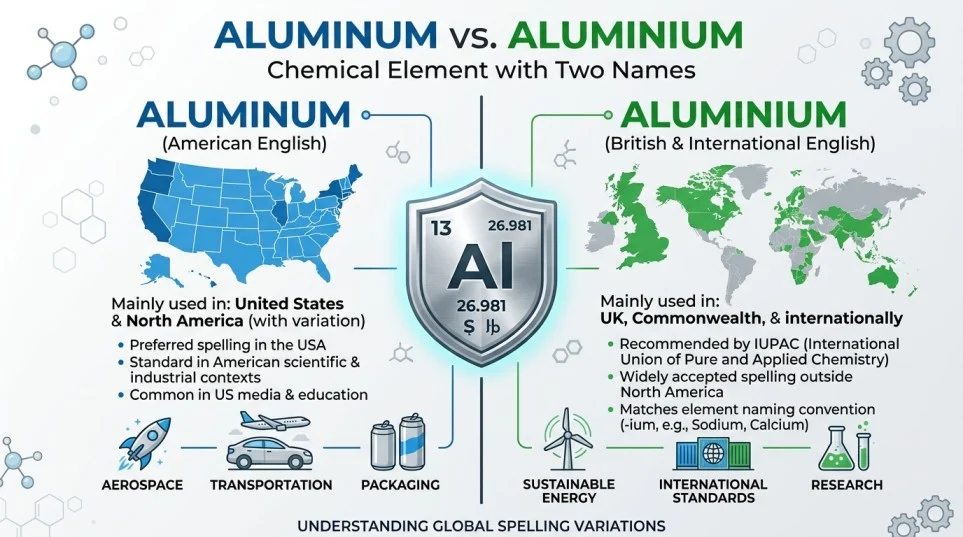
Quick Ans: The difference between aluminum or aluminium is mainly spelling and regional usage. Both words refer to the same chemical element with atomic number 13. “Aluminum” is the preferred spelling in the United States, while “aluminium” is used in the United Kingdom, Australia, Canada, and many other English-speaking countries.
Many people wonder whether they should write aluminum or aluminium. The confusion is understandable because both spellings appear in books, websites, scientific documents, and everyday conversations.
The surprising fact is that both versions are correct.
The difference comes from language conventions rather than chemistry. Scientists, manufacturers, students, and writers may use different spellings depending on their country. As a result, someone reading international content often encounters both terms.
This spelling variation creates questions for students, business professionals, and content creators. Some people assume one version is wrong. Others believe they refer to different metals. Neither assumption is true.
Understanding aluminum or aluminium helps you communicate accurately with international audiences. It also prevents mistakes in academic writing, technical documents, and professional communication.
In this guide, you will learn the history, definitions, regional preferences, advantages, disadvantages, common mistakes, real-world examples, and frequently asked questions about aluminum and aluminium.
Quick Answer: Aluminum or Aluminium
The simplest answer is that both spellings are correct.
| Term | Region of Use | Meaning |
|---|---|---|
| Aluminum | United States | Chemical element 13 |
| Aluminium | United Kingdom, Australia, Canada, and many other countries | Chemical element 13 |
Both words describe the same metal.
Therefore:
- Use aluminum when writing for American audiences.
- Use aluminium when writing for British or international audiences.
What Is Aluminum?
Aluminum is a lightweight, silvery-white metal with atomic number 13 on the periodic table. It is one of the most abundant elements in Earth’s crust.
The American spelling is “aluminum.”
This metal is valued because it is:
- Lightweight
- Corrosion resistant
- Strong
- Recyclable
- Conductive
Because of these qualities, aluminum is widely used in modern industries.
Common Uses of Aluminum
Many products contain aluminum, including:
- Aircraft parts
- Beverage cans
- Construction materials
- Electronics
- Automotive components
- Kitchen utensils
Its versatility makes it one of the world’s most important industrial metals.
Why Americans Use Aluminum
In the United States, “aluminum” became the standard spelling during the 19th century. Eventually, American dictionaries and manufacturers adopted this version.
Today, American schools, businesses, and scientific publications commonly use aluminum.
What Is Aluminium?
Aluminium is exactly the same metal as aluminum. The only difference is the spelling.
Most countries outside the United States prefer the word aluminium.
This spelling follows a naming pattern used by many chemical elements, such as:
- Sodium
- Magnesium
- Calcium
- Titanium
Many scientists felt that “aluminium” sounded more consistent with other element names.
Common Uses of Aluminium
Aluminium is used in:
- Buildings
- Transportation systems
- Packaging
- Aerospace engineering
- Renewable energy projects
- Consumer products
The applications remain identical regardless of spelling.
Why Many Countries Use Aluminium
The International Union of Pure and Applied Chemistry (IUPAC) officially recognizes “aluminium” as the international standard name.
Consequently, many countries adopted this spelling for education and scientific communication.
The History Behind Aluminum or Aluminium
The story of aluminum or aluminium dates back to the early 1800s.
The element was first identified from a substance called alum. Several names appeared before the modern versions emerged.
Early names included:
- Alumium
- Aluminum
- Aluminium
Scientists debated which version sounded best.
Eventually, two spellings survived.
American English adopted aluminum. British English adopted aluminium.
As a result, both versions remain widely accepted today.
Key Differences Between Aluminum or Aluminium
Spelling
The most obvious difference is spelling.
- Aluminum contains one fewer letter.
- Aluminium contains an extra “i.”
Pronunciation
Pronunciation varies slightly.
American pronunciation:
- uh-LOO-muh-num
British pronunciation:
- al-yoo-MIN-ee-um
Regional Preference
The primary distinction comes from geography.
| Region | Preferred Spelling |
|---|---|
| United States | Aluminum |
| United Kingdom | Aluminium |
| Australia | Aluminium |
| New Zealand | Aluminium |
| Canada | Aluminium |
| International scientific communities | Aluminium |
Meaning
Despite spelling differences, the meaning remains identical.
Both terms describe the same chemical element.
Chemical Properties of Aluminum and Aluminium
Whether you write aluminum or aluminium, the properties remain unchanged.
Basic Facts
| Property | Value |
|---|---|
| Atomic Number | 13 |
| Symbol | Al |
| Density | 2.70 g/cm³ |
| Color | Silvery white |
| Magnetic | No |
| Corrosion Resistant | Yes |
Important Characteristics
The metal offers several advantages:
- Lightweight construction
- Excellent corrosion resistance
- High recyclability
- Good electrical conductivity
- Strong strength-to-weight ratio
These properties make it essential in modern manufacturing.
Advantages and Disadvantages
Advantages of Aluminum or Aluminium
Regardless of spelling, the metal provides many benefits:
- Lightweight
- Durable
- Rust resistant
- Easy to recycle
- Cost effective
- Widely available
Disadvantages of Aluminum or Aluminium
Some limitations also exist:
- Softer than steel
- Can dent easily
- Lower strength under extreme loads
- More expensive than some plastics
Even so, its advantages often outweigh its disadvantages.
Real World Examples
Aviation Industry
Aircraft manufacturers use aluminum extensively because it reduces overall weight while maintaining strength.
Beverage Packaging
Soft drink cans are commonly made from aluminum due to its recyclability and low cost.
Construction Projects
Builders use aluminum for windows, roofing systems, and exterior panels.
Electronics
Many laptops and smartphones feature aluminum casings because they are lightweight and attractive.
These examples demonstrate why aluminum remains vital across industries.
Regional and Global Usage
United States
American schools, media outlets, and businesses generally use aluminum.
United Kingdom
British publications almost always use aluminium.
Australia and New Zealand
These countries follow British English standards and therefore prefer aluminium.
Scientific Communities
Many international scientific organizations use aluminium as the official term.
Consequently, the choice between aluminum or aluminium often depends on the audience rather than correctness.
Related Concepts and Comparisons
Aluminum vs Steel
Steel is stronger but heavier.
Aluminum is lighter but generally less strong.
Aluminum vs Titanium
Titanium offers exceptional strength and corrosion resistance.
However, aluminum is significantly cheaper.
Aluminum vs Plastic
Plastic is lighter in some applications.
Meanwhile, aluminum is stronger, more durable, and easier to recycle.
Aluminum vs Aluminium
| Feature | Aluminum | Aluminium |
|---|---|---|
| Meaning | Same metal | Same metal |
| Chemical Symbol | Al | Al |
| Atomic Number | 13 | 13 |
| Primary Difference | American spelling | British spelling |
This comparison highlights that the distinction is linguistic rather than scientific.
Common Mistakes About Aluminum or Aluminium
Thinking They Are Different Metals
Many people assume aluminum and aluminium are separate materials.
In reality, both names describe the same element.
Assuming One Spelling Is Wrong
Neither spelling is incorrect.
The preferred version depends on the audience and region.
Mixing Spellings in One Document
Switching between aluminum and aluminium in the same article can create inconsistency.
Choose one version and use it throughout.
Ignoring Audience Expectations
American readers expect aluminum.
British readers generally expect aluminium.
Matching audience preference improves professionalism.
Beginner to Advanced Writing Tips
Beginner Level
Use the spelling common in your country.
Intermediate Level
Adapt spelling based on your target audience.
Advanced Level
Follow industry or publication style guides.
Academic journals, scientific organizations, and corporate publications may have specific requirements.
Consistency is often more important than the actual spelling chosen.
Step By Step Usage Scenario
Imagine you are writing content about metal recycling.
If your audience is American:
- Use aluminum throughout the article.
- Follow American spelling conventions.
- Maintain consistency.
If your audience is international:
- Consider using aluminium.
- Follow international standards.
- Keep the spelling uniform.
The metal remains the same. Only the spelling changes.
Exercises With Answers
Exercise 1
Do aluminum and aluminium refer to the same element?
Answer: Yes.
Exercise 2
Which spelling is preferred in the United States?
Answer: Aluminum.
Exercise 3
Which spelling is commonly used in the United Kingdom?
Answer: Aluminium.
Exercise 4
What is the chemical symbol for aluminum or aluminium?
Answer: Al.
Exercise 5
True or False: Aluminum and aluminium are different metals.
Answer: False.
When Should You Use Aluminum or Aluminium?
Use aluminum when:
- Writing for American audiences
- Following American style guides
- Creating content for U.S. businesses
Use aluminium when:
- Writing for British audiences
- Following international scientific standards
- Producing content for global markets
Choosing the correct spelling improves readability and audience trust.
FAQs About Aluminum or Aluminium
What is the difference between aluminum or aluminium?
The difference is spelling and regional preference. Both terms refer to the same chemical element.
Is aluminum or aluminium correct?
Both are correct. The preferred choice depends on the audience and country.
Why do Americans say aluminum?
American English adopted aluminum during the 19th century, and the spelling became the national standard.
Why does the UK use aluminium?
British English adopted aluminium because it matched naming patterns used for other chemical elements.
Do scientists use aluminum or aluminium?
Many international scientific organizations prefer aluminium, although American scientists often use aluminum.
Is aluminum different from aluminium chemically?
No. The chemical properties are identical because both names describe the same element.
What is the symbol for aluminum or aluminium?
The chemical symbol is Al.
Which spelling should I use in business writing?
Use the spelling that matches your target audience and regional style guide.
Does Canada use aluminum or aluminium?
Canadian English generally prefers aluminium, though both spellings may appear.
Can I use both spellings in the same article?
It is better to choose one spelling and remain consistent throughout the document.
Conclusion
The debate over aluminum or aluminium is really a question of language rather than science. Both spellings describe the same chemical element with atomic number 13. The metal’s properties, applications, and industrial importance remain identical regardless of how the word is written.
American English favors aluminum, while British English and many international organizations prefer aluminium. Therefore, the best choice depends on your audience.
For U.S. readers, aluminum is the most natural option. For global or British audiences, aluminium may be the better choice. Consistency is equally important because switching between spellings can make writing appear unprofessional.
Whether you work in manufacturing, construction, engineering, education, or content creation, understanding the difference between aluminum or aluminium helps ensure clear communication. By matching the spelling to your audience, you can write more effectively and avoid unnecessary confusion.
Discover More:-
- iOS or Android: Full Comparison Guide for Features, Security, and Performance
- Ax or Axe: Which Spelling Is Correct? Complete Usage Guide

Jennifer Collins is a professional grammar expert and language educator at gramtivo.com, specializing in English grammar, writing skills, and language improvement. She holds a Master’s degree in English Language and Literature from a recognized university in the United States. With years of teaching and content development experience, she is dedicated to helping learners improve their communication skills with clear and practical guidance.