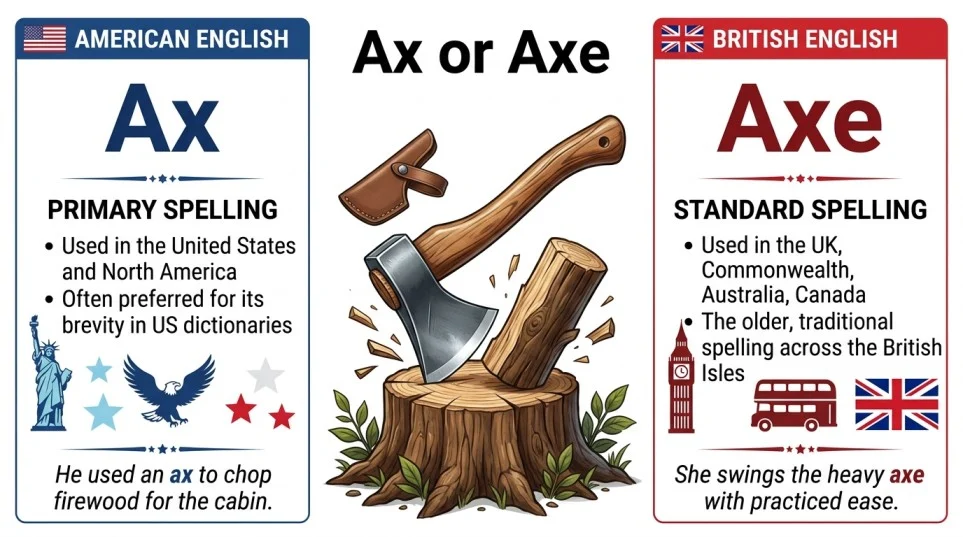
Quick Ans: The difference between ax or axe is mainly spelling, not meaning. Both words refer to the same cutting tool used for chopping wood and other materials. Generally, axe is the preferred spelling in British English, while ax is more common in American English.
Many people wonder whether they should write ax or axe. The confusion is understandable because both spellings appear in books, websites, dictionaries, and everyday writing.
At first glance, it may seem like one spelling is correct and the other is wrong. However, that is not the case. Both forms are accepted by major dictionaries and style guides.
The choice often depends on where you live, who your audience is, and which version of English you use. For example, a writer in the United Kingdom will usually choose axe. Meanwhile, an American writer may prefer ax.
Understanding the difference between ax or axe is important for students, writers, editors, marketers, and business professionals. Using the preferred spelling for your audience can make your writing appear more natural and professional.
This guide explains everything you need to know. You will learn the meaning, history, usage differences, advantages, disadvantages, examples, common mistakes, exercises, and frequently asked questions.
Quick Answer: Ax or Axe
If you need a fast answer, here it is:
| Version | Common Region | Meaning |
|---|---|---|
| Ax | United States | Cutting tool |
| Axe | United Kingdom, Canada, Australia | Cutting tool |
Both spellings are correct.
The main difference is regional preference rather than meaning.
In simple terms:
- Ax is usually preferred in American English.
- Axe is usually preferred in British English and many other English-speaking countries.
What Does Ax Mean?
An ax is a tool with a sharp metal blade attached to a handle. It is commonly used for chopping wood, cutting trees, and splitting logs.
The word can also be used as a verb.
Examples:
- He used an ax to split the firewood.
- The company decided to ax the project.
- She bought a new camping ax.
In American English, this shorter spelling appears frequently in newspapers, books, and online content.
Common Uses of Ax
The word may refer to:
- Woodcutting tools
- Forestry equipment
- Emergency rescue tools
- Symbolic actions such as ending a project
Because of its simplicity, many American publications favor this spelling.
What Does Axe Mean?
An axe has the same meaning as ax. It refers to the identical cutting tool used for chopping and splitting.
The additional letter “e” does not change pronunciation or meaning.
Examples:
- He sharpened his axe before cutting the tree.
- The firefighter carried an axe.
- She displayed an antique axe in her collection.
In British English, axe is the standard spelling.
Common Uses of Axe
The term frequently appears in:
- British publications
- Australian publications
- Canadian publications
- Historical texts
- Outdoor equipment descriptions
As a result, international audiences often encounter the spelling axe more frequently.
The History of Ax and Axe
The debate over ax or axe goes back centuries.
Interestingly, the shorter spelling ax is actually older. Early forms of English often used variations similar to “ax.”
Over time, the spelling axe became more common in British English. Later, American English simplified many spellings, which helped preserve the shorter form.
Examples of similar spelling differences include:
| American English | British English |
|---|---|
| Color | Colour |
| Honor | Honour |
| Theater | Theatre |
| Ax | Axe |
Therefore, the difference follows a broader pattern of regional spelling variations.
Key Differences Between Ax or Axe
Meaning
There is no difference in meaning.
Both words describe the same tool.
Pronunciation
The pronunciation remains identical.
Whether you write ax or axe, people pronounce the word the same way.
Regional Preference
This is where the real difference exists.
American English generally favors ax.
British English generally favors axe.
Writing Style
Many companies and publications choose one spelling and use it consistently.
Consistency matters more than the spelling itself.
Advantages and Disadvantages
Advantages of Using Ax
- Shorter spelling
- Common in American English
- Preferred by many US publications
- Saves one character in headlines
Disadvantages of Using Ax
- May appear unusual to British readers
- Less common internationally
Advantages of Using Axe
- Widely recognized internationally
- Standard in British English
- Common in many global publications
- Familiar to readers in several countries
Disadvantages of Using Axe
- Slightly longer spelling
- Less common in some American style guides
Therefore, the best choice depends on your audience.
Real World Examples
In American Publications
Many American newspapers and websites use ax.
Example:
- The company may ax several departments next year.
In British Publications
Most British publications use axe.
Example:
- The government plans to axe the program.
In Product Packaging
Outdoor equipment manufacturers often choose a spelling based on their target market.
For example, a US brand may sell a camping ax. Meanwhile, a UK retailer may advertise a camping axe.
Regional and Global Usage
United States
American English generally prefers ax.
However, many Americans still use axe, especially in product names and marketing.
United Kingdom
British English almost always favors axe.
This spelling appears in newspapers, schools, and official writing.
Canada
Canadian English typically leans toward axe, although both versions appear.
Australia and New Zealand
The spelling axe is more common.
Consequently, international content often uses axe because it appeals to a broader audience.
Related Concepts and Comparisons
Ax or Axe vs Hatchet
A hatchet is a smaller one handed cutting tool.
An ax or axe is usually larger and designed for heavier work.
Ax or Axe vs Maul
A maul is designed mainly for splitting wood.
An ax or axe is designed for chopping and cutting.
Ax or Axe vs Machete
A machete has a long blade and is commonly used for clearing vegetation.
An ax or axe uses a heavy blade attached to a handle.
Comparison Table
| Tool | Primary Purpose |
|---|---|
| Ax or Axe | Chopping wood |
| Hatchet | Light chopping |
| Maul | Splitting logs |
| Machete | Cutting vegetation |
Understanding these related tools helps clarify the meaning of ax or axe.
Common Mistakes About Ax or Axe
Thinking One Spelling Is Wrong
Many people assume one version is incorrect.
In reality, both spellings are accepted.
Mixing Spellings in the Same Document
Consistency is important.
Choose one version and use it throughout your content.
Ignoring Audience Location
Regional spelling preferences matter.
A British audience may expect axe, while an American audience may expect ax.
Assuming Pronunciation Changes
The pronunciation remains exactly the same.
The extra letter does not create a different sound.
Beginner to Advanced Writing Tips
Beginner Level
Use the spelling most common in your country.
Intermediate Level
Match your spelling to your audience.
For example, use ax for US readers and axe for UK readers.
Advanced Level
Follow the style guide used by your organization or publication.
Consistency across all content strengthens professionalism.
Step By Step Decision Guide
Suppose you are writing an article.
If your audience is primarily American:
- Choose ax
- Use it consistently
- Follow US style guidelines
If your audience is primarily British:
- Choose axe
- Maintain consistency
- Follow UK style standards
For global audiences, many writers choose axe because it is widely recognized internationally.
Exercises With Answers
Exercise 1
Which spelling is more common in American English?
Answer: Ax.
Exercise 2
Which spelling is more common in British English?
Answer: Axe.
Exercise 3
Do ax and axe have different meanings?
Answer: No.
Exercise 4
Is the pronunciation different?
Answer: No.
Exercise 5
True or False: Only one spelling is correct.
Answer: False.
When Should You Use Ax or Axe?
Use ax when:
- Writing for American audiences
- Following US style guides
- Maintaining American English consistency
Use axe when:
- Writing for British audiences
- Following UK style guides
- Creating content for international readers
The best choice depends on context rather than correctness.
FAQs About Ax or Axe
What is the difference between ax or axe?
The difference is spelling preference. Both words refer to the same cutting tool.
Is ax or axe correct?
Both spellings are correct and accepted by major dictionaries.
Why do Americans use ax?
American English often favors shorter spellings, making ax more common in the United States.
Why do British writers use axe?
British English traditionally uses axe as the standard spelling.
Do ax and axe sound different?
No. Both spellings have the same pronunciation.
Which spelling should I use in professional writing?
Use the spelling preferred by your audience and style guide.
Is axe more common worldwide?
Yes. Many English-speaking countries prefer axe over ax.
Can I use both spellings in one article?
You can, but it is better to remain consistent throughout the document.
What do dictionaries say about ax or axe?
Most major dictionaries recognize both spellings as correct.
Which spelling is better for SEO?
The best choice depends on your target audience. US audiences may search for ax, while international audiences may search for axe.
Conclusion
The debate over ax or axe is not about right versus wrong. Instead, it is about regional spelling preferences. Both words refer to the same tool, and both are accepted in modern English.
American English generally prefers ax, while British English and many other English-speaking countries prefer axe. The pronunciation remains identical, and the meaning never changes.
When deciding which spelling to use, consider your audience first. Writers targeting US readers often choose ax. Content aimed at international audiences frequently uses axe.
Consistency is the most important rule. Once you choose a spelling, use it throughout your document. Doing so creates a professional appearance and improves readability.
By understanding the differences between ax or axe, you can write with greater confidence and communicate more effectively with readers around the world.
Discover More:-
- Flyer or Flier: Which Spelling Is Correct and When to Use Each
- There or Their: Difference, Meaning, Examples, and Grammar Guide

Jennifer Collins is a professional grammar expert and language educator at gramtivo.com, specializing in English grammar, writing skills, and language improvement. She holds a Master’s degree in English Language and Literature from a recognized university in the United States. With years of teaching and content development experience, she is dedicated to helping learners improve their communication skills with clear and practical guidance.