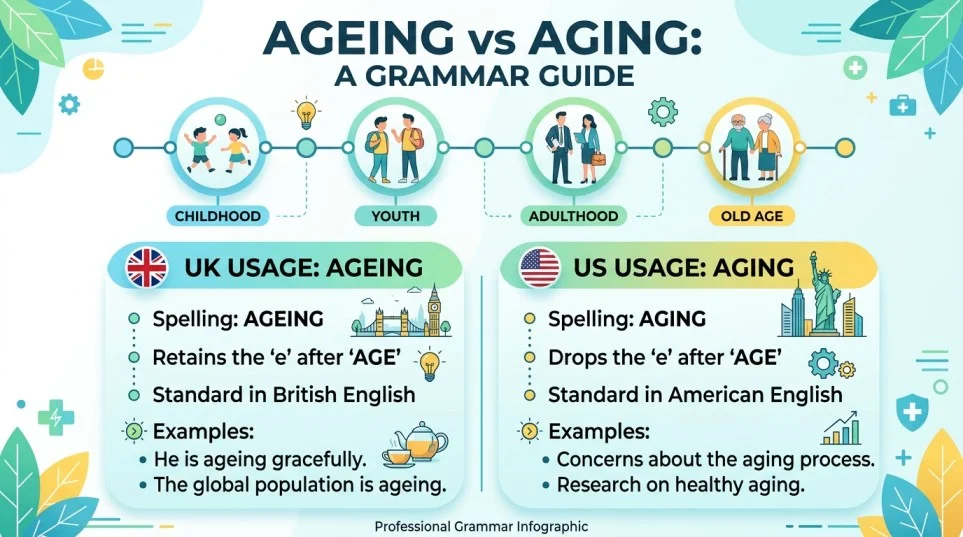
Quick Ans: The difference between ageing or aging is mainly regional spelling. Ageing is the preferred form in British English, while aging is the standard spelling in American English. Both words have the same meaning and refer to the process of growing older over time.
Many writers, students, professionals, and English learners wonder whether they should use ageing or aging. The confusion is understandable because both spellings appear in books, websites, academic papers, and everyday writing.
At first glance, the words seem different. However, they refer to the same process. Both describe the gradual changes that happen as people, animals, plants, materials, or products grow older.
The real issue is not meaning. Instead, the choice depends on the type of English being used.
For example, a newspaper in the United States will almost always write aging population. Meanwhile, a publication in the United Kingdom will typically use ageing population.
Understanding the distinction helps improve writing accuracy and consistency. It also prevents mistakes in academic work, business communication, and content creation.
This guide explains everything you need to know about ageing or aging, including definitions, spelling rules, regional differences, common mistakes, examples, exercises, and frequently asked questions.
Quick Answer: Ageing or Aging
The simplest answer is that both spellings are correct.
| Spelling | Common Region | Correct? |
|---|---|---|
| Ageing | British English | Yes |
| Aging | American English | Yes |
In general:
- Use ageing when writing in British English.
- Use aging when writing in American English.
- Maintain consistency throughout the document.
The meaning remains exactly the same regardless of spelling.
What Does Ageing or Aging Mean?
The terms ageing or aging describe the process of becoming older over time.
This process can apply to:
- People
- Animals
- Plants
- Wine
- Cheese
- Buildings
- Technology
- Materials
The word functions primarily as a noun or adjective.
Examples
- The ageing population is increasing in many countries.
- Scientists study aging and longevity.
- Aging infrastructure requires maintenance.
- The ageing process affects everyone.
Although the spelling changes between regions, the meaning does not.
Why Are There Two Spellings?
English has developed differently in various parts of the world. As a result, some words have alternative spellings.
The difference between ageing or aging comes from regional language conventions.
British English tends to preserve certain spelling patterns. American English often simplifies them.
Consider these examples:
| British English | American English |
|---|---|
| Ageing | Aging |
| Colour | Color |
| Labour | Labor |
| Traveller | Traveler |
| Jewellery | Jewelry |
Therefore, the variation follows a broader pattern found throughout the English language.
Ageing in British English
In the United Kingdom and many Commonwealth countries, ageing is the preferred spelling.
Countries that commonly use ageing include:
- United Kingdom
- Australia
- New Zealand
- Ireland
- South Africa
Examples in British English
- The government is preparing for an ageing population.
- Researchers are studying healthy ageing.
- Ageing infrastructure needs investment.
British dictionaries generally list ageing as the standard form.
Aging in American English
In the United States, aging is the accepted and preferred spelling.
American publications, universities, and businesses typically use this version.
Examples in American English
- The aging population continues to grow.
- Scientists study aging and disease prevention.
- Aging bridges require repairs.
Most American style guides recommend aging exclusively.
Key Differences Between Ageing or Aging
Meaning
There is no difference in meaning. Both spellings describe the process of getting older.
Pronunciation
Pronunciation remains identical.
Grammar
The grammatical function does not change.
Regional Preference
The only meaningful difference is regional usage.
| Feature | Ageing | Aging |
|---|---|---|
| Meaning | Same | Same |
| Pronunciation | Same | Same |
| British English | Preferred | Less common |
| American English | Rare | Preferred |
Consequently, choosing between ageing or aging depends on your audience.
Advantages and Disadvantages of Each Spelling
Advantages of Using Ageing
- Matches British English standards
- Preferred by UK publications
- Appropriate for Commonwealth audiences
- Aligns with British style guides
Disadvantages of Using Ageing
- May look unusual to American readers
- Less common in US publications
Advantages of Using Aging
- Standard in American English
- Widely recognized internationally
- Common in academic journals based in the US
Disadvantages of Using Aging
- May appear inconsistent in British English writing
- Not preferred by many UK editors
The best choice depends on the language standard you follow.
Real World Examples
Academic Writing
A British university may publish research about healthy ageing.
An American university might release a study about healthy aging.
The topic remains identical despite the spelling difference.
Healthcare Industry
Medical organizations frequently discuss:
- Aging populations
- Ageing societies
- Healthy aging
- Healthy ageing
The spelling changes according to location.
Government Reports
UK government documents often reference ageing demographics.
US government reports typically discuss aging demographics.
Thus, audience expectations play a major role.
Regional and Global Usage
United Kingdom
British newspapers, universities, and government agencies overwhelmingly prefer ageing.
United States
American organizations almost always use aging.
Canada
Canadian usage varies. Some publications follow British conventions, while others adopt American spelling.
International Organizations
Many global organizations choose one style and apply it consistently across all documents.
Consistency is usually more important than the specific spelling chosen.
Related Concepts and Comparisons
Ageing or Aging vs Aged
Ageing refers to the process of growing older. Aged describes people who have already reached an advanced age.
Ageing or Aging vs Maturing
Maturing often suggests development and growth. Aging focuses on the passage of time and increasing age.
Ageing or Aging vs Longevity
Longevity refers to the length of life. Aging refers to the process experienced during life.
| Term | Meaning |
|---|---|
| Ageing/Aging | Growing older |
| Aged | Older people |
| Maturing | Developing or growing |
| Longevity | Length of life |
Understanding these related terms helps improve writing precision.
Common Mistakes About Ageing or Aging
Mixing Both Spellings
One common error involves switching between spellings within the same document.
Incorrect:
- The aging population is growing.
- Healthy ageing programs are expanding.
Correct:
- Use aging throughout an American document.
- Use ageing throughout a British document.
Assuming One Spelling Is Wrong
Many people think only one version is correct.
In reality, both are accepted spellings.
Ignoring Audience Location
Writers sometimes choose a spelling without considering readers.
Selecting the appropriate regional form improves professionalism.
Overcorrecting the Word
Some people attempt alternative forms that are not standard.
Always use either ageing or aging depending on your chosen style.
Beginner to Advanced Usage Tips
Beginner Level
Choose the spelling that matches your country’s English standard.
Intermediate Level
Follow the spelling preferences of your school, employer, or publication.
Advanced Level
Consider audience expectations, style guides, and industry conventions.
Professional writers often create style sheets to maintain consistency throughout long documents.
Step By Step Decision Guide
Imagine you are writing an article.
If your audience is American:
- Use aging
- Follow American spelling rules
- Maintain consistency
If your audience is British:
- Use ageing
- Follow British spelling conventions
- Keep the same spelling throughout
This simple approach eliminates confusion.
Exercises With Answers
Exercise 1
Which spelling is preferred in American English?
Answer: Aging.
Exercise 2
Which spelling is preferred in British English?
Answer: Ageing.
Exercise 3
Do ageing and aging have different meanings?
Answer: No.
Exercise 4
Which spelling would a UK newspaper usually use?
Answer: Ageing.
Exercise 5
True or False: Aging is incorrect English.
Answer: False.
When Should You Use Ageing or Aging?
Use ageing if:
- Writing for a British audience
- Following UK style guides
- Creating content for Commonwealth countries
Use aging if:
- Writing for an American audience
- Following US style guides
- Publishing in American journals
Most importantly, remain consistent from beginning to end.
FAQs About Ageing or Aging
What is the difference between ageing or aging?
The only significant difference is regional spelling. Ageing is British English, while aging is American English.
Is ageing or aging correct?
Both spellings are correct. The appropriate choice depends on the version of English being used.
Why do Americans use aging instead of ageing?
American English generally favors simplified spelling forms, which is why aging became the standard.
Why do British writers use ageing?
British English traditionally retains the extra “e” in ageing.
Do ageing and aging mean the same thing?
Yes. Both words describe the process of growing older.
Which spelling should I use in academic writing?
Use the spelling required by your institution, journal, or style guide.
Is aging accepted in the UK?
People will understand it, but ageing remains the preferred British spelling.
Can I use both spellings in one document?
No. Consistency is important. Choose one spelling and use it throughout.
Which spelling is more common worldwide?
Aging often appears more frequently online because of the influence of American publications, but ageing remains widely used in many countries.
How can I remember the difference between ageing or aging?
Associate ageing with British English and aging with American English.
Conclusion
Understanding ageing or aging is simpler than many people think. Both spellings are correct, both share the same meaning, and both refer to the process of growing older.
The key difference lies in regional preference. British English favors ageing, while American English prefers aging. Because the meanings are identical, writers should focus on choosing the version that matches their audience and style guide.
Consistency is especially important in professional writing. Switching between spellings can make content appear unpolished and confusing. For that reason, select one form before you begin writing and use it throughout the document.
Whether you are creating academic papers, business reports, website content, or healthcare articles, understanding the distinction between ageing or aging helps improve clarity and credibility. By following the conventions of your target audience, you can communicate more effectively and maintain professional writing standards.
Discover More:-
- iOS or Android: Full Comparison Guide for Features, Security, and Performance
- Ax or Axe: Which Spelling Is Correct? Complete Usage Guide

Lisa Thompson is a USA-based content writer and language specialist focused on grammar, writing improvement and digital publishing.
She holds a degree in English Language and Communication and has professional experience in educational and web content creation.
As the author of Gramtivo.Com, she aims to help readers improve their writing skills through clear and practical guidance.