
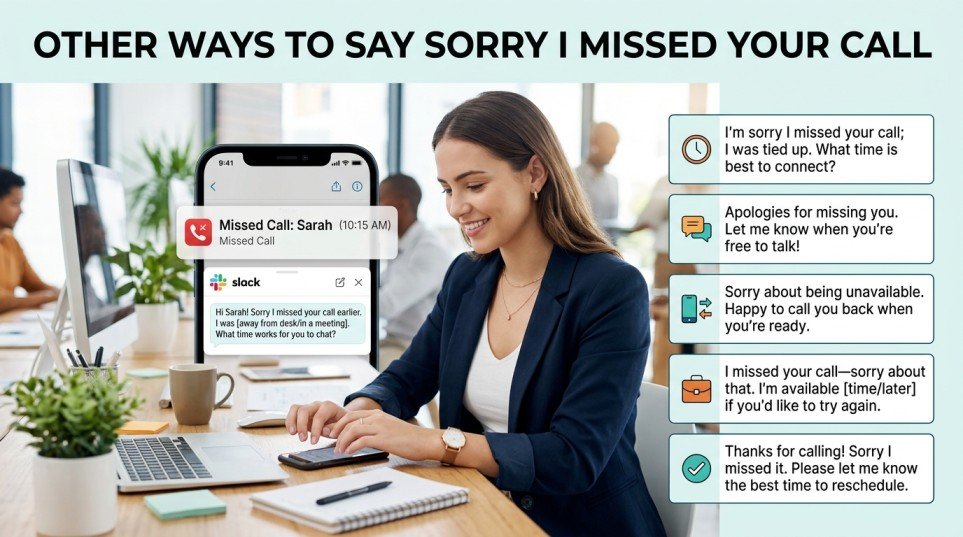
Quick Answer: Instead of saying sorry I missed your call, you can say: I wasn’t able to answer, I missed your call earlier, thanks for calling, I just saw your call, I couldn’t get to the phone.
The phrase “sorry I missed your call” is a common way to acknowledge that someone called you and you were unable to answer. It shows politeness, professionalism, and respect for the other person’s time.
While the phrase works well in many situations, using the same expression repeatedly can make your communication sound repetitive. Native English speakers often use different alternatives depending on whether the conversation is personal, professional, or formal.
Learning alternatives to “sorry I missed your call” helps you sound more natural and confident. It also improves your ability to choose the right tone for emails, text messages, business communication, and everyday conversations. Expanding your vocabulary with other ways to say sorry I missed your call can significantly improve your spoken and written English.
Quick Categories Section
Formal alternatives to “sorry I missed your call”
- I was unavailable when you called
- I was unable to answer your call
- I regret missing your call
- Thank you for your patience
Pro Tip: Use these phrases in professional emails, customer communication, and workplace conversations.
Casual alternatives
- I missed your call earlier
- I couldn’t pick up
- Sorry, I wasn’t near my phone
- I just saw your call
Pro Tip: These work well for friends, family members, and casual contacts.
Professional alternatives
- I wasn’t available to take your call
- Thank you for reaching out
- I apologize for missing your call
- I am returning your call now
Pro Tip: Focus on solutions rather than lengthy apologies in business communication.
Informal expressions
- My phone was away from me
- I didn’t catch your call
- Just noticed your call
- I wasn’t able to get to my phone
Pro Tip: Keep informal expressions for personal conversations rather than professional settings.
“Professional communication is not about apologizing more—it’s about responding effectively.”
Common Mistakes
1. Over-apologizing
Example: “I’m so incredibly sorry I missed your call and caused inconvenience.”
2. Giving unnecessary excuses
Example: Explaining every detail about why you missed the call.
3. Responding too late
Example: Waiting days before acknowledging the missed call.
4. Using overly casual language at work
Example: “Oops, missed your call!”
5. Forgetting to offer a next step
Example: Apologizing without suggesting a callback.
What Does “Sorry I Missed Your Call” Mean?
The phrase “sorry I missed your call” means that someone attempted to contact you by phone, but you were unable to answer at that moment.
Grammatically, it combines an apology (sorry) with an explanation (I missed your call).
Example Sentence:
Sorry I missed your call. I was in a meeting and couldn’t answer.
When to Use “Sorry I Missed Your Call”
- After seeing a missed call notification
- When returning someone’s call
- In voicemail messages
- In text messages
- In professional follow-up emails
- When reconnecting with clients or colleagues
Spoken vs Written: Common in both formats
Formal vs Informal: Generally neutral and appropriate in most situations
Is It Professional or Polite to Say “Sorry I Missed Your Call”?
Polite? ✔️ Yes
Professional? ✔️ Yes
Unlike many casual apologies, this phrase is widely accepted in professional communication because it acknowledges the missed contact respectfully.
Business Example:
“Sorry I missed your call earlier. I’m available now if you’d like to discuss the project.”
Pros and Cons of Using “Sorry I Missed Your Call”
Pros
- Polite and respectful
- Easy to understand
- Works in most situations
- Shows accountability
Cons
- Can sound repetitive
- Overused in business communication
- May focus too much on the apology
- Less effective than action-oriented responses
“A quick response often matters more than a perfect apology.”
Other Ways to Say “Sorry I Missed Your Call” (With Examples)
These alternatives will help you sound more fluent, confident, and natural in different situations.
Use them according to tone, context, and audience to improve your communication skills and sound more professional.
1. Phrase: I missed your call earlier
Meaning: You noticed the call after it happened.
Explanation: A simple and natural alternative.
Example Sentence: I missed your call earlier. Is now a good time to talk?
Best Use: everyday communication
Worst Use: formal apology
Tone: friendly, neutral
Context Variability: casual / professional / spoken
2. Phrase: I wasn’t able to answer
Meaning: You could not pick up the phone.
Explanation: Professional and concise.
Example Sentence: I wasn’t able to answer when you called.
Best Use: workplace communication
Worst Use: highly personal apology
Tone: professional, polite
Context Variability: professional / written
3. Phrase: I couldn’t pick up
Meaning: You were unable to answer.
Explanation: Common in everyday English.
Example Sentence: I couldn’t pick up because I was driving.
Best Use: casual conversation
Worst Use: formal correspondence
Tone: casual, friendly
Context Variability: spoken / casual
4. Phrase: I just saw your call
Meaning: You recently noticed the missed call.
Explanation: Often used in text messages.
Example Sentence: I just saw your call. What’s up?
Best Use: texting
Worst Use: formal email
Tone: casual, conversational
Context Variability: casual / spoken
5. Phrase: Thanks for calling
Meaning: Appreciating the person’s effort.
Explanation: Focuses on gratitude rather than apology.
Example Sentence: Thanks for calling. I wasn’t able to answer earlier.
Best Use: professional communication
Worst Use: urgent situations
Tone: professional, appreciative
Context Variability: professional / written
“Sometimes gratitude sounds more professional than an apology.”
6. Phrase: I was unavailable when you called
Meaning: You could not answer at that time.
Explanation: Formal and professional.
Example Sentence: I was unavailable when you called this afternoon.
Best Use: business communication
Worst Use: casual texting
Tone: formal, professional
Context Variability: professional / written
7. Phrase: I wasn’t near my phone
Meaning: Your phone wasn’t accessible.
Explanation: Friendly and natural.
Example Sentence: Sorry, I wasn’t near my phone.
Best Use: friends and family
Worst Use: formal business emails
Tone: casual, relaxed
Context Variability: casual / spoken
8. Phrase: I apologize for missing your call
Meaning: Formal acknowledgment.
Explanation: Stronger than saying sorry.
Example Sentence: I apologize for missing your call earlier today.
Best Use: client communication
Worst Use: casual texts
Tone: formal, respectful
Context Variability: professional / written
9. Phrase: I didn’t catch your call
Meaning: You missed the call.
Explanation: Common conversational expression.
Example Sentence: I didn’t catch your call earlier.
Best Use: everyday use
Worst Use: formal writing
Tone: friendly, casual
Context Variability: casual / spoken
10. Phrase: I was tied up when you called
Meaning: You were busy.
Explanation: Suggests another commitment.
Example Sentence: I was tied up when you called.
Best Use: workplace discussions
Worst Use: highly formal communication
Tone: professional, conversational
Context Variability: casual / professional
“The best responses acknowledge the call and move the conversation forward.”
11. Phrase: I wasn’t available to take your call
Meaning: You couldn’t answer at the time.
Explanation: Professional and respectful.
Example Sentence: I wasn’t available to take your call this morning.
Best Use: workplace communication
Worst Use: casual texting
Tone: professional, courteous
Context Variability: professional / written
12. Phrase: I just noticed your missed call
Meaning: You recently became aware of the call.
Explanation: Common in texts and messages.
Example Sentence: I just noticed your missed call.
Best Use: texting
Worst Use: formal reports
Tone: casual, friendly
Context Variability: casual / spoken
13. Phrase: Sorry I couldn’t get to the phone
Meaning: You were unable to answer.
Explanation: Natural and conversational.
Example Sentence: Sorry I couldn’t get to the phone earlier.
Best Use: personal conversations
Worst Use: formal correspondence
Tone: warm, casual
Context Variability: casual / spoken
14. Phrase: I was in a meeting when you called
Meaning: A meeting prevented you from answering.
Explanation: Specific and professional.
Example Sentence: I was in a meeting when you called.
Best Use: workplace communication
Worst Use: casual excuse
Tone: professional, direct
Context Variability: professional / spoken
15. Phrase: I was occupied at the time
Meaning: You were busy.
Explanation: More formal wording.
Example Sentence: I was occupied at the time of your call.
Best Use: professional messages
Worst Use: casual texting
Tone: formal, neutral
Context Variability: professional / written
16. Phrase: Thank you for reaching out
Meaning: Appreciating the contact.
Explanation: Focuses on gratitude.
Example Sentence: Thank you for reaching out. I missed your call earlier.
Best Use: client communication
Worst Use: urgent matters
Tone: professional, appreciative
Context Variability: professional / written
17. Phrase: I wasn’t free to answer
Meaning: You were unavailable.
Explanation: Direct and simple.
Example Sentence: I wasn’t free to answer when you called.
Best Use: general communication
Worst Use: formal legal writing
Tone: neutral, polite
Context Variability: casual / professional
18. Phrase: I saw your missed call
Meaning: You noticed the call afterward.
Explanation: Common follow-up phrase.
Example Sentence: I saw your missed call and wanted to call back.
Best Use: phone callbacks
Worst Use: formal letters
Tone: neutral, helpful
Context Variability: casual / professional
19. Phrase: I wasn’t able to get back to you sooner
Meaning: Your response was delayed.
Explanation: Useful for delayed callbacks.
Example Sentence: I wasn’t able to get back to you sooner.
Best Use: professional follow-up
Worst Use: immediate responses
Tone: apologetic, professional
Context Variability: professional / written
20. Phrase: My apologies for missing your call
Meaning: Formal apology.
Explanation: Strong and respectful.
Example Sentence: My apologies for missing your call earlier.
Best Use: business communication
Worst Use: casual conversations
Tone: formal, respectful
Context Variability: professional / written
“Professional reaction phrases often focus on solutions rather than excuses.”
21. Phrase: I was away from my phone
Meaning: You didn’t have access to your phone.
Explanation: Common casual explanation.
Example Sentence: I was away from my phone most of the afternoon.
Best Use: friends and family
Worst Use: formal business communication
Tone: casual, friendly
Context Variability: casual / spoken
22. Phrase: I missed your call while I was busy
Meaning: Other tasks prevented you from answering.
Explanation: Simple explanation.
Example Sentence: I missed your call while I was busy at work.
Best Use: everyday communication
Worst Use: formal apology
Tone: neutral, conversational
Context Variability: casual / professional
23. Phrase: I couldn’t answer at the time
Meaning: You were unavailable.
Explanation: Versatile and professional.
Example Sentence: I couldn’t answer at the time you called.
Best Use: workplace communication
Worst Use: none specific
Tone: professional, neutral
Context Variability: casual / professional / written
24. Phrase: I was unable to respond immediately
Meaning: Your response was delayed.
Explanation: Formal alternative.
Example Sentence: I was unable to respond immediately to your call.
Best Use: business emails
Worst Use: casual texts
Tone: formal, professional
Context Variability: professional / written
25. Phrase: I appreciate your patience
Meaning: Thanking someone for waiting.
Explanation: Positive and professional.
Example Sentence: I appreciate your patience after my missed call.
Best Use: client communication
Worst Use: casual chats
Tone: appreciative, professional
Context Variability: professional / written
26. Phrase: I couldn’t come to the phone
Meaning: You were unable to answer.
Explanation: Traditional expression.
Example Sentence: I couldn’t come to the phone earlier.
Best Use: spoken English
Worst Use: highly formal writing
Tone: polite, conversational
Context Variability: spoken / casual
27. Phrase: I was handling something important
Meaning: You were occupied with another matter.
Explanation: Professional explanation.
Example Sentence: I was handling something important when you called.
Best Use: workplace situations
Worst Use: casual texts
Tone: professional, direct
Context Variability: professional / spoken
28. Phrase: I’m returning your call now
Meaning: You are calling back.
Explanation: Action-focused response.
Example Sentence: I’m returning your call now regarding your message.
Best Use: business communication
Worst Use: text-only responses
Tone: proactive, professional
Context Variability: professional / spoken
29. Phrase: I wasn’t able to connect earlier
Meaning: Communication didn’t happen earlier.
Explanation: Professional and polished.
Example Sentence: I wasn’t able to connect earlier when you called.
Best Use: workplace communication
Worst Use: casual texting
Tone: professional, polished
Context Variability: professional / written
30. Phrase: Thank you for your patience
Meaning: Appreciation for waiting.
Explanation: A highly professional alternative that shifts focus from the mistake to appreciation.
Example Sentence: Thank you for your patience. I am available now if you’d like to talk.
Best Use: client communication
Worst Use: casual friend chats
Tone: professional, appreciative
Context Variability: professional / written
“The most effective alternative often combines acknowledgment, appreciation, and action.”
Mini Quiz / Self-Check
1. Which phrase is best for a client email?
A. I just saw your call
B. Thank you for your patience
C. I couldn’t pick up
Answer: B
2. Which phrase is the most casual?
A. I apologize for missing your call
B. Wasn’t available to take your call
C. I just saw your call
Answer: C
3. Which phrase focuses on gratitude rather than apology?
A. Thank you for reaching out
B. I missed your call earlier
C. I couldn’t answer
Answer: A
Comparison Table: Top Alternatives
| Phrase | Tone | Best Use |
|---|---|---|
| I missed your call earlier | Neutral | Everyday communication |
| I wasn’t able to answer | Professional | Workplace |
| Thanks for calling | Appreciative | Business |
| I just saw your call | Casual | Texting |
| I was unavailable when you called | Formal | Professional |
| I apologize for missing your call | Formal | Client communication |
| Thank you for reaching out | Professional | Business emails |
| I wasn’t available to take your call | Professional | Workplace |
| I’m returning your call now | Proactive | Callbacks |
| Thank you for your patience | Professional | Customer service |
FAQs
1. What are the best alternatives to “sorry I missed your call”?
Popular alternatives include I missed your call earlier, I wasn’t able to answer, and thank you for your patience.
2. Is “sorry I missed your call” professional?
Yes. It is polite and commonly used in professional communication.
3. What is a more professional way to say “sorry I missed your call”?
Try I wasn’t available to take your call or thank you for reaching out.
4. Should I apologize for every missed call?
Not necessarily. In many professional situations, gratitude and a prompt response can be more effective than repeated apologies.
5. What can I text instead of “sorry I missed your call”?
You can say I just saw your call or I missed your call earlier. Is now a good time to talk?
Conclusion
Learning other ways to say sorry I missed your call helps you communicate more naturally and professionally. Different situations require different tones, and having multiple alternatives allows you to choose the most appropriate response.
Practice these phrases regularly and pay attention to context. As your vocabulary grows, your spoken and written English will become more fluent, polished, and effective.
CTA: Which alternative do you use most often? Try using a new one in your next call or message.
Discover More:-
- Other Ways to Say Please Let Me Know Your Availability (30+ Examples)
- Other Ways to Say At Your Earliest Convenience (30+ Examples)

Lisa Thompson is a USA-based content writer and language specialist focused on grammar, writing improvement and digital publishing.
She holds a degree in English Language and Communication and has professional experience in educational and web content creation.
As the author of Gramtivo.Com, she aims to help readers improve their writing skills through clear and practical guidance.