
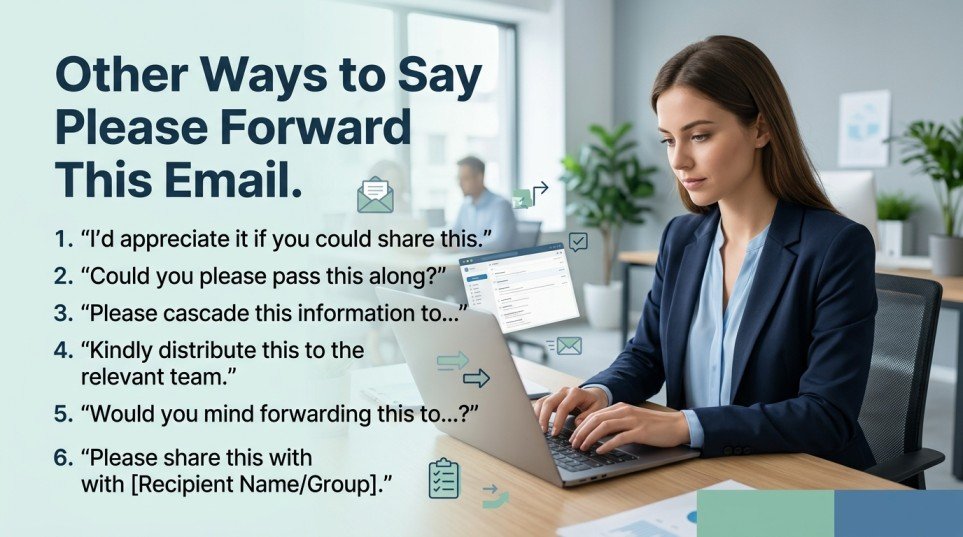
Quick Answer: Instead of saying please forward this email, you can say: please pass this along, kindly share this email, please send this to the relevant person, could you forward this message, please circulate this email.
The phrase “please forward this email” is commonly used in workplace communication when asking someone to share a message with another person or group.
Although the phrase is clear and professional, repeating it too often can make your emails sound repetitive. Native English speakers frequently use different alternatives depending on tone, formality, and context.
Learning alternatives to “please forward this email” helps you sound more polished and professional. It also improves your workplace communication skills and helps you use more natural professional reaction phrases and informal expressions in English when appropriate.
Quick Categories Section
Formal alternatives to “please forward this email”
- Kindly forward this message
- Please circulate this email
- Would you kindly share this email
- Please pass this on to the appropriate person
Pro Tip: Use these in business emails and professional communication.
Casual alternatives
- Can you send this along?
- Please pass this along
- Mind forwarding this?
- Could you share this?
Pro Tip: Best for relaxed workplace conversations or familiar colleagues.
Professional alternatives
- Please direct this email accordingly
- Kindly share this with the team
- Please forward this to the relevant department
- Would you mind circulating this message?
Pro Tip: Keep wording concise and respectful in professional settings.
Informal expressions
- Send this over
- Pass this around
- Shoot this over
- Share this with them
Pro Tip: Avoid these in formal corporate emails.
“Professional emails sound stronger when you vary your language naturally.”
Common Mistakes
- Sounding too demanding
Example: “Forward this email immediately.” - Using informal phrases in formal emails
Example: “Shoot this over to them.” - Being unclear about the recipient
Example: “Please forward this” without specifying to whom. - Overusing the same phrase
Example: Repeating “please forward this email” in every email thread. - Making the sentence too long
Example: Using unnecessary wording that reduces clarity.
What Does “Please Forward This Email” Mean?
It means asking someone to send your email message to another person or group.
Grammatically, it is an imperative request sentence commonly used in professional communication.
Example Sentence:
Please forward this email to the marketing department.
When to Use “Please Forward This Email”
- When sharing information internally
- In workplace or business emails
- When asking someone to contact another department
- In both formal and semi-formal communication
Spoken vs Written: Mostly written
Formal vs Informal: Neutral and professional
Is It Professional or Polite to Say “Please Forward This Email”?
Polite? ✔️ Yes
Professional? ✔️ Yes
Business Example:
“Please forward this email to the appropriate team member for review.”
Pros and Cons of Using “Please Forward This Email”
Pros
- Clear and direct
- Professional tone
- Widely understood
- Easy to use
Cons
- Repetitive in frequent emails
- Can sound robotic
- Slightly impersonal
- Limited tone variation
“Small wording changes can instantly improve your professional communication.”
Other Ways to Say “Please Forward This Email” (With Examples)
These alternatives will help you sound more fluent, polished, and natural in professional communication.
Use them based on tone, audience, and workplace context.
1. Phrase: Kindly forward this message
Meaning: Politely asking someone to send the message onward.
Explanation: Formal and respectful.
Example Sentence: Kindly forward this message to the HR department.
Best Use: formal email
Worst Use: casual chat
Tone: professional, polite
Context Variability: professional / written
2. Phrase: Please pass this along
Meaning: Share the message with others.
Explanation: Friendly but still professional.
Example Sentence: Please pass this along to your team.
Best Use: workplace communication
Worst Use: legal email
Tone: friendly, professional
Context Variability: casual / professional
3. Phrase: Could you forward this message?
Meaning: Asking someone to send the message onward.
Explanation: Polite question format.
Example Sentence: Could you forward this message to management?
Best Use: respectful request
Worst Use: urgent commands
Tone: polite, neutral
Context Variability: professional
4. Phrase: Please circulate this email
Meaning: Share the email with multiple people.
Explanation: Common in office settings.
Example Sentence: Please circulate this email among the staff.
Best Use: team emails
Worst Use: personal chats
Tone: professional, formal
Context Variability: workplace / written
5. Phrase: Kindly share this email
Meaning: Politely asking for distribution.
Explanation: Professional and concise.
Example Sentence: Kindly share this email with the relevant department.
Best Use: business email
Worst Use: informal messaging
Tone: formal, professional
Context Variability: professional / written
“The right email phrase makes communication clearer and more professional.”
6. Phrase: Please send this to the appropriate person
Meaning: Forward to the correct recipient.
Explanation: Useful when unsure who handles the issue.
Example Sentence: Please send this to the appropriate person for assistance.
Best Use: customer support
Worst Use: casual talk
Tone: polite, professional
Context Variability: professional
7. Phrase: Would you mind forwarding this?
Meaning: Polite forwarding request.
Explanation: Softer and more conversational.
Example Sentence: Would you mind forwarding this to the finance team?
Best Use: polite requests
Worst Use: strict instructions
Tone: courteous, friendly
Context Variability: professional / spoken
8. Phrase: Please direct this email accordingly
Meaning: Send the email to the correct destination.
Explanation: Formal workplace phrase.
Example Sentence: Please direct this email accordingly.
Best Use: corporate emails
Worst Use: casual use
Tone: formal, professional
Context Variability: workplace
9. Phrase: Please pass this on
Meaning: Share with another person.
Explanation: Short and natural.
Example Sentence: Please pass this on to your supervisor.
Best Use: everyday office use
Worst Use: formal reports
Tone: neutral, friendly
Context Variability: casual / professional
10. Phrase: Could you share this with the team?
Meaning: Ask someone to distribute information internally.
Explanation: Team-focused wording.
Example Sentence: Could you share this with the team before tomorrow?
Best Use: internal communication
Worst Use: legal writing
Tone: collaborative, professional
Context Variability: workplace
11. Phrase: Please relay this message
Meaning: Communicate the message onward.
Explanation: Slightly formal alternative.
Example Sentence: Please relay this message to the department manager.
Best Use: formal workplace
Worst Use: casual chat
Tone: formal, professional
Context Variability: written / professional
12. Phrase: Kindly pass this email along
Meaning: Politely asking someone to share the email.
Explanation: Formal but natural.
Example Sentence: Kindly pass this email along to the support team.
Best Use: business emails
Worst Use: slang context
Tone: polite, professional
Context Variability: workplace
13. Phrase: Please share this information
Meaning: Distribute the information.
Explanation: Useful when referring to content instead of email itself.
Example Sentence: Please share this information with all employees.
Best Use: announcements
Worst Use: personal conversation
Tone: neutral, professional
Context Variability: workplace / written
14. Phrase: Can you send this along?
Meaning: Casual forwarding request.
Explanation: Friendly and conversational.
Example Sentence: Can you send this along to Jake?
Best Use: casual office talk
Worst Use: executive email
Tone: casual, polite
Context Variability: spoken / casual
15. Phrase: Please distribute this email
Meaning: Send the email to multiple recipients.
Explanation: Common in formal organizations.
Example Sentence: Please distribute this email to all department heads.
Best Use: formal announcements
Worst Use: personal messages
Tone: formal, professional
Context Variability: workplace
“Clear requests make professional emails more effective.”
16. Phrase: Kindly circulate this message
Meaning: Share the message widely.
Explanation: Formal corporate wording.
Example Sentence: Kindly circulate this message to all staff members.
Best Use: corporate communication
Worst Use: casual use
Tone: formal, respectful
Context Variability: professional
17. Phrase: Please forward this to the relevant department
Meaning: Send to the correct department.
Explanation: Specific and professional.
Example Sentence: Please forward this to the relevant department for review.
Best Use: customer service
Worst Use: casual conversation
Tone: professional, direct
Context Variability: workplace
18. Phrase: Could you pass this along?
Meaning: Ask someone to share the message.
Explanation: Soft and conversational.
Example Sentence: Could you pass this along to the interns?
Best Use: friendly workplace
Worst Use: strict formal writing
Tone: casual, polite
Context Variability: spoken / professional
19. Phrase: Please send this onward
Meaning: Continue forwarding the message.
Explanation: Slightly formal phrase.
Example Sentence: Please send this onward to the legal team.
Best Use: formal office use
Worst Use: casual chats
Tone: formal, neutral
Context Variability: professional
20. Phrase: Kindly transmit this email
Meaning: Officially forward the email.
Explanation: Very formal and uncommon.
Example Sentence: Kindly transmit this email to the concerned authority.
Best Use: official communication
Worst Use: friendly emails
Tone: highly formal, professional
Context Variability: written / formal
21. Phrase: Please share this with them
Meaning: Give the message to another group.
Explanation: Simple and natural wording.
Example Sentence: Please share this with them before the meeting.
Best Use: casual office use
Worst Use: legal communication
Tone: friendly, neutral
Context Variability: casual / workplace
22. Phrase: Would you kindly circulate this?
Meaning: Politely asking for distribution.
Explanation: Very respectful tone.
Example Sentence: Would you kindly circulate this among the employees?
Best Use: formal requests
Worst Use: casual messaging
Tone: formal, polite
Context Variability: professional
23. Phrase: Please copy the team on this
Meaning: Include the team in the email thread.
Explanation: Common office phrase.
Example Sentence: Please copy the team on this email.
Best Use: office communication
Worst Use: personal use
Tone: professional, practical
Context Variability: workplace
24. Phrase: Please send this over
Meaning: Forward or transfer the email.
Explanation: Informal but common.
Example Sentence: Please send this over to accounting.
Best Use: casual workplace
Worst Use: formal documents
Tone: casual, efficient
Context Variability: spoken / office
25. Phrase: Mind forwarding this?
Meaning: Casual request for forwarding.
Explanation: Friendly and brief.
Example Sentence: Mind forwarding this to the design team?
Best Use: familiar coworkers
Worst Use: executive communication
Tone: casual, conversational
Context Variability: informal / spoken
26. Phrase: Please ensure this reaches the team
Meaning: Make sure the team receives the message.
Explanation: Focuses on delivery rather than forwarding.
Example Sentence: Please ensure this reaches the team before Friday.
Best Use: important updates
Worst Use: casual chats
Tone: professional, direct
Context Variability: workplace
27. Phrase: Kindly route this email appropriately
Meaning: Send the email through the correct channel.
Explanation: Formal corporate wording.
Example Sentence: Kindly route this email appropriately for approval.
Best Use: large organizations
Worst Use: casual use
Tone: formal, corporate
Context Variability: written / professional
28. Phrase: Please pass this around
Meaning: Share with several people.
Explanation: Informal office expression.
Example Sentence: Please pass this around before the meeting.
Best Use: casual office talk
Worst Use: executive emails
Tone: informal, friendly
Context Variability: casual
29. Phrase: Could you send this to the group?
Meaning: Ask someone to share with a group.
Explanation: Clear and collaborative.
Example Sentence: Could you send this to the group this afternoon?
Best Use: team communication
Worst Use: strict formal writing
Tone: polite, collaborative
Context Variability: professional / casual
30. Phrase: Please forward this accordingly
Meaning: Send to the correct person or department.
Explanation: Concise and professional.
Example Sentence: Please forward this accordingly for further action.
Best Use: business communication
Worst Use: casual conversations
Tone: formal, concise
Context Variability: workplace / written
“Professional communication becomes stronger when your wording stays clear and varied.”
Mini Quiz / Self-Check
1. Which phrase is best for formal corporate communication?
A. Shoot this over
B. Kindly circulate this message
C. Pass this around
Answer: B
2. Which phrase is too informal for executive emails?
A. Please distribute this email
B. Mind forwarding this?
C. Kindly share this email
Answer: B
3. Which phrase works best for team collaboration?
A. Could you share this with the team?
B. Kindly transmit this email
C. Please route this accordingly
Answer: A
Comparison Table: Top Alternatives
| Phrase | Tone | Best Use |
|---|---|---|
| Kindly forward this message | Formal | Business emails |
| Please pass this along | Friendly | Office communication |
| Could you forward this message? | Polite | Requests |
| Please circulate this email | Professional | Team distribution |
| Kindly share this email | Formal | Workplace |
| Please relay this message | Formal | Corporate use |
| Could you share this with the team? | Collaborative | Internal communication |
| Please distribute this email | Professional | Announcements |
| Mind forwarding this? | Informal | Familiar coworkers |
| Please forward this accordingly | Formal | Business communication |
FAQs
1. What are the best alternatives to “please forward this email”?
Top choices include please pass this along, kindly share this email, and please circulate this email.
2. Is “please forward this email” professional?
Yes, it is professional, polite, and commonly used in workplace communication.
3. What is a more formal way to say “please forward this email”?
Use kindly forward this message or please circulate this email.
4. Can I use informal expressions in professional emails?
Only in relaxed work environments; otherwise, keep your wording formal.
5. Why learn alternatives to “please forward this email”?
It improves fluency, professionalism, and variety in workplace communication.
Conclusion
Learning other ways to say “please forward this email” helps you communicate more naturally and professionally. It also allows you to adjust your tone depending on workplace context and audience.
Practice these phrases regularly to improve your business English and email-writing confidence. Small wording changes can make your communication sound clearer and more polished.
CTA: Which professional phrase will you start using in your emails today?
Discover More:-
- Other Ways to Say I Am Writing to Let You Know (30+ Examples)
- Other Ways to Say I’m Glad to Hear That (30+ Examples)

Jennifer Collins is a professional grammar expert and language educator at gramtivo.com, specializing in English grammar, writing skills, and language improvement. She holds a Master’s degree in English Language and Literature from a recognized university in the United States. With years of teaching and content development experience, she is dedicated to helping learners improve their communication skills with clear and practical guidance.

