
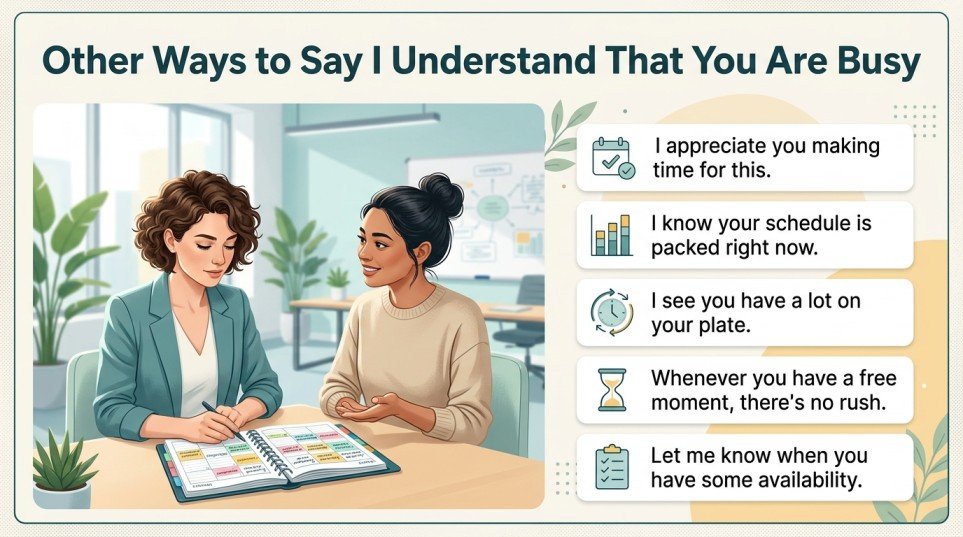
Quick Answer: Instead of saying I understand that you are busy, you can say: I know you have a lot on your plate, I appreciate your time, I understand your schedule is packed, I know you’re juggling many responsibilities, take your time.
The phrase “I understand that you are busy” is commonly used to show empathy, patience, and consideration for someone’s workload or commitments. It acknowledges that the other person may not be able to respond immediately or give something their full attention.
While this phrase is polite and effective, using it repeatedly can make your communication sound repetitive. Native English speakers often choose different expressions depending on whether they are writing an email, speaking to a colleague, or communicating with a friend.
Learning alternatives to “I understand that you are busy” can help you sound more natural and professional. It also improves your ability to adapt your tone to different situations and develop stronger communication skills in both personal and workplace conversations.
Quick Categories Section
Formal alternatives to “I understand that you are busy”
- I appreciate that you have many commitments
- I understand your schedule is demanding
- I recognize that your time is limited
- I appreciate your availability
Pro Tip: Use these phrases in formal emails, business communication, and professional correspondence.
Casual alternatives
- I know you’ve got a lot going on
- I know you’re busy
- I get that you’re swamped
- You’ve got plenty on your plate
Pro Tip: These work best in friendly conversations and informal messages.
Professional alternatives
- I appreciate your busy schedule
- I understand you have competing priorities
- I realize your workload is substantial
- Thank you for making time
Pro Tip: Professional alternatives help you sound respectful without appearing demanding.
Informal expressions
- I know you’re tied up
- I know you’re slammed
- You’ve been pretty busy lately
- Take your time
Pro Tip: Reserve highly informal expressions for people you know well.
“Acknowledging someone’s time shows professionalism and respect.”
Common Mistakes
- Sounding overly apologetic
Example: “I’m sorry to bother you because you’re so busy.” - Repeating the phrase too often
Example: Using “I understand that you are busy” in every email. - Using overly casual language in professional settings
Example: “I know you’re slammed” in a formal business proposal. - Making assumptions about someone’s availability
Example: “You’re obviously too busy to help.” - Adding unnecessary pressure afterward
Example: “I know you’re busy, but I need this immediately.”
What Does “I Understand That You Are Busy” Mean?
The phrase means you recognize and respect that someone has many responsibilities, commitments, or demands on their time.
It is often used to show empathy before making a request or following up on a conversation.
Example Sentence:
I understand that you are busy, so please respond whenever convenient.
When to Use “I Understand That You Are Busy”
- Following up on emails
- Requesting assistance
- Asking for updates
- Scheduling meetings
- Communicating with managers or clients
- Showing patience and understanding
Spoken vs Written: Common in both spoken and written English
Formal vs Informal: Neutral and generally appropriate in most situations
Is It Professional or Polite to Say “I Understand That You Are Busy”?
Polite? ✔️ Yes
Professional? ✔️ Yes
Unlike many similar phrases, this expression is widely accepted in professional communication because it demonstrates empathy and respect.
Business Example:
“I understand that you are busy, but I wanted to follow up regarding the project timeline.”
Pros and Cons of Using “I Understand That You Are Busy”
Pros
- Shows empathy
- Professional and polite
- Easy to understand
- Suitable for most situations
Cons
- Can sound repetitive
- May feel generic
- Sometimes overly cautious
- Less effective if overused
“Respecting someone’s time strengthens professional relationships.”
Other Ways to Say “I Understand That You Are Busy” (With Examples)
These alternatives will help you sound more fluent, confident, and natural in different situations.
Use them according to tone, context, and audience to communicate understanding without sounding repetitive.
1. Phrase: I know you have a lot on your plate
Meaning: You recognize that someone has many responsibilities.
Explanation: A common and friendly way to acknowledge a heavy workload.
Example Sentence: I know you have a lot on your plate, so there’s no rush.
Best Use: workplace conversations
Worst Use: legal documents
Tone: understanding, supportive
Context Variability: casual / professional / spoken
2. Phrase: I appreciate your busy schedule
Meaning: You value someone’s time despite their commitments.
Explanation: Professional and respectful.
Example Sentence: I appreciate your busy schedule and your willingness to help.
Best Use: business emails
Worst Use: casual texts
Tone: professional, respectful
Context Variability: professional / written
3. Phrase: I understand your schedule is packed
Meaning: Their calendar is full.
Explanation: Professional acknowledgment of limited availability.
Example Sentence: I understand your schedule is packed, so I’ll keep this brief.
Best Use: meetings
Worst Use: close friends
Tone: professional, considerate
Context Variability: professional / spoken
4. Phrase: I realize you’re juggling many responsibilities
Meaning: They are managing multiple tasks.
Explanation: Highlights the complexity of their workload.
Example Sentence: I realize you’re juggling many responsibilities right now.
Best Use: management communication
Worst Use: casual jokes
Tone: empathetic, professional
Context Variability: professional / written
5. Phrase: Take your time
Meaning: There is no urgency.
Explanation: Shows patience and understanding.
Example Sentence: Take your time; I know you’re busy.
Best Use: friendly communication
Worst Use: urgent projects
Tone: relaxed, supportive
Context Variability: casual / spoken
“Small wording changes can make your messages feel more thoughtful.”
6. Phrase: I know you’ve got a lot going on
Meaning: Their life is currently busy.
Explanation: Informal and empathetic.
Example Sentence: I know you’ve got a lot going on right now.
Best Use: personal conversations
Worst Use: formal reports
Tone: friendly, caring
Context Variability: casual / spoken
7. Phrase: I recognize that your time is limited
Meaning: They have limited availability.
Explanation: Formal and respectful.
Example Sentence: I recognize that your time is limited, so I’ll be brief.
Best Use: executive communication
Worst Use: casual chat
Tone: formal, professional
Context Variability: professional / written
8. Phrase: I understand you’re managing a heavy workload
Meaning: They have many tasks.
Explanation: Workplace-focused phrase.
Example Sentence: I understand you’re managing a heavy workload at the moment.
Best Use: workplace
Worst Use: social settings
Tone: professional, empathetic
Context Variability: professional
9. Phrase: Thank you for making time
Meaning: Appreciation for their availability.
Explanation: Focuses on gratitude instead of busyness.
Example Sentence: Thank you for making time to discuss this.
Best Use: meetings
Worst Use: casual texting
Tone: appreciative, professional
Context Variability: professional
10. Phrase: I know your calendar is full
Meaning: Their schedule is heavily booked.
Explanation: Common professional expression.
Example Sentence: I know your calendar is full, so I appreciate your help.
Best Use: office communication
Worst Use: informal chat
Tone: respectful, professional
Context Variability: professional
“Often, gratitude sounds stronger than repeatedly mentioning someone’s busyness.”
11. Phrase: I appreciate your availability
Meaning: You value the time they can offer.
Explanation: Polished professional alternative.
Example Sentence: I appreciate your availability despite your commitments.
Best Use: workplace
Worst Use: casual conversation
Tone: professional, appreciative
Context Variability: professional
12. Phrase: I know you’re balancing many priorities
Meaning: They have several important tasks.
Explanation: Common in business communication.
Example Sentence: I know you’re balancing many priorities this week.
Best Use: management discussions
Worst Use: casual messages
Tone: professional, understanding
Context Variability: professional
13. Phrase: I realize you have competing priorities
Meaning: Multiple demands require attention.
Explanation: Professional and diplomatic.
Example Sentence: I realize you have competing priorities at the moment.
Best Use: workplace
Worst Use: family conversations
Tone: professional, respectful
Context Variability: professional
14. Phrase: I know you’re tied up
Meaning: You’re occupied with other tasks.
Explanation: Informal expression.
Example Sentence: I know you’re tied up right now.
Best Use: friendly conversations
Worst Use: formal writing
Tone: casual, understanding
Context Variability: casual
15. Phrase: I understand you have a lot on your agenda
Meaning: Many scheduled commitments.
Explanation: Professional alternative.
Example Sentence: I understand you have a lot on your agenda this week.
Best Use: workplace communication
Worst Use: casual chat
Tone: professional, polite
Context Variability: professional
16. Phrase: I know you’re handling a lot right now
Meaning: They are dealing with many responsibilities.
Explanation: Supportive and empathetic.
Example Sentence: I know you’re handling a lot right now, so there’s no pressure.
Best Use: supportive conversations
Worst Use: formal contracts
Tone: caring, understanding
Context Variability: casual / professional
17. Phrase: I appreciate how busy things are for you
Meaning: You recognize their workload.
Explanation: Polite and professional.
Example Sentence: I appreciate how busy things are for you at the moment.
Best Use: workplace
Worst Use: casual jokes
Tone: respectful, considerate
Context Variability: professional
18. Phrase: I understand you’re stretched thin
Meaning: They have very little free time.
Explanation: Suggests workload pressure.
Example Sentence: I understand you’re stretched thin this month.
Best Use: supportive discussions
Worst Use: formal reports
Tone: empathetic, supportive
Context Variability: professional / spoken
19. Phrase: I know you’ve been busy lately
Meaning: Recent workload has been heavy.
Explanation: Casual acknowledgment.
Example Sentence: I know you’ve been busy lately, so no rush.
Best Use: friends and coworkers
Worst Use: executive communication
Tone: casual, friendly
Context Variability: casual
20. Phrase: I understand your workload is substantial
Meaning: They have significant responsibilities.
Explanation: Formal workplace phrase.
Example Sentence: I understand your workload is substantial right now.
Best Use: business communication
Worst Use: casual conversations
Tone: formal, professional
Context Variability: professional
“Empathy and patience are essential communication skills.”
21. Phrase: I know you’re swamped
Meaning: Extremely busy.
Explanation: Informal expression.
Example Sentence: I know you’re swamped this week.
Best Use: friendly workplace chats
Worst Use: formal emails
Tone: casual, understanding
Context Variability: casual
22. Phrase: I realize your schedule is demanding
Meaning: Their schedule requires significant attention.
Explanation: Professional and polished.
Example Sentence: I realize your schedule is demanding these days.
Best Use: executive communication
Worst Use: casual texts
Tone: professional, respectful
Context Variability: professional
23. Phrase: I understand you have numerous commitments
Meaning: Many obligations require attention.
Explanation: Formal alternative.
Example Sentence: I understand you have numerous commitments this quarter.
Best Use: formal correspondence
Worst Use: casual conversation
Tone: formal, professional
Context Variability: professional
24. Phrase: I know your time is valuable
Meaning: Their time is important.
Explanation: Focuses on respect.
Example Sentence: I know your time is valuable, so I’ll be concise.
Best Use: client communication
Worst Use: casual chat
Tone: respectful, professional
Context Variability: professional
25. Phrase: I appreciate that you’re occupied
Meaning: You understand they are busy.
Explanation: Polite and considerate.
Example Sentence: I appreciate that you’re occupied at the moment.
Best Use: professional messages
Worst Use: friendly banter
Tone: polite, professional
Context Variability: professional
26. Phrase: I understand things are hectic right now
Meaning: Their current situation is busy.
Explanation: Acknowledges temporary pressure.
Example Sentence: I understand things are hectic right now.
Best Use: supportive communication
Worst Use: formal reports
Tone: understanding, warm
Context Variability: casual / professional
27. Phrase: I know you’re pulled in many directions
Meaning: Multiple demands require attention.
Explanation: Describes competing priorities.
Example Sentence: I know you’re pulled in many directions these days.
Best Use: workplace discussions
Worst Use: casual jokes
Tone: empathetic, professional
Context Variability: professional
28. Phrase: I realize you’re working under pressure
Meaning: They face significant demands.
Explanation: Recognizes stress and workload.
Example Sentence: I realize you’re working under pressure currently.
Best Use: supportive workplace communication
Worst Use: social media comments
Tone: empathetic, professional
Context Variability: professional
29. Phrase: I appreciate the demands on your time
Meaning: You recognize competing obligations.
Explanation: Highly professional wording.
Example Sentence: I appreciate the demands on your time and attention.
Best Use: executive emails
Worst Use: casual conversation
Tone: formal, respectful
Context Variability: professional
30. Phrase: Whenever you have a moment
Meaning: Respond when convenient.
Explanation: Indirectly acknowledges busyness.
Example Sentence: Whenever you have a moment, I’d appreciate your feedback.
Best Use: follow-up emails
Worst Use: urgent requests
Tone: polite, patient
Context Variability: professional / written
“The most effective communicators show respect for both people and their time.”
Mini Quiz / Self-Check
1. Which phrase is most professional?
A. I know you’re swamped
B. I appreciate the demands on your time
C. You’ve got a lot going on
Answer: B
2. Which phrase is best for a friend?
A. I recognize that your time is limited
B. I understand your workload is substantial
C. Know you’ve got a lot going on
Answer: C
3. Which phrase focuses on gratitude instead of busyness?
A. Thank you for making time
B. I know you’re tied up
C. I know you’re swamped
Answer: A
4. Which phrase works well in a follow-up email?
A. Whenever you have a moment
B. I know you’re slammed
C. Chill when you can
Answer: A
Comparison Table: Top Alternatives
| Phrase | Tone | Best Use |
|---|---|---|
| I know you have a lot on your plate | Friendly | Workplace conversations |
| I appreciate your busy schedule | Professional | Business emails |
| I understand your schedule is packed | Professional | Meetings |
| Thank you for making time | Appreciative | Professional discussions |
| I recognize that your time is limited | Formal | Executive communication |
| I know you’ve got a lot going on | Casual | Friends |
| I understand you’re managing a heavy workload | Professional | Workplace |
| I know your calendar is full | Professional | Office communication |
| I appreciate the demands on your time | Formal | Client emails |
| Whenever you have a moment | Polite | Follow-ups |
FAQs
1. What are the best alternatives to “I understand that you are busy”?
Some of the best alternatives include I know you have a lot on your plate, thank you for making time, and I appreciate your busy schedule.
2. Is “I understand that you are busy” professional?
Yes. It is a polite and professional phrase commonly used in workplace communication.
3. What is a more formal way to say “I understand that you are busy”?
Try I recognize that your time is limited or I appreciate the demands on your time.
4. What can I say instead of “I know you’re busy” in an email?
You can use I appreciate your busy schedule or whenever you have a moment.
5. Why should I learn alternatives to “I understand that you are busy”?
Using different phrases improves fluency, prevents repetition, and helps you communicate more effectively in professional and personal situations.
Conclusion
Learning other ways to say “I understand that you are busy” helps you sound more polished, empathetic, and professional. Different situations require different tones, and having multiple options improves your communication skills.
Practice these alternatives regularly and pay attention to context. The more variety you use, the more natural, confident, and effective your English will become.
CTA: Which alternative do you use most often? Try incorporating a new one into your next email or conversation.
Discover More:-
- Other Ways to Say At Your Earliest Convenience (30+ Examples)
- Other Ways to Say Happy to Be Part of the Team (30+ Examples)

Jennifer Collins is a professional grammar expert and language educator at gramtivo.com, specializing in English grammar, writing skills, and language improvement. She holds a Master’s degree in English Language and Literature from a recognized university in the United States. With years of teaching and content development experience, she is dedicated to helping learners improve their communication skills with clear and practical guidance.