
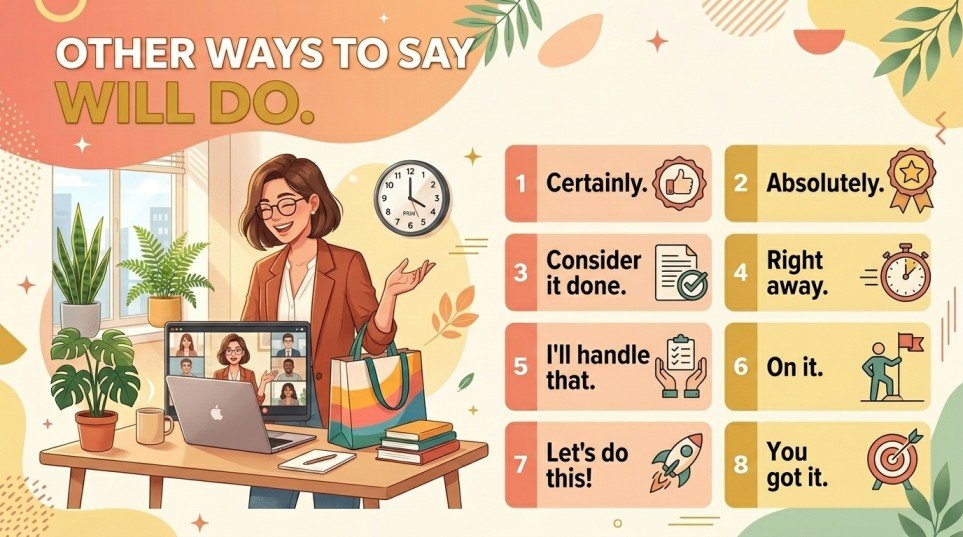
Quick Answer: Instead of saying will do, you can say: consider it done, absolutely, I’ll take care of it, no problem, certainly.
The phrase “will do” is a short and common way to say that you agree to complete a task or follow instructions. It’s widely used in conversations, emails, and workplace communication.
Although it sounds natural, using the same phrase repeatedly can make your English feel repetitive. Native speakers often use different expressions depending on the situation, relationship, and level of professionalism.
Learning alternatives to “will do” helps you sound more fluent, confident, and adaptable. It also improves your ability to use professional reaction phrases and informal expressions in English naturally in conversations.
Quick Categories Section
Formal alternatives to “will do”
- Certainly
- I will handle it
- Consider it done
- I’ll take care of it
Pro Tip: Use these in workplace emails and professional conversations.
Casual alternatives
- Sure thing
- No problem
- Got it
- Absolutely
Pro Tip: These work well in everyday spoken English.
Professional alternatives
- I’ll handle that
- I’ll make it happen
- I’ll see to it
- I’ll get right on it
Pro Tip: Keep your wording clear and confident in business settings.
Informal expressions
- You got it
- On it
- Gotcha
- Leave it with me
Pro Tip: Avoid very casual phrases in formal communication.
“Confident English often comes from using precise responses instead of repetitive ones.”
Common Mistakes
- Using “will do” in highly formal situations
Example: It may sound too casual in executive emails. - Sounding too brief
Example: Replying only with “will do” can feel cold. - Using slang professionally
Example: “Gotcha” is too informal for clients. - Overusing one phrase
Example: Repeating “will do” in every conversation reduces variety. - Ignoring tone and hierarchy
Example: Casual phrases may sound disrespectful in formal workplaces.
What Does “Will Do” Mean?
It means you agree to complete a task or follow a request.
Grammatically, it’s a shortened future expression meaning “I will do that.”
Example Sentence:
Please send the file before noon.
Will do.
When to Use “Will Do”
- When accepting instructions
- In quick workplace replies
- During casual conversations
- In spoken and written English
Spoken vs Written: Common in both
Formal vs Informal: Mostly informal to semi-professional
Is It Professional or Polite to Say “Will Do”?
Polite? ✔️ Yes
Professional? ❌ Not always
Business Example:
“Thanks for the update. I’ll take care of it this afternoon.”
Pros and Cons of Using “Will Do”
Pros
- Short and efficient
- Friendly tone
- Easy to understand
- Common in spoken English
Cons
- Slightly informal
- Can sound abrupt
- Overused in workplaces
- Limited professionalism
“The right response can instantly make your English sound more polished.”
Other Ways to Say “Will Do” (With Examples)
These alternatives will help you sound more fluent, confident, and natural in different situations.
Use them according to tone, context, and audience.
1. Phrase: Certainly
Meaning: You agree formally and politely.
Explanation: Professional and respectful response.
Example Sentence: Certainly, I’ll send the report today.
Best Use: business email
Worst Use: casual jokes
Tone: formal, professional
Context Variability: professional / written
2. Phrase: Consider it done
Meaning: The task will definitely be completed.
Explanation: Confident and proactive phrase.
Example Sentence: Consider it done by tomorrow morning.
Best Use: workplace
Worst Use: uncertain tasks
Tone: confident, professional
Context Variability: professional / spoken
3. Phrase: No problem
Meaning: The task is easy to handle.
Explanation: Casual and reassuring.
Example Sentence: No problem, I’ll handle it.
Best Use: friendly talk
Worst Use: formal email
Tone: relaxed, friendly
Context Variability: casual / spoken
4. Phrase: Absolutely
Meaning: Strong agreement.
Explanation: Enthusiastic confirmation.
Example Sentence: Absolutely, I can do that.
Best Use: positive response
Worst Use: legal writing
Tone: confident, positive
Context Variability: casual / professional
5. Phrase: I’ll take care of it
Meaning: You will handle the task personally.
Explanation: Professional and reassuring.
Example Sentence: I’ll take care of it right away.
Best Use: workplace
Worst Use: joking context
Tone: professional, dependable
Context Variability: professional
“Using varied response phrases makes your communication sound more natural.”
6. Phrase: Sure thing
Meaning: Happy agreement.
Explanation: Friendly and casual.
Example Sentence: Sure thing, I’ll send it over.
Best Use: casual talk
Worst Use: executive meeting
Tone: informal, cheerful
Context Variability: casual
7. Phrase: Got it
Meaning: You understand and will act.
Explanation: Quick acknowledgment.
Example Sentence: Got it, I’ll finish it today.
Best Use: quick replies
Worst Use: formal writing
Tone: direct, casual
Context Variability: spoken
8. Phrase: I’ll handle that
Meaning: You will manage the task.
Explanation: Clear professional wording.
Example Sentence: I’ll handle that before lunch.
Best Use: workplace
Worst Use: casual jokes
Tone: professional, confident
Context Variability: professional
9. Phrase: On it
Meaning: You have already started the task.
Explanation: Very short and informal.
Example Sentence: On it, I’ll update you soon.
Best Use: team chats
Worst Use: formal email
Tone: quick, casual
Context Variability: spoken / workplace
10. Phrase: You got it
Meaning: Agreement to help or complete something.
Explanation: Friendly and conversational.
Example Sentence: You got it, I’ll be there.
Best Use: casual conversation
Worst Use: formal presentation
Tone: friendly, informal
Context Variability: casual
11. Phrase: I’ll see to it
Meaning: You will ensure it gets done.
Explanation: Slightly formal expression.
Example Sentence: I’ll see to it personally.
Best Use: business context
Worst Use: slang context
Tone: professional, formal
Context Variability: professional
12. Phrase: Leave it with me
Meaning: You will handle the matter.
Explanation: Calm and reassuring phrase.
Example Sentence: Leave it with me, I’ll fix it.
Best Use: reassurance
Worst Use: strict formal writing
Tone: supportive, calm
Context Variability: casual / professional
13. Phrase: I’ll get right on it
Meaning: You will start immediately.
Explanation: Shows urgency and responsibility.
Example Sentence: I’ll get right on it now.
Best Use: workplace
Worst Use: relaxed social talk
Tone: proactive, professional
Context Variability: professional
14. Phrase: Happy to help
Meaning: You are willing to assist.
Explanation: Warm and positive phrase.
Example Sentence: Happy to help with that.
Best Use: customer service
Worst Use: strict commands
Tone: friendly, helpful
Context Variability: professional / spoken
15. Phrase: I’ll make it happen
Meaning: You will ensure success.
Explanation: Motivational and confident.
Example Sentence: Don’t worry, I’ll make it happen.
Best Use: leadership
Worst Use: uncertain tasks
Tone: confident, energetic
Context Variability: professional
“Professional English sounds stronger when your replies are specific and varied.”
16. Phrase: Of course
Meaning: Willing agreement.
Explanation: Polite and natural.
Example Sentence: Of course, I can help.
Best Use: general use
Worst Use: legal documents
Tone: polite, warm
Context Variability: casual / professional
17. Phrase: I’ll get it done
Meaning: You promise completion.
Explanation: Direct and confident.
Example Sentence: I’ll get it done by tonight.
Best Use: workplace
Worst Use: uncertain situations
Tone: determined, professional
Context Variability: professional
18. Phrase: I’m on it
Meaning: You are already working on it.
Explanation: Quick workplace response.
Example Sentence: I’m on it right now.
Best Use: team communication
Worst Use: formal writing
Tone: active, casual
Context Variability: spoken / workplace
19. Phrase: That works for me
Meaning: You agree with the request or plan.
Explanation: Flexible and collaborative.
Example Sentence: That works for me, I’ll do it tomorrow.
Best Use: teamwork
Worst Use: urgent tasks
Tone: cooperative, neutral
Context Variability: professional
20. Phrase: I can do that
Meaning: You are capable and willing.
Explanation: Simple confirmation.
Example Sentence: I can do that this afternoon.
Best Use: workplace
Worst Use: emotional talks
Tone: confident, neutral
Context Variability: professional / casual
“Fluent English speakers adapt their tone based on the situation.”
21. Phrase: Happy to do it
Meaning: You are pleased to help.
Explanation: Friendly and positive.
Example Sentence: Happy to do it for you.
Best Use: friendly support
Worst Use: formal documents
Tone: warm, casual
Context Variability: casual
22. Phrase: I’ll manage it
Meaning: You will take responsibility.
Explanation: Calm and capable response.
Example Sentence: Don’t worry, I’ll manage it.
Best Use: reassurance
Worst Use: playful chat
Tone: calm, dependable
Context Variability: professional
23. Phrase: I’ll sort it out
Meaning: You will solve the issue.
Explanation: Common in British English.
Example Sentence: I’ll sort it out this evening.
Best Use: problem-solving
Worst Use: formal legal writing
Tone: casual, confident
Context Variability: casual / spoken
24. Phrase: Understood
Meaning: You understand and accept instructions.
Explanation: Professional and concise.
Example Sentence: Understood, I’ll proceed accordingly.
Best Use: workplace
Worst Use: casual jokes
Tone: formal, direct
Context Variability: professional
25. Phrase: I’ll be happy to help
Meaning: Willingness to assist warmly.
Explanation: Polite and service-oriented.
Example Sentence: I’ll be happy to help with that request.
Best Use: customer support
Worst Use: strict commands
Tone: professional, friendly
Context Variability: professional
26. Phrase: Roger that
Meaning: Message received and accepted.
Explanation: Informal military-origin phrase.
Example Sentence: Roger that, I’ll handle it.
Best Use: playful talk
Worst Use: formal office email
Tone: informal, humorous
Context Variability: casual
27. Phrase: I’ll look into it
Meaning: You will investigate or review something.
Explanation: Useful for uncertain situations.
Example Sentence: I’ll look into it and update you.
Best Use: workplace
Worst Use: completed tasks
Tone: professional, careful
Context Variability: professional
28. Phrase: Done
Meaning: The task is already completed.
Explanation: Very short confirmation.
Example Sentence: Done, I’ve sent the email.
Best Use: quick chats
Worst Use: formal communication
Tone: direct, casual
Context Variability: spoken
29. Phrase: I’ll cover it
Meaning: You will handle responsibility.
Explanation: Helpful and team-focused.
Example Sentence: I’ll cover it while you’re away.
Best Use: teamwork
Worst Use: personal favors
Tone: supportive, professional
Context Variability: workplace
30. Phrase: Say no more
Meaning: You understand immediately.
Explanation: Informal and expressive phrase.
Example Sentence: Say no more, I’ll take care of it.
Best Use: casual conversation
Worst Use: professional meetings
Tone: playful, informal
Context Variability: casual
“The best communicators use different phrases to match tone, audience, and purpose.”
Mini Quiz / Self-Check
1. Which phrase is best for a formal workplace email?
A. Say no more
B. Certainly
C. Gotcha
Answer: B
2. Which phrase is the most informal?
A. Roger that
B. Understood
C. I’ll see to it
Answer: A
3. Which phrase shows urgency?
A. I’ll get right on it
B. That works for me
C. Happy to help
Answer: A
Comparison Table: Top Alternatives
| Phrase | Tone | Best Use |
|---|---|---|
| Certainly | Formal | Business emails |
| Consider it done | Confident | Workplace |
| No problem | Casual | Everyday talk |
| Absolutely | Positive | General replies |
| I’ll take care of it | Professional | Work |
| Got it | Casual | Quick responses |
| I’ll see to it | Formal | Office communication |
| I’m on it | Informal | Team chats |
| Understood | Professional | Instructions |
| Happy to help | Friendly | Customer service |
FAQs
1. What are the best alternatives to “will do”?
Popular alternatives include certainly, consider it done, and I’ll take care of it.
2. Is “will do” professional?
It is polite but slightly informal for professional communication.
3. What should I say instead of “will do” at work?
Use certainly or I’ll handle that for a more professional tone.
4. Can I use informal expressions in English professionally?
Only in relaxed workplaces; otherwise, use formal alternatives.
5. Why learn other ways to say “will do”?
It improves fluency, professionalism, and tone variety.
Conclusion
Learning other ways to say “will do” helps you sound more confident, fluent, and professional in English conversations. It also allows you to adapt your tone depending on the situation and audience.
Practice these phrases regularly in emails, meetings, and everyday discussions. Over time, your responses will sound more polished and natural.
CTA: Which alternative will you start using today?
Discover More:-

Lisa Thompson is a USA-based content writer and language specialist focused on grammar, writing improvement and digital publishing.
She holds a degree in English Language and Communication and has professional experience in educational and web content creation.
As the author of Gramtivo.Com, she aims to help readers improve their writing skills through clear and practical guidance.